On a personal note

This vintage typwriter is our featured image.
Eli, the In Brief Legal Writing Services mascot.
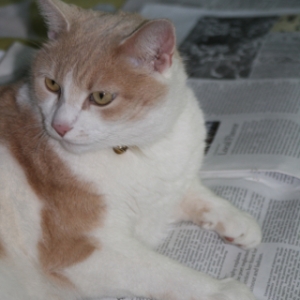
In Brief Legal Services mascot Eli catching up on the latest news. Photo by Alexandra Bogdanovic

It has been a rough week here at In Brief Legal Writing Services.

On Monday, I learned that the little lump I found on Eli’s back is a tumor.

The good news — if there was any — is that this type of tumor is fairly common in dogs and cats. From what I understand, it tends to be more aggressive in dogs, and affects the liver and spleen in only a small percentage of cats (approximately 10 percent). In most cases, surgery to remove the lump is all that’s needed.

According to the vet, an ultrasound is the best way to determine whether an external mass is the result of cancer affecting the internal organs, so we scheduled one for Wednesday. The next steps would depend on the results.

Before the ultrasound, I tried not to borrow trouble. If anything I took comfort in the fact that the lump was small; that it hadn’t changed shape, size or color since I noticed it; that Eli’s behavior hadn’t changed and most importantly, neither had his appetite.

Being a realist, I also thought long and hard about what I would do in the worst-case scenario. I came to the conclusion that I would not subject him to extensive surgery, no matter what. After all, he just turned 10. I’ve had him — or more accurately, he’s had me wrapped around his little paw, for just about eight years now.

He came into my life in February 2008. I was living in Virginia at the time and had just come home from Australia, where my family gathered to celebrate my grandmother’s 90th birthday and I got to watch my favorite football team win the Super Bowl.

The New York Giants won that championship thanks to some heroics by my favorite quarterback, Eli Manning. So imagine my delight — and surprise — when I glanced at the Fauquier SPCA’s flyer on my way out of the office one day. If memory serves, I stopped dead in my tracks and yelped, “Holy crap! The SPCA has a cat named Eli!”

I went to the shelter and instantly decided to adopt him. As much as I wanted to, I couldn’t take him home right away. He stayed at the shelter so he could be neutered, and as I drove home alone, the sun, which had been noticeably absent all day, peeped out from between the clouds.

I picked him up after work on another cold, dreary winter afternoon a couple of days later. As we drove home together, the sun, which I hadn’t seen all day, made another appearance.

Perhaps it was a mere coincidence. Or maybe it was a cosmic sign of approval from my cat Heals (named after New York Islanders and New York Rangers goalie Glenn Healy) who had died of cancer six months before.

In any case, it didn’t really matter. All I knew for sure is that it was definitely meant to be.

 

Oh, no! Not the vet!

This vintage typwriter is our featured image.
Eli, the In Brief Legal Writing Services mascot.
In Brief Legal Services mascot Eli catching up on the latest news. Photo by Alexandra Bogdanovic

So I had to take Eli to the vet today. Actually I was supposed to take him on Wednesday, but luckily for him (or maybe for both of us), it was freezing and I was still recovering from the stomach flu so I decided to reschedule.

Of course that was simply delaying the inevitable.

It doesn’t matter whether he has to go to get his nails trimmed or whether it’s time for his annual shots. He does not like the vet. And, being a cat, he makes his feelings on the subject “purrfectly” clear.

Here’s what always happens: An hour or so before the appointment, I go down to the car and hit the control lever for the front passenger seat until the seat is flat and as far back as possible. Next I go into the basement, grab his carrier and stash it in the upstairs hallway. If I am lucky, I will then find my 15-and-a-half pound cat on my bed so I can easily apply a generous dose of herbal calming gel to his paws.

By this point, there’s usually about 30 minutes until the appointment. Assuming Eli has actually ingested some of the salmon-flavored calming gel (he should theoretically do so when he licks his paws) it is fairly easy to wrangle him into his large blue carrier. Of course the phrase, “fairly easy” is relative… after all, he is a cat.

Getting him into the carrier is one thing. Taking the carrier down a steep set of stairs without breaking my neck is another challenge altogether. By the time I finally get him situated in the car both of us are completely frazzled. By the time I start the engine, a pitiful mewing is sounding from his crate.

Fortunately the trip itself only takes five to ten minutes, depending on the traffic. I drive with one hand on the wheel and one hand on the crate, speaking softly the whole time. I know he’s upset and scared, and I want to offer all the comfort and reassurance I can. After all, I don’t like going to the doctor, either…

When we finally arrive, I wrestle the carrier into the lobby and put it on the floor while I sign in. By now, Eli knows where he is and makes his displeasure known — loudly. With paperwork completed, I take a seat, put the carrier on my lap and give Eli a pep talk — or a lecture, depending on how badly he’s behaving. I breathe a sigh of relief when the vet or vet tech finally takes him into the back room.

But the relief is short-lived. As the minutes tick by I glance between the wall-mounted TV and my cell phone, hoping that Eli is OK and praying that he’s being good. He’s a sweet boy — most of the time. But he has been known to bite, and he fought his old vet so much that she’d have to sedate him just to trim his nails.

Back in those days, Eli would emerge from the clinic looking miserable — and I would leave with a hefty bill.

I shared Eli’s history and my concerns about his behavior with his new vet when we moved back to Connecticut from Virginia. She said in her experience, cats seem to do better when they are not restrained during exams. She also asked whether Eli acts up more when I stay in the exam room — which he does.

Given that, we agreed that Eli would be treated in a separate area while I wait in the lobby. Because I haven’t witnessed any of the procedures, I can’t say exactly what transpires. Apparently it’s working though. To date he hasn’t been sedated and he hasn’t bitten anyone — that I know of. I’ve actually been told that he’s been a good boy.

Perhaps Eli (who just celebrated his 10th birthday) is mellowing in his old age. Or perhaps he’s simply decided to tolerate this new vet and her staff. I can’t say for sure.

I do know that there’s a growing trend towards making vet visits less stressful for pets. You can learn just how they’re doing so in a report on the subject that was recently published on abc.go.com.

Now if only they could do the same for people…


Initiative spotlights convicted animal abusers

If a state task force has its way, it could soon be easier to monitor convicted animal abusers in Connecticut.

Eli, the In Brief Legal Writing Services mascot.
In Brief Legal Writing Services mascot Eli catching up on the latest news. Photo by Alexandra Bogdanovic

Back in October, the co-chairman of the Task Force for the Humane Treatment of Animals classified an initiative calling for the creation of “an animal abuse offender tracking system” as “one of the major proposals for legislation” in 2016.

Existing laws providing for the implementation and management of so-called registries will likely serve as the basis for the proposal, which should be finalized this month and submitted to Connecticut lawmakers when they convene in February.

According to a 2014 report prepared by Connecticut’s Office Of Legislative Research such regulations are already on the books in New York, Tennessee, Rhode Island, Texas and Massachusetts. The report also cites a “model animal abuser registry law” published by The Animal Legal Defense Fund in 2010.

The ALDF’s model law defines an “animal abuser” as a person over eighteen
years of age who has been convicted of a felony violation of [any animal protection
statute] of this state or of the comparable statutes of another state. It mandates when and where an offender must register; the circumstances under which re-registration is required; the personal information the offender must supply; the information the offender must submit pertaining to the incident(s) that resulted in conviction; and the submission of photographs, fingerprints and other identifying characteristics to the law enforcement agency in charge of the registry. It also governs how long an offender must remain on the registry.


New year, new laws

This vintage typwriter is our featured image.

“The AKC was proud to support this important legislation.” – American Kennel Club

A brand new year always brings changes – some of which are good and some of which we can almost certainly do without. Among them are new laws, some of which affect all of us and some that affect only those of us who live in, visit or travel through certain areas.

In any case, the new rules always get their share of ink and generate plenty of conversation. And that makes for copious blog fodder. Have no fear, I’m hardly about to discuss, or even list, every single law that took effect January 1. In this post, I’ll focus on just one – an act changing the New York State social services law regarding victims of domestic violence and their pets.

Black and white photograph of New York Police Department barriers taken by Alexandra Bogdanovic
NYPD barriers. Photo by Alexandra Bogdanovic

The authorized amendment allows those in need of refuge to bring their service or therapy animals to emergency shelters. You can view the full text of the bill  backed by the American Kennel Club that was ultimately signed into law by Governor Andrew Cuomo here.

On its website, the AKC said it made sense to support the legislation.

“Victims of domestic violence are in a vulnerable and frightening situation, and the practical assistance and comfort that a service/therapy animal provides can be essential,” the organization said. Furthermore, the AKC said that knowing they won’t have to leave their animals behind makes it easier for victims of domestic violence to leave dangerous situations.

For more information about the AKC’s support for the new law and related issues, click here.


It’s that time of the year

This vintage typwriter is our featured image.

Yes, it’s that time of the year – again.

As a reporter I wrote more than my share of holiday stories. And believe it or not, a lot of them were about looking out for your pet.

In Brief Legal Writing Services  owner Alexandra Bogdanovic's cat, Eli.
Eli under the Christmas Tree. Christmas 2013.

I wrote those stories because I thought it was important – and because I happen to love animals. After all, I’ve had cats since I was a little kid so I know how stressful and scary it can be when you’ve got to rush Rex or Mittens to the vet.

Having said that, there are a whole host of things that we take for granted at this time of year that can be hazardous or even lethal to companion animals.

Everyone knows that chocolate – or more specifically, the ingredients therein – can cause serious illness in dogs and cats. But there are other things that can make Fido or Cleo sick. Holiday decorations, plants, “people food” and even pet treats can be harmful.

The good news is that preventing unwanted emergencies is a matter of exercising a little common sense and a lot of restraint. Keep decorations and house plants out of reach. When it comes to treats of any type, keep in mind that we shouldn’t overindulge — and neither should our pets.


No easy answers

This vintage typwriter is our featured image.

Recently publicized incidents involving New Jersey and Connecticut animal shelters raise important questions for everyone concerned about the plight of unwanted dogs and cats in America.

As reported on NorthJersey.com, the Montclair, NJ, case highlights the controversy and confusion surrounding the use of the term “no-kill” in association with animal centers, shelters, and so forth. Taken on its face value, the term implies that no animal admitted to the facility will be euthanized for any reason. But as experts in the field quickly point out, that’s not necessarily the case. While policies likely vary, some, like those in place at the shelter in question, do permit euthanasia under extenuating circumstances.

Eli, the In Brief Legal Writing Services mascot.
Eli reading.

Meanwhile, the director of one Connecticut shelter is wrestling with an entirely different issue. For years, many northern shelters, adoption and rescue groups have been “saving” unwanted dogs and cats from southern states where – for numerous reasons – their fate is uncertain. According to published reports, the Branford shelter director is wondering if that’s still a good idea. Her argument is that there are plenty of pets in need of good homes in Connecticut as it is, and that their needs should  be prioritized.

I’m not about to weigh in on either one of these debates. All I know is that any way you look at it, there is no easy answer.