
NYC’s top cop unfazed by random attacks

This vintage typwriter is our featured image.
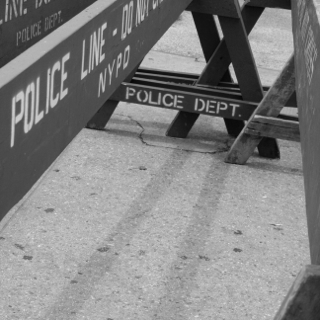
Black and white photograph of New York Police Department barriers taken by Alexandra Bogdanovic
NYPD barriers. Photo by Alexandra Bogdanovic

Oh, goody. New York City Police Commissioner Bill Bratton doesn’t seem to think a recent bunch of random attacks on ordinary New Yorkers is cause for alarm.

I feel so much better now. I’ll hop right on the next commuter train headed into the City. Once I get there, I’ll take the subway all over the place without thinking twice, as if nothing’s happened.

Or not.

I’m old enough to remember how scary Manhattan was in the 1970s and ’80s.  When I was little my parents kept a close eye on me on the train, and one of them — usually my father — had a death-grip on my hand from the minute our feet hit the platform at Grand Central. He didn’t let go until we arrived at our final destination, or until we were on the train heading back to the relative safety of the New York City suburbs.

We walked everywhere in Manhattan back then. Or we took a cab. Riding the bus was rare and taking the subway was unheard of. Dad said it was too dangerous — and I believed him.

I am old enough to appreciate the City’s renaissance. By the turn of the 21st century, it was safe enough — and I felt brave enough — to venture into Manhattan alone. I even camped out in Rockefeller Center one night. Of course I did with a group of friends so we could have the best “seats” for an outdoor concert the next day.

After I moved back to Connecticut from Virginia in 2012, I took advantage of my proximity to the greatest city on the face of the earth. In fact I romped all over it. I even gained the confidence to take the bus and the subway where ever I wanted to go.

Now The New York Times report about  random crimes occurring throughout the Big Apple sends shivers down my spine. According to the Jan. 27 article, at least a dozen people have been targeted by men armed with “knives or razors” in recent months.

In and of itself, news of these incidents — some of which have occurred on the subway, in subway stations and on public streets — is chilling. The police commissioner’s response is, too.

“We will always have crime in the city,” Bratton told The New York Times.

That may be true, Mr. Bratton. But it is your agency’s job to do something about it.


The whole truth?

This vintage typwriter is our featured image.

“The real purpose of this post is to encourage independent, critical thinking.”

On Sunday, The New York Times actually shared some “good news.” Contrary to public opinion… or more accurately, public perception, crime is down. New Yorkers are safer than they think. Their fears are baseless.

If you know me at all, or if you are any good at reading between the lines, you can easily detect the sarcasm here. Or perhaps it’s merely a healthy dose of skepticism. In any case, the purpose of this post is not to bash the Times. If anything the newspaper, which, in my humble opinion, joins the rest of the mainstream media in demonstrating a blatant anti-law enforcement bias, actually made a fairly decent attempt at presenting both sides of this particular story.

The real purpose of this post is to encourage independent, critical thinking – a skill that is not taught (much less encouraged) in American schools  and hence one that I find sorely lacking among the vast majority of Americans.

Of course it is far easier to take what the government – or any other authority – tells us on face value than to question it. Deep down those of us who live in free societies want to believe that authorities have our best interests at heart – so it is far easier to believe that our duly-elected leaders, teachers, police and the media are telling us the truth rather than what we want to hear.

ISIS is being defeated, the economy has recovered, unemployment is down and – at least in New York City – crime has declined as well. A rosy picture indeed. And why not believe it? After all, those who are telling it say they have data to prove their point. Numbers. Cold, hard facts. That’s all the proof you need. Or so they say.

But the numbers can be – and are – easily manipulated by those who provide them and those who report them. This tactic is hardly unique to one political party – or even one group, for that matter. Democrats, Republicans, Socialists, Communists, anarchists, liberals, conservatives, economists, the media and even scientists engage in it.

Acknowledging all of this is the key to sorting through the BS and drawing your own conclusions. It is just one step though. Once you realize that any data can be – and is – manipulated, you must then ask the tough questions. Who is manipulating it? How are they doing so? How do they benefit from twisting the facts?

In some cases finding the answer is simply a question of following the money but in most cases it’s simply a question of using a little bit of common sense.

Speaking of which, here’s a newsflash for The New York Times: perception is reality.