Good news about animal adoption from the ASPCA

This vintage typwriter is our featured image.

We’ve all seen them. In fact it seems like they flash across our TV screens all too often. It’s hard to ignore those heartbreaking images of abused and neglected dogs, cats, puppies and kittens.

We’ve all heard the pleas from the American Society for the Prevention of Cruelty to Animals (ASPCA) and similar animal rescue groups. Make a donation. Sponsor a pet. Adopt don’t buy. Do the right thing.

But recently the ASPCA shared some good news on TODAY. People across the country are actually heeding the call. They’re doing the right thing.

More new homes, fewer deaths for shelter animals

New ASPCA data reveals that the number of dogs and cats that end up in U.S. shelters has dropped significantly in the past six years. Specifically, the animal welfare organization says the number of dogs and cats American shelters is approximately 6.5 million (3.3 million dogs and 3.2 million cats). Back in 2011, the total number of dogs and cats in American shelters was roughly 7.2 million.

Cute Kitten, courtesy of FURRR 911. Photo by A. Bogdanovic
Bolt, a kitten rescued by FURRR 911, at Puttin’ On The Dog & Cats, Too 2016. Photo by A. Bogdanovic

The good news doesn’t end there, however.

More people are adopting pets from shelters now than they did six years ago. The ASPCA estimates that 3.2 million dogs and cats are now adopted from shelters each year, as opposed to 2.7 million in 2011.

Better yet, fewer shelter are animals are being euthanized. The ASPCA’s data analysis back in 2011 revealed that 2.7 million unclaimed shelter animals were killed each year. Today the annual death toll stands at roughly 1.5 million.

Finally, the ASPCA says, more “lost” pets that end up in shelters are reunited with their rightful owners today than in the past (approximately 710,000 per year now as compared to 649,000 in 2011).

Awareness plus action equals success

The ASPCA attributes the success to:

  • A significant change in the way Americans view companion animals
  • Changes in adoption procedures
  • Changes in certain laws
  • Changes in technology
  • Greater availability of affordable spay/neuter clinics
  • More assistance for people who struggle to care for their pets

Pet ownership is a responsibility, not a right

Clearly the reduction in the number of euthanized shelter animals is a huge step in the right direction. But there is still a long way to go until we get to the point where there are no needless deaths.

Finding a humane way to curb the feral animal population in the United States is also an ongoing concern.

In order to address both issues, people must realize that pet ownership is a responsibility. It is not a right. No one is entitled to have a dog, cat, puppy or kitten. In fact, there are some people who should never have dogs, cats, puppies, kittens, or any other pets, for that matter.

Companion animals rely on people for food, shelter, medical care, and most importantly, love. Providing all of that is a tremendous responsibility. But it’s worth it.



Another day, another crisis

This vintage typwriter is our featured image.

“No matter what happens, remember it’s not your fault. Animals are difficult to understand sometimes.” — S.A. Witten (Grandpa)

As I write this, Eli is at the vet — again. And I’m worried sick.

Those of you who have been following this blog since the beginning know that he had a serious health scare earlier this year. He emerged from that (relatively) unscathed and I thought the worst was behind us.

Eli, the In Brief Legal Writing Services mascot.
In Brief Legal Writing Services mascot Eli catching up on the latest news. Photo by Alexandra Bogdanovic

Everything was fine until Friday, when he started coughing. Those of you who have cats know that sound … that cringe worthy sound that usually means Fluffy or Princess is trying to hack up a hair ball. Yes, it sounded like poor old Eli had a really bad one — but he didn’t puke.

On Saturday morning he jumped on my bed at the crack of dawn. In and of itself that is not unusual. The fact that he yowled, hissed and took off for no apparent reason is highly unusual. The fact that he curled up in a little ball and refused to eat all day was also highly unusual.

Over the last couple of days, he’s eaten a little bit of kibble — and that’s it. And that’s highly unusual as well.

This morning, I had the unenviable task of corralling him and putting him in his carrier for the five-minute drive to the veterinarian’s office. Needless to say, he was not very happy. That’s par for the course.

At the office, the vet listened while I gave a detailed description of Eli’s symptoms. She then recommended blood work, an x-ray and exam. I agreed and headed for home.

As I opened the door and came up the stairs, I realized how quiet the house is when Eli’s not around. And I thought about something my 101-year-old grandfather told me on Saturday night.

“No matter what happens, remember it’s not your fault,” he said. “Animals are difficult to understand sometimes.”

So is life.

Law eliminates liability threat for medics, firefighters who treat injured pets

This vintage typwriter is our featured image.
Eli, the In Brief Legal Writing Services mascot.
In Brief Legal Writing Services mascot Eli catching up on the latest news. Photo by Alexandra Bogdanovic

We’ve all seen the heartbreaking pictures and news footage of pets rescued from house fires or natural disasters. And we’ve all seen the heartwarming images of firefighters, paramedics and EMTs rendering First Aid to those hurt and scared cats and dogs.

What you may not know is that in most states, the pet owners can — and do — sue the first responders if their pets die. That’s because the laws in those states prohibit anyone except for licensed veterinarians from treating sick and injured animals.

That’s about to change in Ohio. According to published reports, a law that takes effect there later this summer allows firefighters, paramedics and EMTs to treat injured pets without fear of legal retaliation.

The new law also applies to the treatment of police dogs and companion animals.

“It’s another layer of protection for the good guys,” Cory Smith, director of public policy for companion animals at The Humane Society of the United States, told the Associated Press.

While lawmakers in Ohio –and elsewhere — take steps to protect the first responders who choose to treat injured pets as well as people, another group wants to make sure they are well equipped to do so.

According to an article on iheartdogs.com, the group — Project Breathe — provides fire departments and other first responders with oxygen masks designed specifically for pets. To date, the non-profit organization has donated almost 14,000 masks to U.S. and Canadian fire departments. Training is also provided.

Use of the masks has reportedly saved more than 100 pets.

Sadly, that number is dwarfed by other statistics, however. Some estimates indicate that half a million pets are affected by house fires each year, and 40,000 die.

For information about how to keep your pet safe, visit:

Random acts of violence as seen through my cat’s eyes

This vintage typwriter is our featured image.

I have never laid a hand on my cat in anger. And I never will. But someone once did. That much is for sure.

I adopted Eli from the Fauquier SPCA when he was two. I’ve had him for eight years. So how can I be so sure that someone harmed him when he was little?

In order to understand, you must first understand the family dynamics at play, and my relationship with Eli. Basically, he’s my best friend. He’s my therapy cat. I’m his “number one person.” He counts on me for everything. Food, shelter, and most importantly, a clean litter box. He trusts me and he loves me. When I’m home, he’s never too far away. He sleeps on my bed at night and on any old t-shirt or pair of sweats that still has a trace of my scent during the day.

Eli, the In Brief Legal Writing Services mascot.
In Brief Legal Writing Services mascot Eli catching up on the latest news. Photo by Alexandra Bogdanovic

When I lived in Virginia, it was just the two of us. That’s when we really established that wonderful bond. But when I moved back home, Eli had to get used to living with my mom, too. It took a little while for the two of them to get to know each other and establish their own boundaries. Now they get along famously. My mother is officially Eli’s “number two person.”

Having said all of that, it’s been fairly easy to figure out that poor old Eli was either abused or lived in a really dysfunctional environment before I got him. I’ve watched him over the years.  Here’s what I’ve discovered. He is very sensitive. He runs from anything he thinks he can be hit with — even a relatively harmless toy, like shredded cloth tied to the end of a stick. He is very skittish around some people — especially kids and men. He doesn’t like it when someone approaches him too quickly and he hates loud voices.

In fact, angry voices are definitely a trigger. It doesn’t matter if the anger is directed towards him or towards another person. Either way, it makes him really upset. How do I know? For one thing, he meows. And this is a cat who never says anything unless he’s cranky. If he can’t get his point across that way, he resorts to stronger tactics. He uses his teeth. Yes, he bites.

That’s exactly what he did the other day. I was expressing my opinion about the outcome of a soccer game. And because I wasn’t pleased with the result, I was not exactly speaking softly. The next thing I knew, Eli — who I jokingly refer to as a pit bull in a cat costume — was sinking his teeth into my foot. Repeatedly. And since I didn’t have any shoes or socks on, it hurt. A lot.

I told him, in no uncertain terms, that I wasn’t happy about his behavior. Undaunted, he bit me some more. He even tried to jump onto the bed to get at my hands and arms. I rebuked him again — this time using a sterner voice to let him know he had been a very, very, very bad boy. After a few minutes I walked away and thought about what happened.

“You know,” I told my mother, who was in the room and witnessed the whole episode, “I think he was trying to protect you. I think he thought I was mad at you and that I was going to hurt you. ”

In Brief Legal Writing Services owner Alexandra Bogdanovic's cat, Eli.
Eli under the Christmas Tree. Christmas 2013.

If that was indeed the case, it begs a different question. We all know that abuse directed at our pets takes a huge toll on them. But what happens when they witness humans harming one another? How big a toll does it take on our companion animals when they see us physically or verbally harming each other?

I am sure someone has done some sort of research on this. I’m sure their findings are available in a report somewhere. But to be honest, I haven’t found any information about this issue anywhere online.

The Peacemaker

All of that being stated, I do know how it affected one cat. That was Tiger. She was my first cat — the cat I grew up with. And she was a peacemaker.

Anytime there was a family argument — and trust me, we had plenty — my tiny, Siamese-tabby cross got right in the middle of it. She would literally stand between the warring parties and cry until she got our attention. Once she had it she would end the debate by giving us the dirtiest look. It’s almost is if she were saying, What is wrong with you? Knock it off. Stupid people!

If that’s actually what she was saying, she was right.


Author questions morality of having pets

This vintage typwriter is our featured image.

“A better question would be: Should everyone be allowed to have pets?”

With the state of American politics these days, I’ve come across plenty of reading material that has simultaneously left me speechless and sent my blood pressure through the roof. But when I found this story I didn’t know whether to laugh or cry — and it has nothing to do with politics.

The Miami Herald article I discovered was just one of dozens written about a new book called Run, Spot, Run: The Ethics of Keeping Pets. In it, the author, Jessica Pierce, questions whether it is ethical for people to have pets.

“When we see our cats gazing wistfully out the window, or watch a goldfish swim lazy circles in a bowl, we can’t help but wonder: are we doing the right thing, keeping these independent beings locked up, subject to our control,” she asks in the Herald. “Is keeping pets actually good for the pets themselves?”

As you all know, I have a cat and love animals as much as — or maybe more — than most. But with all due respect to Pierce, this is one of the most ridiculous, stupid, idiotic things I have ever heard. I am not quite sure if it is an extreme case of political correctness, an extreme case of anthropomorphism or both.

A More Relevant Question

In her book, Pierce admits that most people do treat animals well but claims others “take them for granted,” or “think they are disposable.”

Sadly it is true that many people neglect, abuse, and abandon companion animals that require love, food, shelter and medical care in order to thrive. So to me, the pertinent question is not whether it is ethical to have pets, but whether everyone should be allowed to have them.

Eli, the In Brief Legal Writing Services mascot.
In Brief Legal Writing Services mascot Eli catching up on the latest news. Photo by Alexandra Bogdanovic

Clearly the answer to that question is a resounding, “no.”

Some people shouldn’t have pets because they are selfish. Some people shouldn’t have pets because they are irresponsible. Some people shouldn’t have pets because they are emotionally incapable of having them, and others shouldn’t have pets because they are financially incapable of having them.

Then there are the people who shouldn’t have pets because they are just plain evil. These are the people who have dogs and either engage in or sanction dog fighting. These are people who take advantage of dog breeds with aggressive tendencies. These are the people who leave their pets locked up in cages, crates or carriers all day. These are the people who abuse, abandon and neglect companion animals. These are the people who run puppy mills. These are the people who believe in killing animals for fun.

Taking Proper Precautions

I didn’t get any of my cats from a pet store, so I don’t know if there are screening processes in place for people who do that. Correct me if I’m wrong, but from what I’ve heard and read, I don’t think there is. If there isn’t, maybe it is time to rethink that.

I’m also unfamiliar with what’s involved with getting a purebred animal directly from a breeder. I assume that legitimate breeders do what they can to make sure puppies, kittens, and other animals end up in good homes. Again, feel free to let me know if this is the case.

As far as adopting from a shelter or rescue group goes, I can only speak from personal experience. When I adopted Eli from the Fauquier SPCA in 2008, I had to fill out some pretty extensive paperwork and pay an adoption fee before I could bring him home.

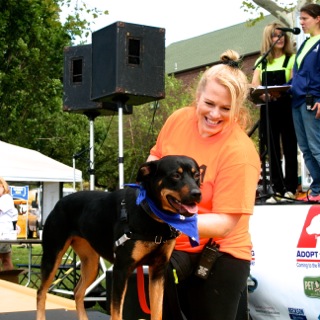
Prospective adopters had lots of dogs to choose from at the annual Puttin on the Dog show in Greenwich last fall. Photo by A. Bogdanovic
Pick me! An Adopt-a-Dog volunteer with a dog up for adoption at Puttin’ on the Dog in Greenwich. September 2015. Photo by A. Bogdanovic

At the local animal shelter where I volunteer, there is a comprehensive screening process in place to ensure successful matches. Prospective adopters must fill out and submit an application which includes specific information. References are required and checked before an adoption goes through. In the interest of full disclosure, specific information about each dog — including their background, age and compatibility with children and other animals — is also listed on the shelter’s website.

As Far As I’m Concerned…

Personally, I’ll never feel guilty about having a pet. In fact, with so many dogs and cats in need of a good home, the only thing I’ll ever feel badly about is that there’s no way to save them all.


Advancing animal advocacy

This vintage typwriter is our featured image.

A new rule currently pending review by the Connecticut General Assembly’s Joint Judiciary Committee calls for additional advocacy for neglected and abused animals.

Speaking up for those who can’t

As proposed, Connecticut House Bill 5344 would allow “a separate advocate” to be appointed “to represent the interests of the animal” or “the interests of justice” in certain cases.

The person selected from a list of qualified volunteers kept by the Commissioner of Agriculture would:

  • Monitor the case
  • Obtain information that would assist the judge or fact finder through consultations with relevant individuals
  • Review relevant records
  • Attend hearings
  • Issue relevant recommendations

Passion and professionalism

The selection of an advocate selected in a case specified under the new rule could be made by the court itself or at the behest of a lawyer or party involved in the case. The advocates would either be attorneys “with knowledge of animal issues and the legal system” or law students from schools that “have students or anticipate having students with an interest in animal issues and the legal system.”

Participating students would be bound by specific guidelines pertaining to legal interns set forth in the Connecticut Practice Book. The “book”  includes the Rules of Professional Conduct, Rules for the Superior Court and Code of Judicial Conduct for Connecticut lawyers.

Personal perspective

Well, here’s another “no-brainer.”

Eli, the In Brief Legal Writing Services mascot.
In Brief Legal Writing Services mascot Eli catching up on the latest news. Photo by Alexandra Bogdanovic

As evidenced by numerous articles on the subject, animal law is a growing discipline requiring a specific skill set. Allowing a separate advocate with the necessary knowledge and/or passion for and interest in the work to do the “heavy lifting” in  cases involving “the welfare or custody of an animal” benefits everyone involved. For one thing, it takes the burden off lawyers who aren’t as well-versed in this particular area. More importantly, it ensures that the person making the final decision has all of the information he or she needs in order to do so.

But most importantly of all, it ensures that there is a “voice” for those who can’t speak for themselves.


A ‘dogged’ quest for justice

This vintage typwriter is our featured image.

I love it when I find cool stories on the Internet — and I love to share good news. So I was definitely excited when I came across a heartwarming article about Patty Richardson.

Richardson is a North Carolina-based private investigator who “specializes in animal cases.” Right now she’s focused on catching the (alleged) scumbags who swipe and sell dogs.

Now that may come as a surprise to you. Frankly it surprised me, too. But given what I’ve learned about “dognapping” and related scams recently, I’m glad to hear there’s someone out there who’s willing to help people whose dogs have disappeared.

Eli, the In Brief Legal Writing Services mascot.
In Brief Legal Writing Services mascot Eli catching up on the latest news. Photo by Alexandra Bogdanovic

Of course, you might not be lucky enough to have a PI like Richardson where you live. And even if you do, there are steps you can take to find your dog before you summon reinforcements. The website fidofinder.com offers a comprehensive plan of action to follow when panic over a missing sets in. You should:

  • Calm down, take a breath and start with the obvious. Thoroughly check the house, yard and immediate area to make sure your dog is really “gone.”
  • Try to figure out how the dog got out of the house or yard and how long it might have been gone. That will give you clues about where it went and how far to look.
  • Designate someone to stay at home and man the phone when you start the search. That way someone will be available if anyone calls to report finding your dog, or brings it directly back to the house.
  • Be prepared to conduct a thorough preliminary search of the neighborhood by bringing a flashlight and photos of the dog with you.
  • Re-canvas your neighborhood on foot and by car if the initial search was not successful. You should also plaster the area with “missing dog” posters; and contact local veterinarians, animal shelters and animal control.
  • Use all available resources to spread the word, including social media and newspaper ads.
  • Remember the power of word-of-mouth. Tell your family, friends and neighbors about your missing pet.

To end on a personal note, here’s a little advice from yours truly. Don’t be afraid to call the authorities if you have reason to believe someone has stolen your pet. After all, the police are here to protect and serve.

Something old, or something new?

This vintage typwriter is our featured image.

A Connecticut lawmaker’s efforts to strengthen existing animal cruelty laws raises an interesting question — and one that may not be unique to his state. Should there be tougher penalties for offenses committed under the current laws, or should the state’s animal cruelty statute be completely rewritten?

Alexandra Bogdanovic
Founder/owner of In Brief Legal Writing Services, Alexandra Bogdanovic. Photo by N. Bogdanovic

In a recent New Britain Herald article, State Rep. Gary Bryan explained why he’s backing legislation that failed to gain enough support to make it to the governor’s desk last year.  If it is enacted, anyone convicted of deliberately “maiming, torturing or mutilating animals” will face harsher punishments than they do now.

But one skeptic quoted in the story says  more can — and should be done.  In fact, the man in charge of New Britain’s animal control claims that the current rules are outdated and confusing. That makes successful prosecution of animal cruelty cases more difficult, Sgt. Paul Keller tells the New Britain Herald.

The solution? Keller suggests scrapping everything and rewriting the state’s animal cruelty statute with an emphasis on clarity and simplicity.

The thought of doing that might make some legislators run screaming from the room. I mean, why make things easier? Why make things better?

But all joking aside, I think they should do whatever it takes to ensure that anyone who intentionally injures an animal in any way is successfully prosecuted and punished to the fullest extent of the law.

If that means working their butts off to make sure the bill Byron’s backing makes it to the governor’s desk this year, so be it. If that means making partial revisions to the existing statute, then so be it. And if that means rewriting the entire statute, well, so be it.

What do you think? Leave a comment and let me know.


Crooks now preying on vulnerable pet owners

This vintage typwriter is our featured image.

I am keeping it brief today because I really don’t have the words to express my outrage about this. It is so low, so despicable, and so disgusting …. How anyone could stoop to this is beyond me.

I mean, let’s face it — stealing someone’s pet is bad enough. Demanding money from someone who has lost a pet is even worse.

But it happens — and apparently it happens more frequently more than anyone realizes, or cares to admit.

According to one news account, it’s happening in Aurora, Missouri. The story about the family that lost their dog and then got a series of phone calls demanding money in exchange for his return appeared on an ABC affiliate’s website Feb. 17. You can read the details here.

Now imagine how you would feel if this happened to you. What would you do? Where would you turn?

Eli, the In Brief Legal Writing Services mascot.
In Brief Legal Services mascot Eli catching up on the latest news. Photo by Alexandra Bogdanovic

Numerous websites offer advice on the topic. Scambusters.org lists five different shakedowns targeting owners of lost pets and shares tips to keep crooks from taking advantage of you when you’re vulnerable. You should:

  • Make sure your pet is always properly licensed and tagged.
  • Keep your pet indoors, in a secure yard, or on a leash at all times.
  • Limit information in your missing pet advertisements or social media posts  to the essentials.
  • Ask for a phone number if you get a call from someone who says they’ve found your pet and claims to be out-of-state.
  • Make any caller who seems to be ‘fishing’ for information about your pet initiate the questions or comments about your pet’s description.

Crooks sink to new low as ‘dognapping’ cases increase

This vintage typwriter is our featured image.

What would you do if someone stole your dog? Or your cat, for that matter?

It’s probably something that has never crossed your mind. But it is something that you should probably start thinking about. Now.

Eli, the In Brief Legal Writing Services mascot.
In Brief Legal Services mascot Eli catching up on the latest news. Photo by Alexandra Bogdanovic

According to a commonly cited statistic, roughly two million companion animals are stolen in the United States each year.  Some disappear from back yards, and some vanish from “public places.” Some are snatched from cars.  Most are never seen again.

Each Valentine’s Day (February 14), Last Chance for Animals (LCA), a Los Angeles-based animal rights and advocacy group, joins similar organizations throughout the country to celebrate Pet Theft Awareness Day.  Its goal is to promote public awareness of the issue.

But to be honest, I had no idea that pet theft is so pervasive until I came across an article on an Ohio television station’s website. The account includes information about a couple that is suing an “estranged family member” who allegedly stole their dog. Shelby Patton, a plaintiff in the case, has reportedly started a petition in an effort to “change Ohio laws” so litigation is no longer necessary.

Fortunately, LCA says there are things pet owners can do to help prevent thefts. You can read those tips here.