

By passing HB5344, CT lawmakers take a huge step forward

This vintage typwriter is our featured image.
Alexandra Bogdanovic
Founder/owner of In Brief Legal Writing Services, Alexandra Bogdanovic. Photo by N. Bogdanovic

I’ve heard a woman’s jewelry says a lot about her. It’s a reflection of her personal taste, style and even her socioeconomic status. Think about it. With one glance at a woman’s jewelry, you can tell if she is engaged, married, or if she has children — if you know what to look for. Sometimes you can also learn a lot about her interests, passions or hobbies.

For the last few months, I’ve worn two charms on two simple, sterling silver necklaces. One is a small black diamond charm in the shape of a paw. The other is a plain sterling silver gavel. Collectively, these simple pieces symbolize two of my greatest passions: animal welfare and justice.

Score One For The Good Guys

My interest in these subjects is both personal and professional. So I have been monitoring the progress of a Connecticut bill that I blogged about soon after it was introduced earlier this year. I am now thrilled to announce that the Connecticut legislators passed HB5344.

With Gov. Dannel Malloy’s signature, Public Act No. 16-30, An Act Concerning Support for Cats and Dogs that are Neglected or Treated Cruelly will take effect in October.

As it stands, the act allows for the appointment of a “separate advocate to represent the interest of justice” by court order or request in certain cases. Specifically, these appointments can be made in animal cruelty cases or any other criminal cases involving “the welfare or custody of a cat or dog.”

The advocate in such cases will be a lawyer or law school student who either specializes in or is interested in animal law. Once appointed, he or she will be responsible for:

  • Monitoring the case
  • Consulting with anyone who has pertinent information about the case
  • Attend hearings
  • Present relevant information or make recommendations to the court based on his or her findings

The Commissioner of Agriculture is tasked with keeping a list of volunteers interested in serving in this capacity. The inclusion of law school students is subject to existing rules regarding the practice of law.

What Does This Mean?

Simply stated, this means that dogs and cats who are  mistreated or neglected will have someone with specialized skills and knowledge looking out for them in court. It means that prosecutors and judges will have additional resources to aid in the successful resolution of animal cruelty cases. It means these cases will be less likely to slip through the cracks. Most importantly, it means the offenders are more likely to be convicted.
Random acts of violence as seen through my cat’s eyes

This vintage typwriter is our featured image.

I have never laid a hand on my cat in anger. And I never will. But someone once did. That much is for sure.

I adopted Eli from the Fauquier SPCA when he was two. I’ve had him for eight years. So how can I be so sure that someone harmed him when he was little?

In order to understand, you must first understand the family dynamics at play, and my relationship with Eli. Basically, he’s my best friend. He’s my therapy cat. I’m his “number one person.” He counts on me for everything. Food, shelter, and most importantly, a clean litter box. He trusts me and he loves me. When I’m home, he’s never too far away. He sleeps on my bed at night and on any old t-shirt or pair of sweats that still has a trace of my scent during the day.

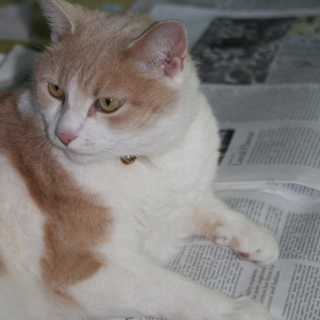
Eli, the In Brief Legal Writing Services mascot.
In Brief Legal Writing Services mascot Eli catching up on the latest news. Photo by Alexandra Bogdanovic

When I lived in Virginia, it was just the two of us. That’s when we really established that wonderful bond. But when I moved back home, Eli had to get used to living with my mom, too. It took a little while for the two of them to get to know each other and establish their own boundaries. Now they get along famously. My mother is officially Eli’s “number two person.”

Having said all of that, it’s been fairly easy to figure out that poor old Eli was either abused or lived in a really dysfunctional environment before I got him. I’ve watched him over the years.  Here’s what I’ve discovered. He is very sensitive. He runs from anything he thinks he can be hit with — even a relatively harmless toy, like shredded cloth tied to the end of a stick. He is very skittish around some people — especially kids and men. He doesn’t like it when someone approaches him too quickly and he hates loud voices.

In fact, angry voices are definitely a trigger. It doesn’t matter if the anger is directed towards him or towards another person. Either way, it makes him really upset. How do I know? For one thing, he meows. And this is a cat who never says anything unless he’s cranky. If he can’t get his point across that way, he resorts to stronger tactics. He uses his teeth. Yes, he bites.

That’s exactly what he did the other day. I was expressing my opinion about the outcome of a soccer game. And because I wasn’t pleased with the result, I was not exactly speaking softly. The next thing I knew, Eli — who I jokingly refer to as a pit bull in a cat costume — was sinking his teeth into my foot. Repeatedly. And since I didn’t have any shoes or socks on, it hurt. A lot.

I told him, in no uncertain terms, that I wasn’t happy about his behavior. Undaunted, he bit me some more. He even tried to jump onto the bed to get at my hands and arms. I rebuked him again — this time using a sterner voice to let him know he had been a very, very, very bad boy. After a few minutes I walked away and thought about what happened.

“You know,” I told my mother, who was in the room and witnessed the whole episode, “I think he was trying to protect you. I think he thought I was mad at you and that I was going to hurt you. ”

In Brief Legal Writing Services owner Alexandra Bogdanovic's cat, Eli.
Eli under the Christmas Tree. Christmas 2013.

If that was indeed the case, it begs a different question. We all know that abuse directed at our pets takes a huge toll on them. But what happens when they witness humans harming one another? How big a toll does it take on our companion animals when they see us physically or verbally harming each other?

I am sure someone has done some sort of research on this. I’m sure their findings are available in a report somewhere. But to be honest, I haven’t found any information about this issue anywhere online.

The Peacemaker

All of that being stated, I do know how it affected one cat. That was Tiger. She was my first cat — the cat I grew up with. And she was a peacemaker.

Anytime there was a family argument — and trust me, we had plenty — my tiny, Siamese-tabby cross got right in the middle of it. She would literally stand between the warring parties and cry until she got our attention. Once she had it she would end the debate by giving us the dirtiest look. It’s almost is if she were saying, What is wrong with you? Knock it off. Stupid people!

If that’s actually what she was saying, she was right.


Something old, or something new?

This vintage typwriter is our featured image.

A Connecticut lawmaker’s efforts to strengthen existing animal cruelty laws raises an interesting question — and one that may not be unique to his state. Should there be tougher penalties for offenses committed under the current laws, or should the state’s animal cruelty statute be completely rewritten?

Alexandra Bogdanovic
Founder/owner of In Brief Legal Writing Services, Alexandra Bogdanovic. Photo by N. Bogdanovic

In a recent New Britain Herald article, State Rep. Gary Bryan explained why he’s backing legislation that failed to gain enough support to make it to the governor’s desk last year.  If it is enacted, anyone convicted of deliberately “maiming, torturing or mutilating animals” will face harsher punishments than they do now.

But one skeptic quoted in the story says  more can — and should be done.  In fact, the man in charge of New Britain’s animal control claims that the current rules are outdated and confusing. That makes successful prosecution of animal cruelty cases more difficult, Sgt. Paul Keller tells the New Britain Herald.

The solution? Keller suggests scrapping everything and rewriting the state’s animal cruelty statute with an emphasis on clarity and simplicity.

The thought of doing that might make some legislators run screaming from the room. I mean, why make things easier? Why make things better?

But all joking aside, I think they should do whatever it takes to ensure that anyone who intentionally injures an animal in any way is successfully prosecuted and punished to the fullest extent of the law.

If that means working their butts off to make sure the bill Byron’s backing makes it to the governor’s desk this year, so be it. If that means making partial revisions to the existing statute, then so be it. And if that means rewriting the entire statute, well, so be it.

What do you think? Leave a comment and let me know.


Crooks sink to new low as ‘dognapping’ cases increase

This vintage typwriter is our featured image.

What would you do if someone stole your dog? Or your cat, for that matter?

It’s probably something that has never crossed your mind. But it is something that you should probably start thinking about. Now.

Eli, the In Brief Legal Writing Services mascot.
In Brief Legal Services mascot Eli catching up on the latest news. Photo by Alexandra Bogdanovic

According to a commonly cited statistic, roughly two million companion animals are stolen in the United States each year.  Some disappear from back yards, and some vanish from “public places.” Some are snatched from cars.  Most are never seen again.

Each Valentine’s Day (February 14), Last Chance for Animals (LCA), a Los Angeles-based animal rights and advocacy group, joins similar organizations throughout the country to celebrate Pet Theft Awareness Day.  Its goal is to promote public awareness of the issue.

But to be honest, I had no idea that pet theft is so pervasive until I came across an article on an Ohio television station’s website. The account includes information about a couple that is suing an “estranged family member” who allegedly stole their dog. Shelby Patton, a plaintiff in the case, has reportedly started a petition in an effort to “change Ohio laws” so litigation is no longer necessary.

Fortunately, LCA says there are things pet owners can do to help prevent thefts. You can read those tips here.


Cruel and unusual punishment

This vintage typwriter is our featured image.

As a cops and courts reporter for more than 20 years, I covered more than my share of heartbreaking stories…

There was the aftermath of 9/11 in the New York City suburbs and the accidental drowning death of a small autistic boy. There were homicides, car crashes that claimed young lives and the “war stories” about battered young veterans coming home from Afghanistan or Iraq.

But for some reason the stories that bugged me most — the ones that I remember to this day — are those that involved animal cruelty, abuse or neglect.

As someone who loves animals and as a responsible pet owner, I couldn’t — and still can’t understand why anyone would deliberately hurt or even neglect an innocent dog, cat, horse… or any other creature for that matter. But you don’t need to love, or even like animals in order to find this behavior reprehensible. All you’ve got to be is a compassionate human being.

Alexandra Bogdanovic
Founder/owner of In Brief Legal Writing Services, Alexandra Bogdanovic. Photo by N. Bogdanovic

As someone who loves animals and as a compassionate person, I found a recent account about the confiscation of dozens of animals in Connecticut to be especially disturbing. According to a wtnh.com report, a complaint alerted authorities that something was amiss at the East Hampton complex back in September. Subsequent attempts to ensure the animals — including more than 30 horses — received adequate care on site reportedly yielded mixed results.

“The horses, along with two dogs, several rabbits and more than 80 chickens, were removed from the Fairy Tail Equine facility after an investigation that determined the animals were malnourished, not receiving proper veterinary care and kept in unhealthy conditions,” the Connecticut Department of Agriculture reported February 3. 

 Connecticut officials also said that the horses, which were confiscated pursuant to  a search-and-seizure warrant signed by a Superior Court judge, were transported to the department’s Second Chance large animal rehabilitation facility in Niantic. The smaller animals that were also seized have since been sent to nearby animal shelters.

 An investigation is ongoing and it is unclear whether the owners will face criminal charges.

In some cases, criminal charges aren’t warranted. Some people are simply financially or emotionally incapable of providing adequate care for their animals. Some are just irresponsible. In such cases, a simple ban on future ownership is all that’s needed.


Having said that, studies show in many cases that people who are capable of harming animals also show little regard for human life. As long as that is so, it’s essential that animal cruelty cases continue to be taken seriously and that offenders are prosecuted to the fullest extent of the law.


Initiative spotlights convicted animal abusers

If a state task force has its way, it could soon be easier to monitor convicted animal abusers in Connecticut.

Eli, the In Brief Legal Writing Services mascot.
In Brief Legal Writing Services mascot Eli catching up on the latest news. Photo by Alexandra Bogdanovic

Back in October, the co-chairman of the Task Force for the Humane Treatment of Animals classified an initiative calling for the creation of “an animal abuse offender tracking system” as “one of the major proposals for legislation” in 2016.

Existing laws providing for the implementation and management of so-called registries will likely serve as the basis for the proposal, which should be finalized this month and submitted to Connecticut lawmakers when they convene in February.

According to a 2014 report prepared by Connecticut’s Office Of Legislative Research such regulations are already on the books in New York, Tennessee, Rhode Island, Texas and Massachusetts. The report also cites a “model animal abuser registry law” published by The Animal Legal Defense Fund in 2010.

The ALDF’s model law defines an “animal abuser” as a person over eighteen
years of age who has been convicted of a felony violation of [any animal protection
statute] of this state or of the comparable statutes of another state. It mandates when and where an offender must register; the circumstances under which re-registration is required; the personal information the offender must supply; the information the offender must submit pertaining to the incident(s) that resulted in conviction; and the submission of photographs, fingerprints and other identifying characteristics to the law enforcement agency in charge of the registry. It also governs how long an offender must remain on the registry.