I don’t care if people are leaving Connecticut in droves. I love it here.
In Brief Legal Writing Services mascot Eli catching up on the latest news. Photo by Alexandra Bogdanovic
I mean honestly, what’s not to love? I’ve got Long Island Sound as a summertime playground. The greatest city in the world is just a short train ride away. If I want to go to the world’s coolest flea markets, they’re just a short car ride away. The possibilities are endless…
Having said all of that, I can’t honestly say I’m always proud of living here. The state economy is a disaster. State leadership under Gov. Dannel Malloy is a joke. The cost of living is obscene. The traffic is a nightmare. The infrastructure is crumbling.
Without going into too much detail, locally things aren’t much better.
Giving credit where it’s due
But I’ve got to give Connecticut lawmakers credit for one thing… and only one thing. They definitely got it right when they came up with a bill that allows advocates with an interest and/or expertise in animal law to provide courtroom assistance in animal cruelty and neglect cases. I also applaud for Malloy for having the courage to sign it into law.
As those of you who follow this blog faithfully know, I’ve been following developments and blogging about this particular law for some time. But because it is the first of its kind in the United States, “Desmond’s Law” is now attracting national attention.
Of course there are more than a few people who don’t like or don’t care about animals. And they probably don’t think this is a good idea. I am sure they think that, at a time when criminal courts are already overburdened, humans should come first.
Well’s here’s what I have to say about that. There is clear evidence that people who are prone to hurting animals are also prone towards engaging in violence against people. So anything that can be done to stop people from hurting animals, and ensuring that they’re punished to the fullest extent of the law when they do is fine with me.
If this bill passes, it will be the best law ever. Or one of them, at any rate
According to published reports, the New York lawmakers are currently mulling proposed rules that would make it illegal to declaw cats there. If it passes, New York would be the first state to ban the activity.
It’s not a slam dunk…
Unfortunately, passage of the bill is not guaranteed. For some reason that defies belief state legislators haven’t supported the measure in the past.
In Brief Legal Writing Services mascot Eli catching up on the latest news. Photo by Alexandra Bogdanovic
And now, a group classified as New York’s “largest veterinary association” is opposing it. This group reportedly claims that declawing should still be made available as a last resort when cats “won’t stop scratching furniture or people.”
With all due respect, I think that’s a bunch of (expletive deleted). There are plenty of ways to teach cats not to scratch without removing their claws.
And quite frankly, there are worse things a cat can do than scratching.
Trust me, I had two cats before Eli. They were both females, and they both were known to scratch from time to time. Eli bites when he’s mad. And it hurts. So it’s a good thing I love him unconditionally.
But there is hope
But back to the issue at hand. Declawing is cruel. Those who oppose the practice say it requires painful surgery that can do permanent damage. It also deprives a cat of the tools it needs in order to hunt, climb and defend itself.
The good news is that the New York measure is finally gaining some traction. Veterinarians in favor of the ban reportedly lobbied for it in Albany. The bill’s sponsor also says “more lawmakers are signing on.”
Although there is no precedence for a statewide ban, the practice is prohibited in some California cities. It has also been disallowed in the U.K. and elsewhere in Europe.
What do you think. Should declawing be banned? Share your opinion in the comment section below.
As a little kid, I always wanted a pet. But I couldn’t have one. For one thing, I was horribly allergic to just about everything. If I patted or got licked by a dog, I had an asthma attack or broke out in hives. If I got scratched by a cat, I got an antihistamine reaction.
When I was 10, everything changed. We got a cat. Her name was Tiger. We got her from some friends that were moving to Saudi Arabia. She was supposed to live in our attic.
In Brief Legal Writing Services mascot Eli catching up on the latest news. Photo by Alexandra Bogdanovic
And she was only supposed to stay with us long enough to eradicate the mice that were running rampant in our apartment. She never caught a mouse. And I had her for 17 years.
It’s a good thing our landlord was cool with it. That’s not always the case.
The case of the selective ‘no pets policy’
In an article I came across the other day, the author answered an interesting question about an allegedly selective “no pets policy.” Specifically, the reader who submitted the question to The New York Times “Ask Real Estate” page, wanted to know if his (or her) new landlord could make good on a threat to evict him (or her). The alleged threat to do so is based on a claim that the reader has a pet and is therefore in violation of his (or her) lease.
In this case, the reader lives in a “rent-stabilized apartment” in Brooklyn. His (or her) chihuahua has also lived there for the past 10 years.
Based on the information provided the short answer is “no.” You can read a more detailed explanation here.
In the same article, you can also learn why the new building owners are well within their rights to extend “pet friendly” leases to some new tenants, but not to others.
If there’s one thing scarier than getting kicked out of your home…
Being homeless is a frightening prospect for anyone. But if there’s one thing scarier for an animal lover, it’s being forced to choose between their home and their pet.
With that in mind, I’m including a list of resources below that you can consult if you or someone you know is facing eviction. Please keep in mind that this material is provided strictly for informational purposes and is not legal advice.
Not too long ago, I did a post about Sir Patrick Stewart and his pit bull, Ginger. As you may recall, Stewart and his wife are fostering the dog, but can’t adopt her because breed specific laws in the U.K. are preventing them from taking her there.
Their story, which is heartbreaking and heartwarming, made me think about breed specific laws here. And I’ve come to the conclusion that the harshest of these rules and regulations — while well-intentioned — are worthless.
What is breed-specific legislation?
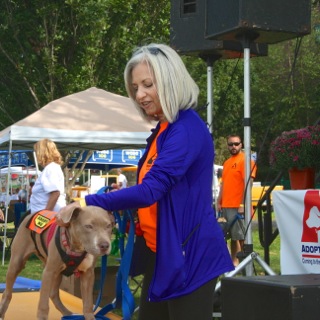
An Adopt-a-Dog volunteer with a dog up for adoption at the annual Puttin’ on the Dog show in Greenwich last September. Photo by A. Bogdanovic
According to the National Canine Research Council, breed-specific legislation (BSL) or breed-discriminatory legislation (BDL) is “a law or ordinance that prohibits or restricts the keeping of dogs of specific breeds, dogs presumed to be specific breeds, mixes of specific breeds, and/or dogs presumed to be mixes of one or more of those breeds.”
These rules and regulations include but are not limited to:
Complete bans
Mandatory spay/neuter
Muzzling
Liability insurance requirements
Mandatory micro-chipping and/or tattoos
Age requirements for those who own or walk certain types of dogs
Exclusion from some public places
Training requirements
Submission of photograph(s) and additional identifying information to the relevant authority/authorities.
Taking aim at ‘dangerous dogs’
Some of these laws are reasonable — and unfortunately, some are necessary. Those that promote responsible pet ownership, public education and awareness, can actually be effective.
But sadly, most of the harshest breed-specific laws are knee-jerk reactions to tragic incidents involving alleged dog “attacks.”
Because the victims are often children, the incidents resulting in permanent injuries or — in the most horrible circumstances — death, grab national headlines and there is a rush to judgment before all of the facts are known. Bowing to public pressure, ignorant but well-meaning lawmakers create sweeping laws that are designed to “protect” the public.
The reality is that these laws target entire groups of dogs based on the actions of a few. according to an article on onegreenplanet.org, the “dangerous dog” breeds often targeted by breed-specific laws are:
Pit bulls (not an actual breed)
American bulldogs
Mastiffs
Dalmatians
Chow Chows
German Shepherds
Doberman Pinscher
Other breeds also make the list, according to the article. In fact, the author maintains, some of these laws can even affect Chihuahuas. Personally, I find it sad, but not surprising. It seems these laws are designed any type of dog that has a tendency to bite.
That being stated, I’ve never been bitten by a Chihuahua. But I did get bitten by my ex-husband’s yellow Lab-cross. And I still have the scar to prove it…
Collateral damage
The saddest part of this whole situation is that a lot of these laws have drastic, if unintended consequences.
Pick me! An Adopt-a-Dog volunteer with a dog up for adoption at Puttin’ on the Dog in Greenwich. September 2015. Photo by A. Bogdanovic
Breed-specific laws create a huge burden for animal welfare and rescue groups in two significant ways. They force people to surrender or “dump” their dogs, and make those dogs harder to place. Trust me, I know. I volunteered with a rescue group for years (and still do, on a limited basis).
Worse yet, these laws result in needless, senseless, pointless deaths. Whole groups of dogs are slaughtered. Because they “look” dangerous. Because they belong to a breed prone to “aggressive tendencies.” Or for no reason, whatsoever.
Now here’s where I get really angry, and the post gets controversial.
What if we did this to people. What if we decided that a whole group of people was “dangerous” based on the actions of a few? And what if we decided to restrict where this entire “dangerous” race lived or made them wear identifying clothing, or worse yet, decided to wipe them off the face of the earth?
Oh, wait… humans have done something like that from time to time, haven’t we? Why not all that long ago, the President of the United States tried to prohibit entire groups of people from certain countries from coming here just because a few Muslim extremists from that part of the world have engaged in terrorism.
Many years ago, I saw Patrick Stewart star in a one-man theater production of A Christmas Carol. It was phenomenal. He was phenomenal. In fact, the performance moved me to tears…
And while that performance left no doubt that he is a fantastic actor, a recent news article left me with no doubt that he is much more. He is a fantastic human being.
Speaking as someone whose interactions with professional athletes made me cynical extremely cynical about celebrities, that’s saying a lot.
A man and his dog
The story to which I’m referring is the one about Stewart and Ginger. Ginger is a dog that Stewart and his wife are fostering. But she’s not just any dog. She’s a pit bull. And she’s clearly wormed her way into the actor’s heart.
As he tells the media: “I find that my relationship to the world and to the news every day in the papers and on the television has been changed by Ginger, because she has brought such a quality of patience and tolerance and fun into our lives, that it has, in a very short space of time, shifted my sense of where our world might be going. I literally find myself more optimistic than I was, and there is only Ginger to account for this. It is the impact of sharing my life for only seven or eight days with Ginger.”
Sadly, Stewart and his wife can’t adopt Ginger because U.K. laws make it all but impossible to bring her back there when they go home.
But what’s even more unsettling is the public reaction to the story.
Mixed reviews
There are few animals on the planet more polarizing than pit bulls. A lot of people love them, — no matter what. And a lot of people hate them — no matter what.
The story about Stewart and Ginger generated plenty of comments from people in both camps. The pro-pit bull people said Stewart’s relationship with Ginger just goes to show that these dogs are loyal, loving, and misunderstood. The anti-pit bull people said it doesn’t matter. As far as they’re concerned, all pit bulls are unpredictable, dangerous, killers.
An Adopt-a-Dog volunteer with a dog up for adoption at the annual Puttin’ on the Dog show in Greenwich last September. Photo by A. Bogdanovic
Personally I love pit bulls. For the most part, I think they’re great dogs. But they’re also big, strong, dogs. So I wouldn’t necessarily feel comfortable having one in a household with small children or the elderly. I wouldn’t necessarily feel comfortable having one in a household with an inexperienced owner, either. In my opinion, these aren’t necessarily the best dogs for beginners.
All of that being stated, I’m not a big fan of so-called breed legislation. I think it’s overkill.
All we really need to do to help pit bulls is to actively promote responsible pet ownership and forums for honest, open dialogue without fear of recrimination, without name-calling and without hateful rhetoric.
It’s not asking a lot — but sadly it seems it’s asking too much.
She weighed just 30 pounds when a Good Samaritan found her wandering the streets in Branford, Connecticut last month. She was clearly starving. And by all accounts, she was near death.
In Brief Legal Writing Services mascot Eli catching up on the latest news. Photo by Alexandra Bogdanovic
For weeks, veterinarians at two animal hospitals struggled to save her. Her treatment included surgery to remove an object that had been obstructing her intestines — and a lot of TLC.
Their efforts paid off and today, Hope — whose plight attracted plenty of attention from the media and public — seems to be well on the road to recovery. If all goes according to plan, she could soon be adopted.
DNA test may yield clues in ongoing investigation
In the meantime, a reward has been offered and authorities are still seeking information about the person or people who may be responsible for neglecting Hope.
Now the administrator of the animal shelter where the Good Samaritan brought Hope says the results of a recent DNA test might provide some additional insight.
“She is actually predominantly Rottweiler, 80 to 90 percent. One of the parents had to be a full-bred and the other parent was a mix,” Laura Burban told the media. “If somebody was breeding a certain type of dog, it would help us in our investigation, potentially, if anyone knows who was breeding this type of dog in the area. For some people who are backyard breeders, they breed long-term. They have many puppies, many litters and we thought it would be helpful.”
Animal cruelty and neglect
Under Connecticut law, someone is guilty of animal cruelty if they:
Deprive the animal of essential food and water
Abandon it
Confines it without providing proper care
The maximum punishment upon conviction for the first offense is a $1,000 fine, one year in prison or both. A second and each subsequent offense is classified as a Class D felony.
Pestering or harassing service animals could soon be illegal in Connecticut.
According to published reports, people who rely on service animals to help them engage in the daily activities most of us take for granted have pushed for the legislation now being considered by Connecticut lawmakers.
Back off!
Unfortunately, Bristol resident Christine Elkins recently shared with some Connecticut legislators and the media, many people just don’t respect boundaries when it comes to interacting with service animals and their handlers. Requests to refrain from approaching or petting the animals usually go unheeded, she says. Some people are ignorant… and others are rude, Elkins adds.
For Elkins, it is no laughing matter. As the Associated Press reports, she has “balance and mobility problems.” In her case, the potential ramifications of a fall caused by someone distracting her service dog are frightening.
The current Connecticut law
Current Connecticut law only prohibits other dog owners from allowing their dogs to interact with service animals. Section 22-364b, Control of dogs in proximity to guide dogs, stipulates:
In Brief Legal Writing Services mascot Eli catching up on the latest news. Photo by Alexandra Bogdanovic
“The owner or keeper of a dog shall restrain and control such dog on a leash when such dog is not on the property of its owner or keeper and is in proximity to a blind, deaf or mobility impaired person accompanied by his guide dog, provided the guide dog is in the direct custody of such blind, deaf or mobility impaired person, is wearing a harness or an orange-colored leash and collar which makes it readily-identifiable as a guide dog and is licensed in accordance with section 22-345.”
A violation of section 22-364b is an infraction. However, the law also stipulates that an owner whose failure to control their dog results in an attack on and injury to the guide dog is liable for “any damage done to such guide dog…” Specifically, the owner is liable for:
Vet bills (for treatment and “rehabilitation)
The cost of a new guide dog, if necessary
“Reasonable” attorney’s fees
Under the proposed law, any person who deliberately interferes with a service animal would be guilty of a Class C misdemeanor. The maximum punishment would be three months in prison.
Bill does not prohibit ‘friendly’ interactions
In response to concerns raised by some of their colleagues, Connecticut lawmakers recently changed language in the bill to reflect that it is “only targeting any person who “intentionally interferes” with the service animal’s duties.”
The bill is currently pending review by the House of Representatives.
For information about existing laws in other states, click here.
Every so often, I come across a story that makes me want to put my fist through the wall, or kick someone’s butt, or both. This was one of them. But at least it seems to have a happy ending.
A heartbreaking story…
Back in November, a Philadelphia cop allegedly decided he didn’t want his dog any more. So he allegedly got rid of her.
According to published reports, he just threw her away. Literally. Luckily, a Good Samaritan found her in the trash bag in a park where she was allegedly abandoned.
Founder/owner of In Brief Legal Writing Services, Alexandra Bogdanovic. Photo by N. Bogdanovic
“The Good Samaritan and her dog came upon a garbage bag and as they got closer found a dog’s head was visible. The Good Samaritan called the PSPCA’s Humane Law Enforcement team who sent two officers to the scene to rescue the dog and bring it back to the shelter to receive the medical care it needed,” the Pennsylvania SPCA said in a March 23 press release.
Judging by the picture, her rescuers intervened in the nick of time…
With a happy ending
As Cranberry recovered from her ordeal, authorities tried to figure out exactly how she ended up in such a horrible predicament. And their efforts paid off.
Last week, Michael Long, a Philadelphia police officer, was arrested on several charges including two misdemeanor counts of animal cruelty.
“This arrest today is the culmination of an investigation conducted by our officers and the Philadelphia Police Internal Affairs Unit,” said Nicole Wilson Director of Humane Law Enforcement. “We look forward to the opportunity to see justice through the courts in this matter.”
Regardless of the outcome, it also looks like Long will lose his job since he has reportedly been “suspended with intent to dismiss.”
Most importantly, Cranberry got adopted and has been living with her new family since December.
A recent search for blog fodder resulted in so many cool articles, I thought I’d touch on all of them in one post rather than doing individual posts on each one. It’s more timely this way. Hopefully it will be just as informative.
Think carefully before you get a wolfdog, or a wolf-dog…
In an article on a Denver TV station’s website, Anica Padilla asked whether wolf-dogs (or wolfdogs) make good family pets.
Padilla’s article was a follow-up to a previous story about the confiscation of an alleged wolf hybrid by local authorities.
The general consensus reached by the experts cited in the latest story is that wolf hybrids (aka wolfdogs or wolf-dogs) are wonderful animals. But they doesn’t mean they’re good pets. Getting one as a family pet is definitely not a good idea.
Because they’re not (and never will be) completely tame, wolf hybrids have different needs than the average dog. They’re generally bigger, more energetic and have a different way of bonding with people.
There are other traits that make wolf hybrids harder to care for than a golden retriever, poodle or chihuahua. And depending on where you live, it may be illegal to have one.
I speak from experience. No, I never had a wolfdog. But as a reporter in Virginia, I spent more than my share of time writing about a woman who got in trouble with the state for breeding them. I don’t remember the specifics, but I do remember that it wasn’t much fun…
Now that’s no ordinary cat
In Brief Legal Writing Services mascot Eli catching up on the latest news. Photo by Alexandra Bogdanovic
On a similar note, some residents in a Paterson, New Jersey, neighborhood got quite a surprise when they spotted an unusual cat last week.
According to published reports, one witness described it as “something like a puma.” Another admitted that she didn’t know what kind of cat it was. She just knew it wasn’t an ordinary house cat.
As it turned out, she was right. It was definitely not an ordinary cat. It was an “exotic” cat called a Savannah. A Savannah is a cross between a domestic cat and an African wildcat called a serval.
Apparently this one escaped when its owner left the window open, but there was never any cause for alarm, one man told the media.
“The cops know him, everyone knows him,” the man said. “He’s always on the window. Real nice cat.”
Although they can get quite big, a local animal control officer told the media that ownership of Savannahs is legal in New Jersey “as long as they’re at least one percent domestic cat.”
Santa Monica’s bravest go above and beyond to save a dog
Since everyone can use something to make them smile — especially on a Monday — I just had to share this feel good story about some California firefighters.
According to media accounts, it took a truly heroic effort, but Santa Monica’s bravest were able to save a 10-year-old dog from certain death last week.
Nalu, a Bichon Frise/Shih Tzu mix belonging to a Santa Monica woman, lost consciousness and was in grave danger when firefighter Andrew Klein found him trapped inside her burning apartment.
The drama continued outside, where Klein and another firefighter administered emergency medical treatment. Working together, it reportedly took them 20 minutes to revive the little dog.
Within a couple of days after his ordeal, Nalu seemed to be well on the road to recovery.
“He was essentially dead, so to see him kissing people and walking around wagging his tail was definitely a good feeling,” Klein told the media.
A few months back, Alaska became the first state where courts are instructed to consider the pet’s well-being in divorce cases in which custody is an issue.
The question then became, which state or states, would follow suit. And the answer is… Rhode Island.
Of course, it’s not a done deal, yet. But if everything goes according to plan, it will be.
Rhode Island’s pet custody bill
In Brief Legal Writing Services mascot Eli catching up on the latest news. Photo by Alexandra Bogdanovic
As proposed, an Act Relating to Domestic Relations — Pets — Custody, would amend existing state laws by adding a new section pertaining to the custody of pets. It specifically directs courts to “consider the best interests of the animal” when “awarding possession of a domestic animal in a divorce or separation proceeding.”
The bill’s co-sponsor, Rhode Island State Rep. Charlene Lima, recently told The New York Times that she planned to “introduce specific guidelines to be considered, such as which spouse most cared for the animal and took it to the vet, and whose lifestyle was best suited to pet ownership.”
Lima added that she hopes the measure, if passed, will help protect innocent animals from human vindictiveness.
“A lot of time I think it’s used as retribution,” Ms. Lima told The New York Times. “People can get really vicious in divorces, and using emotional attachment to a pet is something they can use to gain leverage.”
When people are at their worst, pets lose
If the findings of a 2014 survey cited in The New York Times article are any indication, Lima’s assessment is right on target.
More than a quarter of the participants in the American Academy of Matrimonial Lawyers (AAML) survey acknowledged “an increase in the number of couples who have fought over the custody of a pet during the past five years.”
More than 20 percent of the participants “said that courts are more frequently allowing pet custody cases,” and 20 percent acknowledged “an increase in courts deeming pets to be an asset during a divorce.”
As Maria Cognetti, president of the AAML at the time, noted, “far too many spouses attempt to initiate these disputes as a negotiating strategy, often believing that they can use the animal as a kind of bargaining chip. This tactic is usually not effective and can come back to ‘bite’ the antagonist throughout the divorce process.”
In other words, don’t try to make your dog, cat or any other pet a pawn in your divorce. Because there’s no law in Rhode Island… yet. And if you don’t live in Alaska, the court doesn’t have to take your pet’s best interests into account. Legally, it can just treat your pet like any other piece of personal property. And if that’s the case, you won’t like the outcome. And your pet will pay the price.




 In Brief Legal Writing Services