
Life with a scary smart cat

This vintage typwriter is our featured image.

Official disclaimer: I am not a crazy cat lady. For one thing, I only have one cat. For another, I harbor no illusions that he is my “child,” and I do not treat him as such. Eli is definitely a cat.

Having said that, after living with him for more than nine years, I’ve come to the conclusion that he’s a genius. Seriously. This is one scary smart cat.

How do I know? Simple. Through personal observation, that’s how.

Anecdotal evidence

The other day for example, my 11-ish, (possibly) Birman/American Shorthair mix, was clearly looking for something when he came into the living room. He’d already eaten, but I knew there were some leftovers on his saucer and asked him if he wanted his “crumbs.” He promptly went to the spot where he usually eats, and didn’t find his saucer there. So he came and sat in front of me.

Eli, the In Brief Legal Writing Services mascot.
In Brief Legal Writing Services mascot Eli catching up on the latest news. Photo by Alexandra Bogdanovic

“Go on,” I told him. “Go and find your crumbs.” I didn’t point him in any particular direction. I didn’t tell him where they were. I simply told him to go find them. And he did.

In past posts, I’ve shared how I taught Eli to sit, so I won’t do so again. However, it’s interesting to note that while he does sit on command, he usually sits when he wants to. To me, this is a sure sign of intelligence. He thinks about it. If it’s in his best interest to plop his butt on the floor, that’s what he does. If he doesn’t feel like it, I can tell him to sit until the cows come home and it won’t make a bit of difference. Like I said, Eli is definitely a cat.

A few other things of interest:

  • If I tell Eli to go to his “number two person,” he goes to my mom.
  • If she tells him to find his “number one person,” he comes to me.
  • If I ask him to “show me out,” he goes to the door.
  • He comes when he’s called (if it suits him)

Room for debate

Of course, there’s always room for debate. And there’s been plenty of debate about just how intelligent our pets are. There’s been plenty of debate about how much they really understand, how much they remember and how much self-awareness they truly have.

Skeptics say that dogs and cats don’t really understand what we’re saying. They say that our pets only understand body language and tone of voice.

Personally I believe that our pets do understand those things. I know for a fact that they understand and appreciate the love and kindness that we share with them. As living, breathing creatures, they need those things.

Don’t we all?
 

Patrick Stewart story puts renewed emphasis on pit bull plight

This vintage typwriter is our featured image.

Many years ago, I saw Patrick Stewart star in a one-man theater production of A Christmas Carol. It was phenomenal. He was phenomenal. In fact, the performance moved me to tears…

And while that performance left no doubt that he is a fantastic actor, a recent news article left me with no doubt that he is much more. He is a fantastic human being.

Speaking as someone whose interactions with professional athletes made me cynical extremely cynical about celebrities, that’s saying a lot.

A man and his dog

The story to which I’m referring is the one about Stewart and Ginger. Ginger is a dog that Stewart and his wife are fostering. But she’s not just any dog. She’s a pit bull. And she’s clearly wormed her way into the actor’s heart.

As he tells the media: “I find that my relationship to the world and to the news every day in the papers and on the television has been changed by Ginger, because she has brought such a quality of patience and tolerance and fun into our lives, that it has, in a very short space of time, shifted my sense of where our world might be going. I literally find myself more optimistic than I was, and there is only Ginger to account for this. It is the impact of sharing my life for only seven or eight days with Ginger.”

Sadly, Stewart and his wife can’t adopt Ginger because U.K. laws make it all but impossible to bring her back there when they go home.

But what’s even more unsettling is the public reaction to the story.

Mixed reviews

There are few animals on the planet more polarizing than pit bulls. A lot of people love them, — no matter what. And a lot of people hate them — no matter what.

The story about Stewart and Ginger generated plenty of comments from people in both camps. The pro-pit bull people said Stewart’s relationship with Ginger just goes to show that these dogs are loyal, loving, and misunderstood. The anti-pit bull people said it doesn’t matter. As far as they’re concerned, all pit bulls are unpredictable, dangerous, killers.

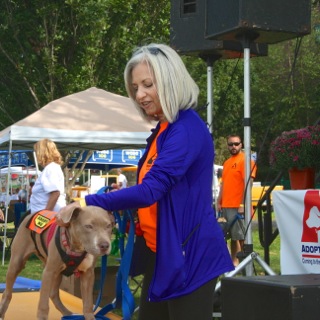
Take me home! A dog up for adoption and an Adopt-a-Dog volunteer. Photo by A. Bogdanovic
An Adopt-a-Dog volunteer with a dog up for adoption at the annual Puttin’ on the Dog show in Greenwich last September. Photo by A. Bogdanovic

Personally I love pit bulls. For the most part, I think they’re great dogs. But they’re also big, strong, dogs. So I wouldn’t necessarily feel comfortable having one in a household with small children or the elderly. I wouldn’t necessarily feel comfortable having one in a household with an inexperienced owner, either. In my opinion, these aren’t necessarily the best dogs for beginners.

All of that being stated, I’m not a big fan of so-called breed legislation. I think it’s overkill.

All we really need to do to help pit bulls is to actively promote responsible pet ownership and forums for honest, open dialogue without fear of recrimination, without name-calling and without hateful rhetoric.

It’s not asking a lot — but sadly it seems it’s asking too much.

Springtime safety tips for pet owners

This vintage typwriter is our featured image.

Yay! It’s sunny. It’s 70 degrees. It won’t get dark here until 7:29 p.m. And I’m… stuck inside, working. Actually it’s taken me the better part of an hour to come up with an idea for today’s post.

So I decided to go with the obvious. Warm weather and springtime safety tips for pet owners.

Exercise some common sense

When it comes to warm weather, pets and people aren’t all that different. We all want to be outside, having fun. And we can all get a bit carried away.

Eli, the In Brief Legal Writing Services mascot.
In Brief Legal Writing Services mascot Eli catching up on the latest news. Photo by Alexandra Bogdanovic

But while we are responsible  — and know there are consequences for — rash decisions, our pets don’t. So it’s up to us to look out for them.  It’s our responsibility to learn the signs that our furry friends are in physical discomfort or distress. Some of the symptoms are obvious, but because dogs and cats are also adept at hiding weaknesses, some aren’t so obvious. Don’t leave anything to chance… talk to your vet about what to look out for.

While you’re at it, have a frank discussion with the vet or another expert about your pet’s outdoor activities. If you’re going to let your cat romp around the neighborhood or leave your dog outside on its own for prolonged periods (something I personally recommend against) learn how to make the environment as safe and comfortable as possible. Find out:

  • How to create an “escape proof” yard.
  • What type of shelter to buy or build.
  • How to mitigate any hazards posed by other animals.
  • How to ensure your pet has access to food and water.
  • How to make sure your pet can be readily identified if it goes missing.

Taking these precautions is largely a matter of common sense. On the other hand, failing to take them could cause a lot of trouble. In Connecticut, for example, failing to provide proper shelter for an outdoor pet can result in animal cruelty charges.

Keep hazardous items out of reach

According to the ASPCA, a litany of springtime items pose a threat to our pets. These include:

  •  Easter candy and decorations
  • The ingredients in lawn and garden chemicals,
  • The plants and flowers that will soon appear in our gardens
  • household cleaning products that we’ll use to get rid of winter funk

Keeping these items out of reach is key to keeping our pets safe at this time of year. But if you do have reason to believe your pet has swallowed a harmful substance, it is crucial to call your own vet or the ASPCA Poison Control Center at (888) 426-4435.

A cat may be able to land on its feet, but that doesn’t mean it won’t get hurt

Before you yield to temptation and throw the windows wide open, the ASPCA also recommends checking all of the screens. Make sure they aren’t ripped or torn, and make sure they are well secured, the organization recommends. This is especially important for cat owners — after all, your cat may be able to withstand a fall from a significant height — but that doesn’t mean he or she will come out of it completely unscathed.

Starving dog’s DNA may hold clues in cruelty case

This vintage typwriter is our featured image.

Her name is Hope.

She is five to seven years old.

She weighed just 30 pounds when a Good Samaritan found her wandering the streets in Branford, Connecticut last month. She was clearly starving. And by all accounts, she was near death.

Eli, the In Brief Legal Writing Services mascot.
In Brief Legal Writing Services mascot Eli catching up on the latest news. Photo by Alexandra Bogdanovic

For weeks, veterinarians at two animal hospitals struggled to save her. Her treatment included surgery to remove an object that had been obstructing her intestines — and a lot of TLC.

Their efforts paid off and today, Hope — whose plight attracted plenty of attention from the media and public —  seems to be well on the road to recovery. If all goes according to plan, she could soon be adopted.

DNA test may yield clues in ongoing investigation

In the meantime, a reward has been offered and authorities are still seeking information about the person or people who may be responsible for neglecting Hope.

Now the administrator of the animal shelter where the Good Samaritan brought Hope says the results of a recent DNA test might provide some additional insight.

“She is actually predominantly Rottweiler, 80 to 90 percent. One of the parents had to be a full-bred and the other parent was a mix,” Laura Burban told the media. “If somebody was breeding a certain type of dog, it would help us in our investigation, potentially, if anyone knows who was breeding this type of dog in the area. For some people who are backyard breeders, they breed long-term. They have many puppies, many litters and we thought it would be helpful.”

Animal cruelty and neglect

Under Connecticut law, someone is guilty of animal cruelty if they:

  • Deprive the animal of essential food and water
  • Abandon it
  • Confines it without providing proper care

The maximum punishment upon conviction for the first offense is a $1,000 fine, one year in prison or both. A second and each subsequent offense is classified as a Class D felony.

Harassing service animals could soon be illegal in Connecticut

This vintage typwriter is our featured image.

Pestering or harassing service animals could soon be illegal in Connecticut.

According to published reports, people who rely on service animals to help them engage in the daily activities most of us take for granted have pushed for the legislation now being considered by Connecticut lawmakers.

Back off!

Unfortunately, Bristol resident Christine Elkins recently shared with some Connecticut legislators and the media, many people just don’t respect boundaries when it comes to interacting with service animals and their handlers. Requests to refrain from approaching or petting the animals usually go unheeded, she says. Some people are ignorant… and others are rude, Elkins adds.

For Elkins, it is no laughing matter. As the Associated Press reports, she has “balance and mobility problems.” In her case, the potential ramifications of a fall caused by someone distracting her service dog are frightening.

The current Connecticut law

Current Connecticut law only prohibits other dog owners from allowing their dogs to interact with service animals. Section 22-364b, Control of dogs in proximity to guide dogs, stipulates:

Eli, the In Brief Legal Writing Services mascot.
In Brief Legal Writing Services mascot Eli catching up on the latest news. Photo by Alexandra Bogdanovic

“The owner or keeper of a dog shall restrain and control such dog on a leash when such dog is not on the property of its owner or keeper and is in proximity to a blind, deaf or mobility impaired person accompanied by his guide dog, provided the guide dog is in the direct custody of such blind, deaf or mobility impaired person, is wearing a harness or an orange-colored leash and collar which makes it readily-identifiable as a guide dog and is licensed in accordance with section 22-345.”

A violation of section 22-364b is an infraction. However, the law also stipulates that an owner whose failure to control their dog results in an attack on and injury to the guide dog is liable for “any damage done to such guide dog…”  Specifically, the owner is liable for:

  • Vet bills (for treatment and “rehabilitation)
  • The cost of a new guide dog, if necessary
  • “Reasonable” attorney’s fees

Under the proposed law, any person who deliberately interferes with a service animal would be guilty of a Class C misdemeanor. The maximum punishment would be three months in prison.

Bill does not prohibit ‘friendly’ interactions

In response to concerns raised by some of their colleagues, Connecticut lawmakers recently changed language in the bill to reflect that it is “only targeting any person who “intentionally interferes” with the service animal’s duties.”

The bill is currently pending review by the House of Representatives.

For information about existing laws in other states, click here.

Put a pet trust in place, just in case…

This vintage typwriter is our featured image.


Alexandra Bogdanovic
Founder/owner of In Brief Legal Writing Services, Alexandra Bogdanovic. Photo by N. Bogdanovic

Just call me old-school.

In addition to the calendars on my phone and iPad, I still keep a wall calendar in my home office. And to be honest, I’ve never been happier about turning the page.

Yes, March was a tough month here at In Brief Legal Writing Services. There was the anniversary of my father’s death; the loss of an old friend; and an unspeakable family tragedy that left us reeling. Collectively these incidents serve as a reminder that life — the wild and crazy and wonderful and wacky ride we’re all on while we’re here — is so incredibly short.

No one will live forever…

Collectively, it was also a reality check. A big one. After all no one likes being reminded about their own mortality. No one like to think about “what will happen if… or what will happen when….” No one really wants to think about putting their affairs in order. So it’s easy to procrastinate. You swear you’ll do it tomorrow and then tomorrow becomes the next day and the next thing you know it’s a week later… so you start all over.

But as any good lawyer will tell you, making your wishes known through a will or trust is essential. If done properly, the creation of a written, legally binding directive regarding the provisions for your loved ones in the event of permanent disability or death, will give everyone peace of mind.

True, there is a lot to consider. And depending on your circumstances, these considerations may go well beyond “who gets what.” For pet owners, a critical question that is often overlooked is, “what will happen to the animal(s).”

What is a pet trust?

A recent article on forbes.com addresses the issue. Specifically it discussed the importance of creating a “pet trust.”

Basically, a pet trust is a legal mechanism that allows an owner to have a certain amount of money set aside for the care of his or her animal(s) in the event of catastrophic illness/injury or death. It also allows the owner to designate someone to manage the trust and/or care for the animal(s). It can also detail how the animal’s or animals’ needs should be addressed.

Because pet trusts are governed by individual state laws, experts strongly recommend that pet owners discuss the matter with qualified attorneys during the estate planning process.

You can find information about individual state laws regarding pet trusts here.

Don’t leave your pet’s future to chance…

Each situation is different, so a pet trust might not be the right option for you. But unless you know beyond a shadow of a doubt that  friend or relative is willing to assume responsibility for your pet(s) in the event that you can no longer care for the animal(s), please, please, please make some sort of provisions for their care. Don’t leave it to chance.

Good news for Tennessee pet owners

This vintage typwriter is our featured image.

Once upon a time, there were limited options for the anguished owners of lost or missing pets. They could make posters, pin them on utility poles around town and hope. In a best-case scenario, the owner and their pet would be reunited after a Good Samaritan who had seen the poster found the cat or dog wandering in the neighborhood; or the stray ended up on someone’s doorstep and they called the number on its tag.

Eli, the In Brief Legal Writing Services mascot.
In Brief Legal Writing Services mascot Eli catching up on the latest news. Photo by Alexandra Bogdanovic

Luckily, advances in technology have changed all of that. Today many pets are microchipped, so it is easier to identify the animal and its owner. The Internet and social media platforms allow owners to notify huge numbers of people about their missing dog or cat. On the flip side, these tools also allow people who have found missing or lost pets to try to find their rightful owners.

Of course there are also all sorts of apps that have been specifically designed to ensure that lost dogs and cats are safely returned to their owners.

And now the Tennessee Department of Health has come up with another solution…

Web-based resource uses info from rabies tags

According to information on a Tennessee TV station’s website, the state health department has created a new tool that lets someone who has found a dog or cat locate its owner by using the information on the animal’s rabies tag.

“Those who find stray pets wearing TDH rabies tags can now use this tool on the TDH website to search for and identify the veterinarians who vaccinated the animals, who can then help with information to find the owners,” NewsChannel9 reports.

The only downside to this is that the health department isn’t the only agency that issues rabies tags. So even if a stray dog or cat has one, it could very well be from another agency.  In fact, that’s likely to be the case in Tennessee municipalities that have independent  licensing protocols.

If someone finds an animal with a rabies tag that’s issued by an agency other than the health department, however, they should call the phone number provided. That way, the issuing agency can help reunite the dog or cat with its family.

Beat the odds

According to the ASPCA, approximately 710,00 stray dogs and cats that end up in shelters are reunited with their owners. Of those, most are dogs (620,000). The agency estimates that only 90,000 stray cats in shelters are returned to their rightful owners.

American Humane Association estimates cited on petfinder.com indicate that millions of American dogs and cats are lost or stolen each year. Furthermore, “one in three pets will become lost at some point in their life.”

What can’t be quantified or qualified is the heartache pet owners experience when their dog or cat disappears… or the joy when they’re reunited.

A happy ending for Cranberry the pit bull-mix

This vintage typwriter is our featured image.

Every so often, I come across a story that makes me want to put my fist through the wall, or kick someone’s butt, or both. This was one of them. But at least it seems to have a happy ending.

A heartbreaking story…

Back in November, a Philadelphia cop allegedly decided he didn’t want his dog any more. So he allegedly got rid of her.

According to published reports, he just threw her away. Literally. Luckily, a Good Samaritan found her in the trash bag in a park where she was allegedly abandoned.

Alexandra Bogdanovic
Founder/owner of In Brief Legal Writing Services, Alexandra Bogdanovic. Photo by N. Bogdanovic

“The Good Samaritan and her dog came upon a garbage bag and as they got closer found a dog’s head was visible. The Good Samaritan called the PSPCA’s Humane Law Enforcement team who sent two officers to the scene to rescue the dog and bring it back to the shelter to receive the medical care it needed,” the Pennsylvania SPCA said in a March 23 press release.

Judging by the picture, her rescuers intervened in the nick of time…

With a happy ending

As Cranberry recovered from her ordeal, authorities tried to figure out exactly how she ended up in such a horrible predicament. And their efforts paid off.

Last week,  Michael Long, a Philadelphia police officer, was arrested on several charges including two misdemeanor counts of animal cruelty.

“This arrest today is the culmination of an investigation conducted by our officers and the Philadelphia Police Internal Affairs Unit,” said Nicole Wilson Director of Humane Law Enforcement. “We look forward to the opportunity to see justice through the courts in this matter.”

Regardless of the outcome, it also looks like Long will lose his job since he has reportedly been “suspended with intent to dismiss.”

Most importantly, Cranberry got adopted and has been living with her new family since December.

Wolf-dogs, exotic cats and a firefighter who went beyond the call of duty

This vintage typwriter is our featured image.

A recent search for blog fodder resulted in so many cool articles, I thought I’d touch on all of them in one post rather than doing individual posts on each one. It’s more timely this way. Hopefully it will be just as informative.

Think carefully before you get a wolfdog, or a wolf-dog…

In an article on a Denver TV station’s website, Anica Padilla asked whether wolf-dogs (or wolfdogs) make good family pets.

Padilla’s article was a follow-up to a previous story about the confiscation of an alleged wolf hybrid by local authorities.

The general consensus reached by the experts cited in the latest story is that wolf hybrids (aka wolfdogs or wolf-dogs) are wonderful animals. But they doesn’t mean they’re good pets. Getting one as a family pet is definitely not a good idea.

Because they’re not (and never will be) completely tame, wolf hybrids have different needs than the average dog. They’re generally bigger, more energetic and have a different way of bonding with people.

There are other traits that make wolf hybrids harder to care for than a golden retriever, poodle or chihuahua. And depending on where you live, it may be illegal to have one.

I speak from experience. No, I never had a wolfdog. But as a reporter in Virginia, I spent more than my share of time writing about a woman who got in trouble with the state for breeding them. I don’t remember the specifics, but I do remember that it wasn’t much fun…

Now that’s no ordinary cat

Eli, the In Brief Legal Writing Services mascot.
In Brief Legal Writing Services mascot Eli catching up on the latest news. Photo by Alexandra Bogdanovic

On a similar note, some residents in a Paterson, New Jersey, neighborhood got quite a surprise when they spotted an unusual cat last week.

According to published reports, one witness described it as “something like a puma.” Another admitted that she didn’t know what kind of cat it was. She just knew it wasn’t an ordinary house cat.

As it turned out, she was right. It was definitely not an ordinary cat. It was an “exotic” cat called a Savannah. A Savannah is a cross between a domestic cat and an African wildcat called a serval.

Apparently this one escaped when its owner left the window open, but there was never any cause for alarm, one man told the media.

“The cops know him, everyone knows him,” the man said. “He’s always on the window. Real nice cat.”

Although they can get quite big, a local animal control officer told the media that ownership of Savannahs is legal in New Jersey “as long as they’re at least one percent domestic cat.”

Santa Monica’s bravest go above and beyond to save a dog

Since everyone can use something to make them smile — especially on a Monday — I just had to share this feel good story about some California firefighters.

According to media accounts, it took a truly heroic effort, but Santa Monica’s bravest were able to save a 10-year-old dog from certain death last week.

Nalu, a Bichon Frise/Shih Tzu mix belonging to a Santa Monica woman, lost consciousness and was in grave danger when firefighter Andrew Klein found him trapped inside her burning apartment.

The drama continued outside, where Klein and another firefighter administered emergency medical treatment. Working together, it reportedly took them 20 minutes to revive the little dog.

Within a couple of days after his ordeal, Nalu seemed to be well on the road to recovery.

“He was essentially dead, so to see him kissing people and walking around wagging his tail was definitely a good feeling,” Klein told the media.

“He’s very happy, and we’re very happy, too.”

For what it’s worth, so am I.

Rhode Island might follow Alaska’s lead on pet custody

This vintage typwriter is our featured image.

A few months back, Alaska became the first state where courts are instructed to consider the pet’s well-being in divorce cases in which custody is an issue.

The question then became, which state or states, would follow suit.  And the answer is… Rhode Island.

Of course, it’s not a done deal, yet. But if everything goes according to plan, it will be.

Rhode Island’s pet custody bill

Eli, the In Brief Legal Writing Services mascot.
In Brief Legal Writing Services mascot Eli catching up on the latest news. Photo by Alexandra Bogdanovic

As proposed, an Act Relating to Domestic Relations — Pets — Custody, would amend existing state laws by adding a new section pertaining to the custody of pets. It specifically directs courts to “consider the best interests of the animal” when “awarding possession of a domestic animal in a divorce or separation proceeding.”

The bill’s co-sponsor, Rhode Island State Rep. Charlene Lima, recently told The New York Times that she planned to “introduce specific guidelines to be considered, such as which spouse most cared for the animal and took it to the vet, and whose lifestyle was best suited to pet ownership.”

Lima added that she hopes the measure, if passed, will help protect innocent animals from human vindictiveness.

“A lot of time I think it’s used as retribution,” Ms. Lima told The New York Times. “People can get really vicious in divorces, and using emotional attachment to a pet is something they can use to gain leverage.”

When people are at their worst, pets lose

If the findings of a 2014 survey cited in The New York Times article are any indication, Lima’s assessment is right on target.

More than a quarter of the participants in the American Academy of Matrimonial Lawyers (AAML) survey acknowledged “an increase in the number of couples who have fought over the custody of a pet during the past five years.”

More than 20 percent of the participants “said that courts are more frequently allowing pet custody cases,” and 20 percent acknowledged “an increase in courts deeming pets to be an asset during a divorce.”

As Maria Cognetti, president of the AAML at the time, noted, “far too many spouses attempt to initiate these disputes as a negotiating strategy, often believing that they can use the animal as a kind of bargaining chip.  This tactic is usually not effective and can come back to ‘bite’ the antagonist throughout the divorce process.”

In other words, don’t try to make your dog, cat or any other pet a pawn in your divorce. Because there’s no law in Rhode Island… yet. And if you don’t live in Alaska, the court doesn’t have to take your pet’s best interests into account. Legally, it can just treat your pet like any other piece of personal property. And if that’s the case, you won’t like the outcome. And your pet will pay the price.