After hearing her voice at least once a day every day for God only knows how long, I have come to the conclusion that a day without hearing from “Carmen” is like a day without sunshine.
Apparently, “Carmen” is really concerned about me. For some reason my financial well-being means a great deal to her. “She” really wants to help me improve my credit and get lower interest rates. I know because she calls to tell me so. At least once per day. Every day.
Founder/owner of In Brief Legal Writing Services, Alexandra Bogdanovic. Photo by N. Bogdanovic
Sometimes she calls in the morning. Sometimes she calls in the afternoon. Sometimes she calls when I’m in the middle of dinner. If I don’t answer, she leaves a message. She doesn’t care if I hang up. She just calls back. You’d think she could take a hint. Or not.
I have no idea how she got my cell phone number… but sometimes she even calls on that.
To be honest, I’ve had it. I can’t take it anymore. I’m sick of hearing her funky, computer-generated voice. At this point, I just want “her” to quit bugging me. Are you out there “Carmen?” Can you hear me? If so, just leave me alone already! Please!
On a serious note, I guess I should take matters into my own hands. But here in Connecticut, the only way to keep from getting harassed by telemarketers is to sign up with the National Do Not Call Registry. There’s information on the state’s Department Of Consumer Protection website about how to how to join.
The DCP says it also enforces the “Do Not Call” law, so if worst comes to worst, I guess I can always file a complaint with the agency. The only catch is I’d have to put it in writing.
In the meantime, I’m taking this opportunity to appeal to state and federal lawmakers. I am asking nicely… no, I’m begging you. Enact stricter telemarketing laws. Please!
“I have never met an animal I didn’t like. On the other hand, there are plenty of people I hate.” – Me.
Anyone who has read these posts should know a few things about me by now. First, I love animals. Second, I have definite opinions about the law and related issues. Third, I am not shy about sharing them.
I mean come on, in the last couple of weeks, I’ve expressed my displeasure with the United States Supreme Court and the New York City police commissioner (among others).
So it may come as a surprise that I’m blogging about something that I actually agree with. Specifically, I am applauding Alaskan lawmakers who are trying to break with legal tradition by viewing pets as something other than personal property.
According to a recent KTUU report, state legislators are pondering a proposed rule that allows for the “protection” of pets when their caretakers are getting divorced or are embroiled in domestic violence. If enacted, the law would:
Change the existing regulations so owners of animals confiscated due to neglect or cruelty would have to pay their cost of care through “bond or other security.”
Revise current domestic violence measures to let courts include animals, and their temporary care, when issuing protective orders.
Tweak the divorce and marriage dissolution statutes now on the books so animals’ “well-being” is taken into account in court decisions regarding ownership or joint ownership.
“Pets are often considered part of a family and the courts should be able to consider their well-being,” said Rep. Liz Vazquez, who co-sponsored the bill. “This legislation will make it more difficult for a pet to be used by an abuser to keep a victim from reporting that abuse.”
In Brief Legal Services mascot Eli catching up on the latest news. Photo by Alexandra Bogdanovic
Now from what I’ve read, some Alaskans — who are understandably more pragmatic about animals than those of us who live elsewhere — question the wisdom of this legislation. Apparently they believe other issues deserve a higher priority.
While I fully endorse the proposal, I also understand why some might question it. In particular, I understand why some might mock the idea that courts should be allowed to consider an animal’s “well-being.” Those most likely to do so are the types of people who question the extent of animal intelligence, scoff at the suggestion that the average dog or cat has any self-awareness and shudder at the application of human emotions to our pets.
Personally, I don’t know what goes on in the space between my cat’s ears. But here’s what I know for sure: Eli is smart, sensitive and loyal, among other things. To me he is much more than personal property. He is my best friend. And if anything, I “belong” to him.
As a cops and courts reporter for more than 20 years, I covered more than my share of heartbreaking stories…
There was the aftermath of 9/11 in the New York City suburbs and the accidental drowning death of a small autistic boy. There were homicides, car crashes that claimed young lives and the “war stories” about battered young veterans coming home from Afghanistan or Iraq.
But for some reason the stories that bugged me most — the ones that I remember to this day — are those that involved animal cruelty, abuse or neglect.
As someone who loves animals and as a responsible pet owner, I couldn’t — and still can’t understand why anyone would deliberately hurt or even neglect an innocent dog, cat, horse… or any other creature for that matter. But you don’t need to love, or even like animals in order to find this behavior reprehensible. All you’ve got to be is a compassionate human being.
Founder/owner of In Brief Legal Writing Services, Alexandra Bogdanovic. Photo by N. Bogdanovic
As someone who loves animals and as a compassionate person, I found a recent account about the confiscation of dozens of animals in Connecticut to be especially disturbing. According to a wtnh.com report, a complaint alerted authorities that something was amiss at the East Hampton complex back in September. Subsequent attempts to ensure the animals — including more than 30 horses — received adequate care on site reportedly yielded mixed results.
“The horses, along with two dogs, several rabbits and more than 80 chickens, were removed from the Fairy Tail Equine facility after an investigation that determined the animals were malnourished, not receiving proper veterinary care and kept in unhealthy conditions,” the Connecticut Department of Agriculture reported February 3.
Connecticut officials also said that the horses, which were confiscated pursuant to a search-and-seizure warrant signed by a Superior Court judge, were transported to the department’s Second Chance large animal rehabilitation facility in Niantic. The smaller animals that were also seized have since been sent to nearby animal shelters.
An investigation is ongoing and it is unclear whether the owners will face criminal charges.
In some cases, criminal charges aren’t warranted. Some people are simply financially or emotionally incapable of providing adequate care for their animals. Some are just irresponsible. In such cases, a simple ban on future ownership is all that’s needed.
Having said that, studies show in many cases that people who are capable of harming animals also show little regard for human life. As long as that is so, it’s essential that animal cruelty cases continue to be taken seriously and that offenders are prosecuted to the fullest extent of the law.
You must admit, my quest for blog fodder has yielded some pretty interesting results. Since I started doing these posts, I’ve written about everything ranging from pets (including my own) to New York City crime, an assessment of the Virginia courts and a recent U.S. Supreme Court ruling.
Founder/owner of In Brief Legal Writing Services, Alexandra Bogdanovic. Photo by N. Bogdanovic
Last week I came across an interesting article in The Plainville Citizen about a controversial dog confiscation case. The lawsuit reportedly headed for U.S. District Court in Connecticut “pits” the “owners and trustee” of a pit bull named Luca — who stands accused of biting people in three separate incidents — against the Town of Plainville. For brevity’s sake, I won’t go into too much detail about the litigation but you can read about it here.
I only say that because — as intriguing as it is — the lawsuit itself isn’t really what caught my attention. Now the details about the attorney representing the plaintiffs — that grabbed my attention. The man’s name is Richard Bruce Rosenthal, and according to The Plainville Citizen’s report, he is a self-proclaimed “dog lawyer.” He is also the co-founder of The Lexus Project, which provides “legal defense for all breeds.”
While doing some additional research about the organization, it became evident that some people embrace its mission — and some condemn it. Although I have mixed feelings on the subject, I am unwilling to do either.
However I am curious about whether or not animal advocacy is a growing trend in the legal world. At this point, I know of a former lawyer who is now involved in the mediation of animal disputes. I also read about a character with a similar role in the novel, The Hand That Feeds Youby A.J. Rich.
How about you? Are you a lawyer or paralegal involved in animal advocacy? Do you know anyone who is? What do you think of the idea?
Oh, goody. New York City Police Commissioner Bill Bratton doesn’t seem to think a recent bunch of random attacks on ordinary New Yorkers is cause for alarm.
I feel so much better now. I’ll hop right on the next commuter train headed into the City. Once I get there, I’ll take the subway all over the place without thinking twice, as if nothing’s happened.
Or not.
I’m old enough to remember how scary Manhattan was in the 1970s and ’80s. When I was little my parents kept a close eye on me on the train, and one of them — usually my father — had a death-grip on my hand from the minute our feet hit the platform at Grand Central. He didn’t let go until we arrived at our final destination, or until we were on the train heading back to the relative safety of the New York City suburbs.
We walked everywhere in Manhattan back then. Or we took a cab. Riding the bus was rare and taking the subway was unheard of. Dad said it was too dangerous — and I believed him.
I am old enough to appreciate the City’s renaissance. By the turn of the 21st century, it was safe enough — and I felt brave enough — to venture into Manhattan alone. I even camped out in Rockefeller Center one night. Of course I did with a group of friends so we could have the best “seats” for an outdoor concert the next day.
After I moved back to Connecticut from Virginia in 2012, I took advantage of my proximity to the greatest city on the face of the earth. In fact I romped all over it. I even gained the confidence to take the bus and the subway where ever I wanted to go.
Now The New York Times report about random crimes occurring throughout the Big Apple sends shivers down my spine. According to the Jan. 27 article, at least a dozen people have been targeted by men armed with “knives or razors” in recent months.
In and of itself, news of these incidents — some of which have occurred on the subway, in subway stations and on public streets — is chilling. The police commissioner’s response is, too.
“We will always have crime in the city,” Bratton told The New York Times.
That may be true, Mr. Bratton. But it is your agency’s job to do something about it.
“Before Miller, every juvenile convicted of a homicide offense could be sentenced to life without parole. After Miller, it will be the rare juvenile offender who can receive that same sentence.”
– from the majority opinion in the recent Supreme Court of the United States (SCOTUS) ruling on Montgomery v. Louisiana, delivered by Justice Anthony M. Kennedy.
Four years ago, a Supreme Court ruling in Miller v. Alabama put an end to life sentences without the possibility of parole for most young killers.
The majority held that children are fundamentally different from adults, and that several key characteristics specific to minors — such as lack of maturity and the propensity for some to be easily influenced –should be taken into account when they are sentenced. Furthermore, SCOTUS ruled, an offender’s ability to change must also be taken into account. Finally, the Court said that a life sentence without the possibility of parole is too severe in most cases, and essentially amounts to cruel and unusual punishment.
Last week, America’s highest court held that the 2012 ruling can be applied retroactively.
In other words, all juvenile offenders found guilty of murder and sentenced to life without the possibility of parole at any time before the Miller decision took effect must now get a chance to seek it. According to published reports, that could affect up to 1,000 offenders in three states.
Looking at these decisions from a strictly logical — rather than a strictly legal — standpoint, it is clear that they reveal a basic but serious flaw in the American justice system.
As we all know, the system is designed to protect the defendant’s rights from the time he or she is first questioned by the authorities through a trial (if the case comes to that) and beyond. The goal is to thwart unscrupulous police conduct, prevent wrongful conviction and remedy wrongful conviction if it occurs.
The preservation of a defendant’s Constitutional rights is paramount, and understandably so.
On the other hand — as the SCOTUS rulings in Miller and Montgomery demonstrate — the system routinely shows little regard, much less compassion, for victims and their families.
Of course it goes without saying that not all victims of violent crime are fine, upstanding, law-abiding citizens. One could even argue that some people who are murdered deserve their fate. Make no mistake about it: my argument does not pertain to them, but to ordinary people who have been killed in cold blood. It also pertains to the “young offenders” who have taken their lives.
Take Henry Montgomery. Today he is known as the petitioner in Montgomery v. Louisiana. But he was just 17 when he killed a cop in East Baton Rouge back in 1963. He was ultimately convicted and sentenced to life in prison without the possibility of parole and is now 69.
In delivering the court’s decision that the Miller ruling should apply to Montgomery’s case, Justice Kennedy wrote:
“Extending parole eligibility to juvenile offenders does not impose an onerous burden on the States, nor does it disturb the finality of state convictions. Those prisoners who have shown an inability to reform will continue to serve life sentences. The opportunity for release will be afforded to those who demonstrate the truth of Miller’s central intuition — that children who commit even heinous crimes are capable of change.”
After spending most of his life in prison, Montgomery claims that he has changed. Maybe that’s true and maybe it isn’t. The bottom line is that he was convicted of killing Charles Hurt. A jury determined that Montgomery robbed Hurt of his future, and robbed Hurt’s family of a future with him. And that will never change.
Yet the Court makes no mention of the toll the crime likely took on Montgomery’s loved ones in its January 25 ruling on his case. Instead, Kennedy quotes from another case, Graham v. Florida, writing:
“Because retribution ‘relates to an offender’s blameworthiness, the case for retribution is not as strong with a minor as with an adult.'”
Yes, it would seem that a young killer’s rights trump all. The fact that a life has been taken means little. The fact that a family is left behind to pick up the pieces means nothing if the murderer was young, or too stupid to know better, or easily influenced.
A cynic could even say the odds are stacked against victims, their loved ones and the hard-working prosecutors that seek justice for them.
Founder/owner of In Brief Legal Writing Services, Alexandra Bogdanovic. Photo by N. Bogdanovic
As anyone with even the most basic knowledge of criminal justice can tell you, crimes are committed against the community, not individuals. So technically, prosecuting attorneys represent “the people,” not the individual victim. In and of itself, that fundamental lack of personal advocacy can be confusing and frustrating, especially for those traumatized by violent crime.
Then there are the rules that can prevent the revelation of certain information about the defendant — such as prior convictions — at trial because it could be prejudicial. On the other hand, there’s little to keep the defense from calling witnesses to discredit the victim — especially if there’s anything sketchy in his or her past.
Now, to make matters even worse, the families of people murdered by minors initially sentenced to life in prison without the possibility of parole must come to grips with the fact that those killers may someday go free. For those who wish to prevent it, their only recourse may be to write the Parole Board or appear at the offender’s parole hearing to have their say.
I can only imagine how scary, unpleasant and stressful that would be. It would be cruel and unusual punishment, indeed.
*Because this blog is written for a general audience, Bluebook citations are not included.
Don’t you just love getting mail from the government?
Your pulse quickens, your stomach knots and your mouth gets all dry. Your hands shake, you start to sweat and your head is pounding.
You study the return address, trying to figure out whether or not to open it. Maybe if you ignore it, it will just go away. Maybe you’ll “lose” it.
Then again, maybe not.
And in all fairness to much-maligned bureaucrats out there, sometimes those envelopes do contain good news. Sometimes it’s your tax refund.
Most of the time, it’s not.
Founder/owner of In Brief Legal Writing Services, Alexandra Bogdanovic. Photo by N. Bogdanovic
I got my property tax bill from the Town of Greenwich recently. And then the state sent me a note informing me it’s my turn to report for jury duty.
I already paid my taxes. As for jury duty, I’m supposed to go later this week. On one hand, I’m dreading it since I’m supposed to be at the courthouse early and it will probably take an hour to get there. On the other hand, it would be kind of cool to be chosen for a high-profile case.
I suppose it would be fairly easy for me to “get out of it” if I really want to. I have a paralegal certificate — so I know a bit about the law. I also spent the better part of 21 years covering cops and courts…
Then again, the experience could provide some very interesting blog fodder.
In any case, I will definitely let you know what happens… as soon as I can.
Dateline — Greenwich, Conn. As I write this, a winter storm is raging.
“Just Another Snow Storm.” Greenwich, Conn., December 2010. Photo by Alexandra Bogdanovic
Howling wind. Freezing rain. Sleet. Ice. Snow. You name it, we’ve got it. Or we’re going to get it before the day is over. And then I will spend my birthday cleaning up the mess.
For now I am safe and warm and dry. In fact, I am tucked up on the couch with my favorite fuzzy green blanket and laptop for warmth. The TV is on in the background, providing me with the details from the third Premier League football match of the day. Across the Pond, West Ham is leading Manchester City, 2-1, but I’m hardly invested in the outcome. I’ve got other stuff on my mind.
It suddenly dawned on me while channel surfing between games that there ought to be a law on days like this. Make that several. First of all, there ought to be a law against extensive TV storm coverage. We get it. It’s snowing. It’s windy. It’s cold. Newsflash: it’s winter.
There ought to be a law against any politicians commenting on a storm. What in God’s name do you have to say that we don’t already know? Personally, if I want to know about the weather, I can look out the window. Peering through the glass, I can also tell if the roads have been plowed, or if my neighborhood has been affected by a power outage. Based on personal observation, I can also make an educated guess about storm impacts on local, regional and national transportation. Believe it or not, I can rely on common sense to decide whether or not it’s safe to travel.
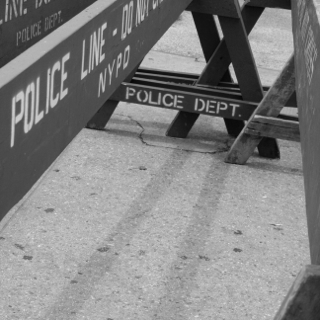
NYPD barriers. Photo by Alexandra Bogdanovic
There ought to be a law against snowplows shoving all the ice, sleet, slush and snow into private driveways. I don’t care where you put it. If you can’t think of an alternate location, I’ve got a few suggestions…
There ought to be a law against idiots in sports utility vehicles, or any 4-wheel drive vehicles for that matter. Just because you’ve allegedly got better traction doesn’t mean you can stop on a dime in slippery conditions. In case you haven’t figured it out, the added height of most SUVs equals a higher center of gravity. Turn that steering wheel abruptly at an unsafe speed and I guarantee you will flip your SUV or end up in a ditch.
There ought to be a law against rude and inconsiderate behavior. Calm down. Relax. It’s just another winter storm. It is not the end of the world. Or is it?
“I’m beginning to think that the definition of a healthy cat is one that has never been to the vet.”
– My mother.
My poor cat.
Until recently, Eli went to the vet for his shots and a check-up once a year. He also went to get his nails trimmed every three months.
Since January 15, he’s been to the vet three times. A fourth visit – this time for surgery – has been scheduled for sometime this week. Needless to say, he’s not very happy about this turn of events. And it should go without saying that neither am I.
By now those of you who have been following this saga know that I initially took Eli, who just turned 10, to the vet for his regular appointment and nail trim. I also mentioned the small lump I’d found on his back, and agreed that the vet should take a sample of it as a precaution. Three days later I learned that the little lump that hadn’t changed color or size since I discovered it was, in fact, a tumor.
In Brief Legal Writing Services mascot Eli under the Christmas Tree. Christmas 2013. Photo by A. Bogdanovic
The vet then recommended an ultrasound to make sure that the cancer hadn’t affected Eli’s liver or spleen. Again, I agreed. I also agreed to let the vet get a blood sample while she was at it. Later that day, I was relieved to learn that the ultrasound didn’t show anything horrible; it seemed that after all the drama, a simple operation to remove the mass was all that was necessary.
But, no. It couldn’t be that easy for poor old Eli. The vet did an about-face, saying the surgery we’d initially scheduled had to be postponed until the results of his blood analysis came back. And when they did, it turned out that some of the indicators for kidney function were within the higher end of the acceptable range.
So instead of bringing him in for surgery last Friday, I had to bring him in for more blood work and a urinalysis, instead. The only reason I agreed to those procedures is because the doctor said the results could determine whether they have to take any precautions with the anesthesia when he does have surgery.
I told her that I was kind of concerned that all of this traveling back and forth was taking a toll on Eli. Not to mention what it was doing to my nerves. We’ve both had enough — or to be brutally honest — more than enough.
He’ll have his surgery, and that will be that. Even if the blood work and urinalysis do show some other issues, I am not subjecting him to any more invasive procedures, and I will limit future vet visits as much as I can.
I take pride in being a responsible pet owner; I love Eli more than life and I want him to be healthy. More importantly, I want him to be happy.
He and I have had a great eight years together, and I pray we will have many more. Having said that, I know I can’t control the future, and I have no idea what it holds. But I can promise this: as long as Eli is alive, I will do everything in my power to make sure he has the best quality of life possible.
Newsflash: it’s winter, it’s cold and it might snow.
Dateline — Greenwich, Conn. As I write this, the East Coast is bracing for a weekend snow storm. And if the media is to be believed, this will be a storm of epic proportions – especially in the mid-Atlantic states.
Here in the greater New York City suburbs, some meteorologists are actually showing some restraint. They say we will only get 4 to 7 inches where I live and more further to the south and west. I’ll take it — but I must confess that I’ll be much happier if this nor’easter is a total dud. I’d really rather not spend my birthday shoveling snow, especially since I’ll officially be one step closer to the big “5-0.”
Founder/owner of In Brief Legal Writing Services, Alexandra Bogdanovic. Photo by N. Bogdanovic
But all joking aside, the arrival of winter and all of the unpleasantness that it entails raises serious concerns for pet owners, animal lovers and those of us who are also interested in the law as it relates to the health and safety of dogs and cats.
To that end, local and national news outlets publish tons of stories about caring for companion animals during this time of year. One article that recently caught my attention was about a proposed change to existing rules in Ohio. According to the article on nbc4i.com, state lawmakers are considering proposed legislation requiring pet owners to bring their dogs inside in “extreme weather conditions.” Under current laws, people are allowed to leave healthy dogs outdoors as long as they provide adequate shelter.
Connecticut law also mandates that animals have access to acceptable “protection from the weather.” Anyone who fails to provide it may be charged with cruelty to animals. The penalty upon conviction is a maximum fine of $250, up to one year in jail, or both.
In New York, there are comprehensive rules about what constitutes appropriate shelter for “dogs left outdoors” and the penalties for failing to provide it. Perpetrators face fines ranging from $50 to $100 for the first offense, and $100 to $250 for the second and each ensuing offense. Under the law, violators have a set period of time to bring the standard to acceptable standards. Failure to take necessary action within that period can result in another violation.
Personally, I think it boils down to compassion and common sense. Please use both.





 In Brief Legal Writing Services