Blog

The Curt Schilling case: a closer look

This vintage typwriter is our featured image.
“I do not agree with what you have to say, but I’ll defend to the death your right to say it.”
— Evelyn Beatrice Hall/Voltaire
Last week, numerous media outlets, including The Hartford Courant published stories detailing some outrageous comments made by former Major League Baseball player Curt Schilling and the fallout from those comments.
For those of you who haven’t heard, Schilling, the former Boston Red Sox pitcher turned ESPN analyst, lost his job at the sports network after making some disparaging comments on Facebook.
According to published accounts, Schilling re-posted or “shared” an offensive image and caption mocking the transgender community. Then he reportedly added his own opinion saying, “A man is a man no matter what they call themselves. I don’t care what they are, who they sleep with, men’s room was designed for the penis, women’s not so much. Now you need laws telling us differently? Pathetic.”

Although the material has been deleted, Schilling has stridently defended his right to express his opinion, and lashed out at his critics.

I Do Have A Dog In This Fight

Personally I find Schilling’s comments extremely offensive. I think most people do. But unlike “most people” I do have a dog in the fight. For those of you who don’t know, my ex-husband, Adam, is transgender. He fully transitioned after we divorced, and is now Audrey.

Book Cover

I told my story in my memoir, Truth Be Told: Adam Becomes Audrey. As it turned out, the book is a brutally honest account of how I met, fell in love with and married the man of my dreams, only to find out that he self-identified as a woman — and what happened after I learned the truth.

Quite frankly, a lot of people haven’t appreciated my honesty — probably because it doesn’t jive with their politically correct expectations. They probably wanted to read a happy story about a spouse who instantly accepted her husband’s true identity and acted accordingly.

But that’s not the way it was. Not for me. Finding out that the person I once considered my soul mate had kept such a devastating secret from me wasn’t easy to accept and it wasn’t easy to understand.

So I wasn’t always kind to my ex. In fact, I said some pretty cruel things after we got divorced — and I wrote about it. Granted, I am human and that cruelty was born out of resentment, hurt, anger and a colossal sense of betrayal.  That’s not an excuse or justification for my behavior. There is no excuse.

Having said that, I must also say that I am fiercely protective of Audrey. Before she completed her transition, I told her  that I would never, ever hate her because she is transgender. I never have and I never will. So if anyone has issues with her — or anyone else in the transgender community–  they can come straight through me. And trust me, I am an extremely formidable opponent.

Having said that, I would love to give Schilling a piece of my mind. But don’t get me wrong. I’m not angry at him. If anything, I’m sad. Clearly this is an extremely ignorant individual. Clearly this is someone who lacks the ability to express his opinion in an acceptable manner. Clearly this is someone who has no qualms about engaging in what is easily perceived as hateful rhetoric. Clearly this is someone who is emotionally and intellectually incapable of wrapping his head around the concepts of diversity and tolerance.

Piling On Doesn’t Help

Clearly Schilling is paying a hefty price for all of that. He’s lost his job and his reputation is once again taking a beating at the hands of the “polite police.”

While I’m hardly about to condone his behavior or pretend to understand it, I will say that piling on doesn’t help. Castigating people like Schilling doesn’t do a damn thing to change them. If anything it makes them cling to their beliefs even more. It makes them even more defiant. It causes more resentment, more bitterness and yes — more hate.

Instead of wasting considerable time and energy trying to turn Schilling — and those like him — into pariahs, we would be much better off if we simply viewed these incidents as chances to engage in an open and honest dialogue about the important issues at hand.

Here are some talking points:

  • What is the clinical definition of a transgender person?
  • How does a transgender person differ from a transsexual?
  • How many transgender people are there in the United States?
  • How many transgender people are victims of hate crimes in the United States?
  • What is the suicide rate for transgender people in the United States?
  • Do people really “choose” to self-identify as the other gender or are they literally “trapped in the wrong body since birth?”
  • My son or daughter has a classmate that is biologically male/female but identifies as the other gender and wants to be treated as such. How do I explain this to my child?
  • I know someone who enjoys cross-dressing. Does that mean he or she is transgender?
  • Does everyone who self-identifies as another gender fully transition to that gender?
  • What does “transitioning” entail?
  • What is a “bathroom bill?”
  • What do the laws passed in North Carolina and Mississippi really say?
  • How do we best balance the transgender population’s rights to access the public restroom of their choosing with the general public’s right to privacy?
  • How do we combat misconceptions about the transgender community without alienating the general public?
  • How can the transgender community and the general public come together to promote greater tolerance and understanding?

Obviously some of these topics will make people uncomfortable. But then again, making progress is never easy.


To learn more about the issues facing the transgender population visit:

The Human Rights Campaign

GLAAD

The Trevor Project


Bathroom bill boycotts: getting to the bottom of it

This vintage typwriter is our featured image.

These days it seems you can’t turn around without hearing about another bathroom bill boycott.

It’s almost as if every rock star on the face of the planet has refused to perform in North Carolina. Several governors have banned all but essential state-funded travel there. Even the corporate world has contributed to the backlash.

Yes, the reaction to North Carolina’s anti-LGBT law — known during the legislative process as House Bill 2 or HB2 — has been swift and harsh. And if a recent Huffington Post article is accurate, the “punishment” meted out by these groups has already proved costly.

Acceptable Protest Or Something Else?

Yet there is a question that remains unasked — at least in the mainstream media, where the politically correct narrative always rules the day. Is all of this economic pressure an acceptable form of protest — or is it something else? Specifically, is it an acceptable form of extortion?

In order to answer the question, we must first find the legal definition of extortion. It is: The obtaining of property from another induced by wrongful use of actual or threatened force, violence, or fear, or under color of official right.

So by the strict reading of this definition alone, the answer is “no.” The bathroom bill boycotts cannot be classified as extortion. No property has changed hands — and as far as I can tell, there has been no “wrongful use of actual threatened force, violence or fear…”

However, an explanation of the term on thefreedictionary.com also includes the following: Other types of threats sufficient to constitute extortion include those to harm the victim’s business… Many statutes also provide that any threat to harm another person in his or her career or reputation is extortion.

Depending on how you look at it, that either muddies the waters or clarifies things a lot. We know the bathroom bill boycotts are designed to deprive North Carolina and its individual municipalities of income. One could also argue that they are designed to damage or inflict further damage on the state’s reputation. Although they are not directly targeted, North Carolina businesses are also being harmed as a result of the activity.

So based on that, the bathroom bill boycotts are an accepted form of extortion. But of course the politically correct crowd will never admit it.

It Is What It Is

Alexandra Bogdanovic
Founder/owner of In Brief Legal Writing Services, Alexandra Bogdanovic. Photo by N. Bogdanovic

Don’t get me wrong. Clearly discrimination against any individual or any group is unacceptable. Clearly hate and ignorance are unacceptable. Clearly people should stand up for groups that are unfairly treated.

So if you want to engage in civil disobedience, fine. If you want to organize a rally, great. If you want to start a petition, fine. If you want to write to the governor, that’s fine, too. If you usually vacation in North Carolina and you are so upset by the anti-LGBT law that you literally don’t want to go there, awesome. Cancel your reservations and go somewhere else.

If you happen to be an entertainer or a corporate mogul or a politician and you want to engage in glorified extortion, that’s your decision. Just don’t call it a bathroom bill boycott.

This time a pit bull was the victim

This vintage typwriter is our featured image.

Every once in a while, I come across a story that makes me cry. This week I found two.

A Real Tear-Jerker

The first one was an article I found on Yahoo.com. To sum it up, the story is about a man who was afraid of pit bulls — and was scared to death of what his wife’s pit bull-mix might do to their newborn baby. As it turned out, the pit bull-Lab cross loved the little girl. As they grew up together, the bond between the girl and her dog got even stronger.

But one day, everything went horribly wrong. The man, Greg Heynen, claims some neighborhood children poisoned Zack — the pit bull-cross who faithfully followed his daughter to bed every night. Zack died and for the first time, Greg’s daughter didn’t have her faithful companion by her side as she climbed the stairs at bedtime.

That’s when Greg’s own dog, Sam, stepped in. Somehow sensing the little girl’s distress, Sam escorted the little girl upstairs that night — and continued the tradition until his death six years later.

Needless to say, a lot of people commented on this story. Some of them said it made them cry. Others expressed outrage that children killed Zack. One even said that they should be poisoned as well. Others said they should be thrown in jail. Most agreed they should be punished in some way.

I agree. If these children deliberately poisoned Zack, they should be punished to the fullest extent of the law. If permitted under state law, I would charge and try them as adults. Not only did they (allegedly) kill an innocent animal — they robbed a little girl of the rest of her childhood with her best friend. They robbed the Heynen family of a loyal and loving pet.

More importantly, if this was a deliberate act, these children demonstrated the depraved indifference characteristic of hard-core criminals. This is no exaggeration. Scientific studies provide irrefutable proof that children capable of harming animals can and sometimes do grow up to become serial killers.

Leo’s Story

The other story is one that hits closer to home. In fact, it’s about one of the dogs at the animal shelter where I have volunteered for almost three years.

Take me home! A dog up for adoption and an Adopt-a-Dog volunteer. Photo by A. Bogdanovic
An Adopt-a-Dog volunteer with a dog up for adoption at the annual Puttin’ on the Dog show in Greenwich last September. Photo by A. Bogdanovic

At this point, Leo, another pit bull-mix, has been at the shelter almost as long as I have. He came to Adopt-A-Dog in Armonk, N.Y., after a Good Samaritan spotted him by the side of a busy highway and rescued him in the spring of 2014.

He’s such an awesome dog that everyone at the shelter thought a family would adopt him pretty quickly. But a couple of things seemed to work against him from the beginning. For one thing, he will do best in a home with older teenagers. Secondly, he will be happiest in a household without any other pets.

The good news is that he’s thrived in the shelter’s enrichment and training program. He loves agility and he loves to swim, so he’d be a perfect companion for someone who needs a training partner!

You can learn more about Leo by clicking on the “What’s up at Adopt-A-Dog?” link in the sidebar here at inbrieflegalwriting.com tomorrow. You can also visit his profile page on the shelter’s website.

Finally, if you live in the New York metropolitan area and are interested in learning more about Adopt-A-Dog, you can also visit the shelter during our open house and adoption event on Saturday, April 23. The event, at 23 Cox Avenue in Armonk, N.Y., will be held from 10 a.m. to 3 p.m. We look forward to seeing you there!

How a newspaper with Trump ties (allegedly) crossed the line

This vintage typwriter is our featured image.

I must admit, the Washington Examiner has been a wonderful source for blog fodder lately.

A recent edition included a story about a reporter, Ross Barkan, who just left the New York Observer.  In the article, Barkan told T. Becket Adams that “a buildup of a variety of factors” prompted his decision.

Even so, Barkan’s resignation came soon after the Observer — or more accurately, its editorial board — endorsed Republican presidential candidate Donald Trump. The timing prompted widespread speculation that the endorsement was the straw that broke the camel’s back.

“The endorsement definitely did not unfold like I thought it would, given that we are so closely tied to Trump,” Barkan told the Examiner.

Trump’s son-in-law, Jared Kushner, is the publisher of the Observer. So it really shouldn’t come as a huge surprise that the publication backed the controversial candidate. And speaking as someone who was a newspaper reporter for more than 21 years, it  really isn’t a big deal. Editorial boards endorse candidates all the time. The only time it constitutes a breach of journalistic ethics is when the board actively tries to influence the way reporters cover the political process.

Crossing The Line

What is far more disturbing is the number of published reports that Kushner and the Observer’s editor-in-chief Ken Kurson, actively participated in the preparation of a speech Trump made in March.

As Barkan so aptly put it: “The editor-in-chief should not be reviewing a speech for a presidential candidate, not matter who that presidential candidate is: Trump, Bernie, Kasich, I don’t care.”

I absolutely agree. If it is true — and at this point there doesn’t seem to be any reason to believe it isn’t — it is at best a blatant conflict of interest. At worst… Well, there’s just no polite way to put it, so I will leave it up to your imagination.

If it is true — and I only say if given Mr. Trump’s propensity for suing people and his followers’ propensity for physical violence — it is disgusting and disappointing. But again, it is hardly surprising.

In my 20-plus years working at community newspapers in three states, I had a few good editors. They worked hard. They played by the rules. They actually believed in fairness, accuracy and objectivity. (Yes, I’m serious. You can stop laughing now.) They were good mentors, good people and good friends.

I also worked for some really, really, really, bad editors. (I’m not kidding. They were horrible.) As far as I could tell, they really only cared about only two things:

  1. Using the newspaper (and its staff) to advance their own political philosophies and agendas.
  2. Getting the story first — at any and all costs.

Lest you think I am exaggerating, I assure you that isn’t the case. I could give specific examples. I could tell stories that would make you cringe. I could give blow-by-blow accounts of behavior that I witnessed, recount conversations in which I was personally targeted for standing up to these workplace bullies and so forth. But we all know that wouldn’t be very smart, so I won’t go there.

The Worst Job In America

Given everything I’ve told you — and what I’ve left unsaid — does it really come as a shock that “newspaper reporter” just ranked as the worst job in America for the third year in a row?

Reasons given for this dubious distinction in an article republished on time.com, include an average salary of $37,200 and projected job growth in negative numbers.

An average salary of roughly $37,000? That’s rich. In my 20-plus years on the job I never made more than $28,000 per year. On the other hand, an average work week was at least 50 hours. More often than not, I worked more than 60 hours per week. Obviously, I didn’t make any overtime.

All of that being stated, the job was rewarding in other ways. I won 11 Virginia Press Association awards and one New York Press Association award. More importantly, I won the respect and admiration of readers and sources.

And once upon a time, I actually loved what I did.

At the time, that made it all worthwhile.


A taxing situation: IRS turns its back on honest citizens

This vintage typwriter is our featured image.

When it comes to controversial issues, I’m clearly not afraid to speak my mind.

But when I do so in this forum I usually try to keep my emotions out of it. I prefer to present both sides of the argument in a calm, rational, mature and objective fashion. It’s the same philosophy I had as an award-winning reporter: Present “Side A” and “Side B” and let the readers reach their own conclusions.

Based on what I just read, this post will be different. I am extremely angry and utterly disgusted by the alleged IRS conduct revealed in a Washington Examiner editorial. But in all honesty I am hardly surprised.

IRS Philosophy: For Illegal Immigrants, (Almost) Anything Goes

Published yesterday, the editorial details IRS Commissioner John Koskinen’s response to an investigation conducted by Indiana Senator Dan Coats. Based on his findings, Coats raised serious questions about the federal tax agency’s policies regarding the fraudulent use of Social Security Numbers.

Essentially, Coats says, the IRS looks the other way when illegal immigrants use fake Social Security numbers in order to secure jobs. Koskinen doesn’t deny it. If anything, he says, letting the activity to go unchecked is a good thing because it “helps the agency collect more in taxes.”

Koskinen says the agency does not condone the theft and/or use of Social Security Numbers belonging to other people in order to claim refunds, however.

As A Victim of Identity Theft, I Beg To Differ

He cannot be serious.

Koskinen’s agency may not condone the theft and fraudulent use of Social Security Numbers in order to claim refunds — but the IRS does nothing to stop it, little to correct it and nothing to help victims of identity theft who are entitled to legitimate refunds.

Alexandra Bogdanovic
Founder/owner of In Brief Legal Writing Services, Alexandra Bogdanovic. Photo by N. Bogdanovic

How do I know? I speak from experience.

A few years ago, I actually filed my tax returns early and happily anticipated the large refund I had coming. There was no problem with state return. But issues surfaced when my accountant tried to file my federal return electronically. The next thing I knew, someone from his office was asking if I’d been declared as a dependent or if I’d already submitted  my federal return electronically.

To make a long story short, it turned out that someone had used my Social Security Number and married name to file a fake return and get my refund. Now keep in mind that this happened after I’d gotten divorced and officially reclaimed my maiden name. It took several consultations with authorities and months in order to resolve the situation — and in the end the IRS issued the refund check using the wrong last name anyhow.

When I called them out on the mistake, they gave me limited options: put the check in the bank or wait even longer for another one.

Needless to say, I took the money.

It’s National Scrabble Day!

This vintage typwriter is our featured image.

I knew I was really scraping the bottom of the proverbial barrel when I typed the following into my search favorite search engine just now: “April 13 is national…”

And boy did my computer come up with some interesting answers. But as soon as I saw the first one, I knew exactly what to write about. Today is National Scrabble Day!

I’m serious. If you don’t believe me, just type the same phrase into your own search engine and see what happens. You can also read all about the unofficial holiday here.

The Best Board Game Of All Time

In Brief Legal Writing Services typewriter  illustration
Vintage typewriter key. Photo by Alexandra Bogdanovic

I must admit, I am much happier about this than I should be. But for one thing, I was getting sick and tired of writing about serious stuff. I also had no idea what on earth to write about today. And anyhow, I absolutely love Scrabble. As far as I’m concerned, it’s the best board game of all time. Or one of them, anyway.

By way of full disclosure, I’m old enough to remember playing board games as a child. That’s right. Not video games. Board games. I got my first one when I was five. I think it was Candy Land, but I’m not too sure.

I don’t know exactly how old I was when I started playing Scrabble, either. But chances are my mom taught me how to play — probably after Christmas or Easter dinner.  And we’ve had some pretty intense games since then. What can I say? I’m an extremely competitive person.

Having said that, I also play fair. So on one rare occasion, I was beating Mom quite handily — or at least I thought I was. At any rate, I made a strategic decision to take it easy on her, and it backfired. At the last-minute, she used her two remaining tiles to spell some stupid word like “ox” or “ax” and found a place to put it in order to get a whole bunch of bonus points. With that, she won. And I learned a valuable lesson. I’ve never “thrown a game” since.

Getting Schooled By The Master

Ironically, my favorite memory of playing Scrabble also involved a game that I lost. That time my grandmother beat me fair and square.

On a beautiful Australian afternoon, we set up the game board on the picnic table in my grandparents’ back yard. As my mother, grandfather and a few more relatives watched, my grandmother, who was in her 80s at the time, calmly proceeded to outwit and outplay me. If I remember correctly, she spanked me fairly soundly.

But it was hardly surprising. Grandma was brilliant.

As a farmer’s wife in drought-prone Australia, she raised five kids — including my mom — in some trying circumstances. In addition to running her household with all of the aplomb befitting a banker’s daughter, she was also active in her community.

In her free time, she enjoyed helping my grandfather with his crossword puzzles. She loved to travel and took the opportunity to do it whenever she could. Her adventurous spirit took her across the world on several occasions. She came to the United States for both my high school graduation and  my wedding.

In 2009, she and Grandpa celebrated their 70th wedding anniversary. But her health was failing by then. She died just one week of their 73rd wedding anniversary in July 2012.

Her memory lives on.

In honor of National Pet Day…

This vintage typwriter is our featured image.

Happy National Pet Day, everybody! I hope you and your dogs, cats, gerbils, hamsters, ferrets, exotic fish, birds, pot-bellied pigs, bunnies, snakes, lizards and geckos are having a blast.

My apologies to anyone I omitted. It was an honest mistake. In the interest of full disclosure, I didn’t even know today is National Pet Day until I saw the topic trending on Twitter.

And as for Eli… Well, let’s just say he’s completely oblivious. And that’s probably a good thing. He’s demanding enough as it is.

The Significance of National Pet Day

From what I gather, this is a relatively new holiday… or more accurately, a new pseudo-holiday. You can read more about it here.

The website also features a message from the founder. And if you’re in need of last-minute ideas, there’s a whole list of different ways you can celebrate. They’re all great suggestions, and the best part is, a lot of the ideas are things you can — and in my humble opinion, should — do throughout the year.

Personally, I make it a point to volunteer at a local animal shelter once a week — and more often than that when I can. Even though I volunteer in an administrative capacity and don’t have much direct contact with the dogs there, it’s something I enjoy. It feels good to know I’m contributing — even in a small way — to an organization committed to finding great homes for unwanted dogs and cats.

The Best Cats In The Known Universe

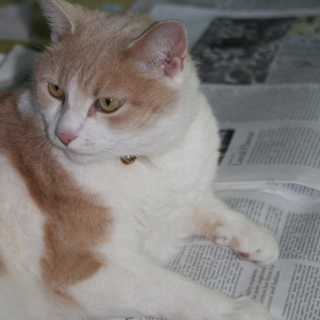
Eli, the In Brief Legal Writing Services mascot.
In Brief Legal Writing Services mascot Eli catching up on the latest news. Photo by Alexandra Bogdanovic

One thing I’ve never done is gotten a cat from a pet store or breeder. And I never will. There are too many cats and kittens in shelters that need a good home. There are so many that one person can’t possibly save them all, but together we can make a difference.

The way I see it, I’ve already saved three.

First there was Tiger. She was the cat that my mom agreed to take when some family friends moved to Saudi Arabia. She was supposed to stay with just us long enough to eradicate the mice in our house and then she was going to the pound. That’s what Mom said. But I’m an only child and I was 10 when we got the little Siamese-American Domestic Short Hair cross. Once I fell in love with her, there was no turning back. Tiger became the family peacemaker, my best friend and constant companion for 17 years. She purred, kneaded my legs and died peacefully in my lap at age 20.

Then there was Heals. Named after New York Islanders, Rangers and Toronto Maple Leafs goaltender Glenn Healy, she was a big orange and white tabby with a cheerful disposition and indomitable spirit. Some friends found her wandering around their neighborhood, but no one claimed her and they couldn’t keep her. So I took her. And like Tiger before her, Heals quickly became my best friend. In 11 years together, we got through my father’s death, my divorce, and relocation to Virginia. She died of cancer in September, 2007.

And now I’ve got Eli. My sweet baby boy. My “pit bull in a cat costume.” I fell in love with him when I saw his picture on a Fauquier SPCA poster a couple of weeks after I came home from Australia in February 2008. Being a big New York Giants fan, I knew I had to have a cat named Eli. When the sun came out on the day I decided to adopt him, and it came out again on the day I brought him home, I knew I made the right decision. The buff and white short hair-mix is by far the smartest of the three — and by far the most sensitive. I love him more than life and I hope we’re together for a long time.

Then again, I know nothing lasts forever. I know when Eli’s time comes — whenever that may be — it will be hard to say good-bye. I’ll need time to grieve, and time to heal. And then, when the time is right, a new cat will come into my life. There’s no doubt I’ll love him — or her. And there’s no doubt I’ll get unconditional love in return.

And that makes it all worthwhile.


Mississippi House Bill 1523: you be the judge

This vintage typwriter is our featured image.
Alexandra Bogdanovic
Founder/owner of In Brief Legal Writing Services, Alexandra Bogdanovic. Photo by N. Bogdanovic

I would have posted this sooner, but I’ve been sort of busy. In fact, I just finished reading Mississippi House Bill 1523 — all 16 pages of it.

For those of you who haven’t heard about it, the bill is also known as the “Religious Liberty Accommodations Act.” Mississippi Gov. Phil Bryant just gave it his stamp of approval, meaning the new law will take effect this summer.

As written, the law both prohibits discrimination against people with deeply held religious beliefs and moral convictions and allows them to discriminate against other groups based on those same beliefs and convictions.

As you can imagine, the ACLU, the Human Rights Campaign and GLAAD have had plenty to say about the issue. You can read their take on it here.

In black and white

Of course, their comments are based solely on their interpretation of the law. For those of you who want to form your own conclusions, I’ve included some relevant text from a copy of the bill reviewed by state legislators below.

In pertinent part, it says:

  • “Laws and government actions that protect the free exercise of religious beliefs and moral convictions about marriage and human sexuality will encourage private citizens and institutions to demonstrate tolerance for those beliefs and convictions and therefore contribute to a more respectful, diverse and peaceful society…”
  • “…it is possible for the government to recognize same-sex marriage without forcing persons with sincerely held religious beliefs or moral convictions to conform.”
  • “The sincerely held religious beliefs or moral convictions protected by this act are the belief or conviction that: (a) Marriage is or should be recognized as the union of one man and one woman; (b) Sexual relations are properly reserved to such a marriage; and (c) Male (man) or female (woman) refer to an individual’s immutable biological sex as objectively determined by anatomy and genetics at birth.”

But wait, there’s more…

The law bars the state government from taking action against anyone who, on the basis of their moral convictions or religious beliefs:

  • Refuses to perform surgery or provide any other treatment commonly administered to aid in a transgender individual’s transition.
  • Creates policy addressing a number of issues including but not limited to access to bathrooms, locker rooms and similar facilities.
  • Refuses to provide services associated with the celebration of certain marriages.

It also prohibits the state from punishing religious organizations or members of such organizations who, on the basis of strictly held religious or moral beliefs refuse to:

  • Preside at or authorize certain marriages.
  • Allow marriages to be held on their property.
  • Provide services for certain marriages.

Finally, the law allows state employees who are authorized to issue marriage licenses to request permission to recuse themselves in instances contradictory to their religious beliefs or moral convictions. The same stipulation applies to state employees who are authorized to perform marriage ceremonies.

Think about it

Clearly this is a highly controversial and emotionally charged issue. Those of you who know me personally or who have been following this blog for any length of time know that I have strong feelings about it. After all, laws like this directly affect someone who I once loved and will always care for.

But the bottom line is that when it comes to issues like this, there are always two sides to every story. And there are never any easy answers. So I will leave it at that. For now.


Next in NYC – pleas for ‘knife control’

This vintage typwriter is our featured image.

Those of you who have been following this blog for any length of time know quite a bit about me by now. You know I love animals, I have a cat named Eli, I live near New York City and I volunteer at a local animal shelter. You also know I’m divorced, my ex-husband is transgender and I’ve written a book.

To be honest, that’s probably way more than you want to know. But there’s more.

In case you haven’t figured it out, I’m also tough on crime and I have a lot of friends who are cops. So it shouldn’t come as a surprise that I’m not a big fan of New York City Mayor Bill de Blasio or New York City Police Commissioner Bill Bratton.

The mayor’s blatant lack of respect for law enforcement is reprehensible. His recent statements about gun control and its impact on crime are misguided at best. Bratton’s comments about the  vicious stabbings and slashings plaguing the City are both insensitive and disturbing.

Taking A Stab At It

In a recent article in the New York Daily News, Bratton happily took credit for a reduction in gun crimes, but seemed unconcerned about the use of other weapons.

Black and white photograph of New York Police Department barriers taken by Alexandra Bogdanovic
NYPD barriers. Photo by Alexandra Bogdanovic

“Slashings and stabbings aren’t going away,” Bratton told the Daily News. “But I’m confident that over time, (like) just about everything else we focus on around here, they will go down.”

Really? That’s all you have to say, commissioner? Is that supposed to be reassuring? Am I supposed to believe you? Well, here’s a newsflash for you: I don’t. In fact, I think you’re full of it. And that’s putting it mildly.

The fact of the matter is, there have been hundreds of attacks involving the use of knives, razors and similar weapons in New York City so far this year. The unpleasant truth is, it is now happening more than it has in the past. And to add insult to injury, Bratton and de Blasio just don’t seem to give a damn.

Jumping the Gun?

But perhaps I’m being a bit hasty. Maybe I should give the “dynamic duo” the benefit of the doubt. From what I’ve read, there’s now a nifty new plan in place called “Operation Cutting Edge” that’s supposed to combat the problem. Maybe it will actually work. We’ll just have to wait and see.

In the meantime, I’ve got an even better idea. Let’s implement a universal  “knife control”  policy in the Big Apple. The mayor and the rest of the “nanny state” can have fun creating and forcing all sorts of new laws on New Yorkers. These would limit the use of sharp objects including but not limited to bread knives, steak knives, butter knives, cake knives and so forth. Of course there would be an outright ban on the possession of switch blades, bowie knives, machetes and other such tools. The possession and use of all but electric razors would also be prohibited.

Of course I’m being sarcastic, but you never know. The way things are going in New York City, it might just come to that.

Passport, please: convicted sex offenders fight tougher travel rules

This vintage typwriter is our featured image.

I rarely read The Wall Street Journal, but every so often, I come across interesting articles there during my endless search for new stuff to write about. Last week I found an intriguing piece about a controversial law called the International Megan’s Law to Prevent Demand for Child Sex Trafficking.

From what I understand, the law allows the government to issue modified passports for people convicted of certain sex offenses involving children and adolescents. Specifically, the essential travel documents issued under the law include some sort of symbol identifying the holder as a sex offender.

Pros and Cons

Those who like the idea say it can help combat the worldwide exploitation of  children. Specifically, they say the use of a passport mark promotes awareness and communication between authorities in different countries. If nothing else,  it is a simple and effective way to let them know when people who have engaged in criminal activity with minors are entering and leaving their countries, proponents claim.

On the other hand, opponents say the law is unfair. They claim it makes life even more difficult for people who already face hardship resulting from their inclusion on sex offender registries. They argue that it wrongly targets some people found guilty of relatively minor transgressions. Some even question whether or not the law is constitutional, and a federal suit has already been filed in California.

According to The Wall Street Journal, the suit is the first of its kind. I’m sure it won’t be the last.

Cry Me a River

For what it’s worth, here’s my take on the issue. I am a firm believer in the old saying, if you can’t do the time, don’t do the crime. And nothing bothers me more than a criminal with entitlement issues.

Alexandra Bogdanovic
Founder/owner of In Brief Legal Writing Services, Alexandra Bogdanovic. Photo by N. Bogdanovic

I don’t care if you’ve been convicted for something as simple as sharing inappropriate photos on your cell phone or social media and I have no sympathy whatsoever if you’ve engaged in something as reprehensible as child molestation or abuse. There is simply no excuse for any kind of criminal activity involving or targeting minors.

As far as I’m concerned, the second you decide to target, prey upon, and exploit someone else, especially someone vulnerable, someone who can’t fight back or defend themselves, you’ve lost whatever right to “fair treatment” that you think you’re entitled to.

So if you’re worried about being branded as a sex offender and you don’t think that having a symbol on your passport identifying you as one is “fair,” here’s a tip: don’t break the law. It’s that simple.