Blog

Actually words do matter, Mr. Trump

This vintage typwriter is our featured image.

It is with great trepidation that I am sharing my opinion on recent events in this forum.

As I have mentioned before, this is a business site — and while I have chosen to address controversial issues and share personal experiences here — I have also taken great pains to stick to apolitical topics.

Alexandra Bogdanovic
Founder/owner of In Brief Legal Writing Services, Alexandra Bogdanovic. Photo by N. Bogdanovic

The decision to do so is largely a matter of common sense, given the ugliness of U.S. presidential politics and the candidates currently involved therein. Furthermore, I am a private person who generally has little desire to air my personal opinions publicly.

However, there are times when I simply cannot remain silent. So today, I am writing to refute U.S. presidential nominee Donald J. Trump’s assertion that the lewd and vulgar remarks he made about women 11 years ago are of little consequence.

To begin with, let’s examine Trump’s claims that the remarks were simply “locker room talk” that he engaged in during a private conversation, and that they are not indicative of his true feelings about women.

There are two specific reasons why these claims lack merit.

The first is based upon my personal experience. Having been around plenty of public figures as a journalist, I can say with great certainty that you will very rarely, if ever, see the genuine person when they are in the spotlight. In public, every single second is contrived. Why? Because they know they are being watched. It is only in the private, unguarded moments when they feel safe and at ease, that you will see the person’s true character. So in my humble opinion and experience, the words Trump uttered when he had no reason to fear being caught are definitely indicative of his true character.

The second, and more important is that in Connecticut, where he once had a home and now owns at least one luxury high-rise that I know of, the activity Trump so callously described in his alleged “locker room talk” is a crime. The relevant portion of C.G.S. §53a-72a states that someone is guilty of sexual assault in the third degree when they compel “another person to submit to sexual contact (A) by the use of force against such other person or a third person, or (B) by the threat of use of force against such other person or against a third person, which reasonably causes such other person to fear physical injury to himself or herself or a third person…” The offense is a Class D felony, punishable upon conviction by up to five years in prison and/or a maximum fine of $5,000.

To brag about wanting to, or being able to engage in such conduct — specifically kissing women without their consent or grabbing them by their private parts — and then chalking it up to “locker room talk” is inane at best, and arguably symptomatic of depraved thinking at worst.

Now as Trump and his supporters rightfully contend, it is not illegal to say what he said, as long as he never actually acted on it. And, as Trump and his supporters contend, there are some people who may not find his remarks vulgar, offensive or morally reprehensible at all. Frankly, I don’t know who they are — and I don’t want to know. But I digress.

In the last few days, Trump has repeatedly attempted to mitigate his own behavior by drawing comparisons to things former President Bill Clinton has allegedly said and done. However, his insistence that his verbal denigration of women pales in comparison to Clinton’s alleged and actual sexual transgressions also falls flat for one extremely significant reason.

If elected, Donald J. Trump will find himself in a position where a poor choice of words can have very, very, serious consequences — because words are very powerful.

Throughout the ages, words have been used as weapons and used as tools to broker peace. They have spurred men to action. They have sparked revolutions. They have been used to ensure the punishment of the guilty, and for the wrongful indictment of the innocent. Historically, words have been used to lift people from the depths of despair and to beat them into submission. Words have shaped countries and cultures and people.

The greatest dissidents, the greatest thinkers, the greatest leaders of all time, were known not only for what they did, but for what they said, and what they wrote.

So actually, Mr. Trump, words do matter.
An open letter to young girls and women everywhere

This vintage typwriter is our featured image.

Dear Sisters,

I am writing to you as someone who is finally comfortable in her own skin.

It has been a long and difficult journey.

From what I’ve been told (and what I remember) I was a precocious little girl, with a vivid imagination and a flair for the dramatic. But as a little girl and teenager, I also experienced verbal and emotional abuse. At home, my father constantly put me down. At school, my classmates bullied me.

Alexandra Bogdanovic
Founder/owner of In Brief Legal Writing Services, Alexandra Bogdanovic. Photo by N. Bogdanovic

I suppose I was an easy target. I was always a little bit overweight. I had eczema and asthma. I wore a patch and/or glasses to correct my “lazy” eyes. I wasn’t athletic. I wasn’t stupid, but I was never the smartest kid in class. I wasn’t a gifted musician or a dancer or an artist… The things that seemed to come so easily to other kids were always harder for me

I lacked self-confidence and experienced low self-esteem. I was afraid of being laughed at and I was afraid to fail. I am sure some of you can relate.

In high school, things finally changed for the better. A teacher helped me discover a hidden talent. I discovered that I could write. My confidence blossomed. But it was fragile. And I was still young.

In the ensuing years came the joys and sorrows of college, college romance, entry into “the real world,” engagement, marriage and divorce. At 30, I moved back “home” to recover from the bitter blow that ended my marriage to the man I planned on being with forever. At 34, I moved to Virginia for a new job and a much-needed change of scenery.

Alone in a new place, I made my share of mistakes. I trusted the wrong people. I misjudged alleged friends. After eight-and-a-half years, I lost my job. But by the time I returned home for the second time, I’d written a book — and I’d found myself.

Today I am hardly perfect. But I am happy being me. Finally.

And if there’s anything I hope you can learn from my story, it is the following:

  • Each of you is unique.
  • Each of you matters.
  • Each of you deserves to be loved.
  • Each of you deserves respect.
  • Each of you has something meaningful to share with the rest of the world.

Ultimately your worth is defined not by your physical appearance, but by the choices you make and the values you hold. You can allow others to govern your emotions, or you can take control of them yourself.  You can live up to other people’s expectations or set your own. You can measure your beauty by “conventional” and societal standards, or ignore them and live by your own. You can measure your success by your material possessions or by the difference you’ve made. You can let the world beat you down. Or you can summon the courage to hold your head up high. No matter what.

It’s all up to you.

Love,

Alexandra


Author’s note: The preceding was written in response to recent news accounts about U.S. presidential candidate Donald J. Trump’s lewd, sexist and misogynist comments caught on tape in 2005.

Don’t let the bed bugs bite — it’s illegal!

This vintage typwriter is our featured image.

It’s official. Connecticut has a bed bug law. Or an anti-bed bug law. Or a bed bug extermination law. Or something like that.

On October 1, the new law, officially known as An Act Concerning The Rights And Responsibilities Of Landlords And Tenants Regarding The Treatment Of Bed Bug Infestations, took effect.

It sounds self-explanatory, right? Well in one sense, it is. But then again, nothing is really simple when lawmakers/politicians get involved. I mean in all honesty, it shouldn’t take half a page just to summarize a law.

Eli, the In Brief Legal Writing Services mascot.
In Brief Legal Writing Services mascot Eli catching up on the latest news. Photo by Alexandra Bogdanovic

But in this case, it does. Go figure.

Luckily, it won’t take me nearly that long to get to the point. So here’s the deal:

If you own certain types of rental units specified by law, there are certain things you are now legally obligated to do in the event of a potential or actual bed bug infestation. Some are fairly obvious. For example, you must give your tenants advance notice when you are going to inspect the premises or have it treated. You must also pay for the inspection and any necessary treatment. You must get help for any tenants that are physically unable to “comply with preparation for inspection or treatment procedures.”

As an owner of an applicable rental property in Connecticut, you are prohibited from renting it if you “know or reasonably suspect it is infested.” You must also advise current tenants about infestations, and provide requested information about recent bed bug inspections to prospective tenants.

As the landlord, how you decide to get rid of the bed bugs is up to you. You can do it yourself or you can hire a “pest elimination specialist” do it for you.

Under the new law, tenants have certain responsibilities as well. These include:

  • Advising the landlord about potential or actual bed bug infestations
  • Providing access to the dwelling
  • Assuming any costs of preparing the dwelling for inspection/treatment
  • Following instructions regarding the elimination or control of the infestation; or paying “additional costs arising from noncompliance”
  • Not removing infested material from the premises without permission

The act also lists “remedies”  for landlords and tenants who don’t play by the rules. These include but are not restricted to a $250 fine for “non-compliant landlords” and potential eviction for uncooperative tenants.

Some Interesting Facts About Bed Bugs

Interestingly, as the Centers for Disease Control (CDC) notes, bed bugs do not carry disease or pose “serious medical threat” to most people. And contrary to popular belief, their presence is not necessarily indicative of an unclean environment — although they do like to hide in clutter.

From what I understand, they also like to travel and can be found throughout the world.

Unfortunately they love to bite us while we sleep — prompting our desire to eradicate them from our lives. Aside from that, they seem to be annoying but relatively harmless creatures.

And now that we know what to do about them, I have another suggestion for my state legislators. How about a law governing the elimination of stink bugs?

Just saying…

It’s the law: CT animal advocacy measure among those now in effect

This vintage typwriter is our featured image.

Some time ago, I blogged about Connecticut legislation drafted to permit lawyers and would-be lawyers to “represent” animals in certain cases.

Since my first post, Connecticut Governor Dannel P. Malloy signed the bill into law. I am now happy to report that he Act Concerning Support For Cats and Dogs that are Treated Cruelly officially took effect Oct. 1.

To refresh your memory, the law allows attorneys specializing in animal cruelty and neglect cases — and law school students with an interest in the subject — to “advocate for the interests of justice in certain proceedings involving animals.” There are three circumstances in which this can happen:

Eli, the In Brief Legal Writing Services mascot.
In Brief Legal Writing Services mascot Eli catching up on the latest news. Photo by Alexandra Bogdanovic
  • In animal cruelty or animal fighting cases
  • In “court proceedings stemming from an animal control officer’s seizure of a cruelly treated or neglected animal”
  • In “criminal cases involving the welfare or custody of cats or dogs.”

Qualified advocates (selected from lists kept by the Department of Agriculture) can now attend hearings, act as observers and provide relevant information to the judge or “fact finder.” In certain circumstances, they can also issue recommendations.

In accordance with the new law, any party involved in the case can request a special advocate’s services. The court can also appoint a special advocate.

The law is also summarized here.

New rules pertaining to human trafficking, bed bugs, child support, protection for victims of domestic violence, abuse in nursing homes, and medicinal use of marijuana also took effect Oct. 1.

Now that makes for a lot of blog fodder. So stay tuned…

Why I haven’t I created a Facebook page for In Brief Legal Writing Services — yet

This vintage typwriter is our featured image.

As a new business owner, I’ve had a lot to do over the past year.

I created this website, and began blogging regularly. I opened a Twitter account. I have a (minimal) presence on Google+. I am building a client base through Upwork.com.

The only thing I haven’t done is start a Facebook page. Some people — including “the experts– (whoever they are) say it’s the single most important thing all new business owners should do. “They” are probably right (whoever “they” are).

Alexandra Bogdanovic
Founder/owner of In Brief Legal Writing Services, Alexandra Bogdanovic. Photo by N. Bogdanovic

So why haven’t I done it? Why wasn’t it my first priority?

Call me a rebel. Call me an individualist. Call me a big fan of critical thinking. Call me stubborn. Call me obstinate. Call me pig-headed. Call me an idiot. Call me anything you’d like.

It won’t change how I feel about Facebook. I hate it. I always have — and I always will.

I hate it because I value my privacy. I hate it because it seems inane. I hate it because “everyone” participates — although I must confess, I don’t know who “everyone” is.

I hate Facebook because I had to post stories (or links to stories) there when I worked at various newspapers. It was time-consuming and it was a pain in the butt — to put it nicely.

I hate Facebook so much that I never created a page to promote my book, Truth Be Told: Adam Becomes Audrey, even though “everybody” insisted that I should. I suppose “everyone” will say that I would have sold more books if I had started a Facebook page to promote my memoir. But here’s a newsflash: I don’t really care.

All of that being stated, I suppose I will have to put my personal feelings aside sooner or later. After all, this is about business.

So yes, I am planning on creating a Facebook page for In Brief Legal Writing Services. I’m determined to do it by the end of the year. And when I do, I hope to see you there.

Equal opportunity? Making a case for young lawyers

This vintage typwriter is our featured image.

Before I get to the point of this post, I must admit to something.

I come from a long line of lawyers — sort of. My grandfather was an attorney. One of his sons (my uncle) had a law degree, and my father — who studied international law at the Sorbonne — might have also gone into the “family business” if he hadn’t been forced to flee from his country (a former Communist regime) as a political refugee.

And now I’m a paralegal — although technically I am not working as one in the conventional sense.

Alexandra Bogdanovic
Founder/owner of In Brief Legal Writing Services, Alexandra Bogdanovic. Photo by N. Bogdanovic

Go figure.

But that actually brings me to my point. Finally.

The reason I’m not working as a paralegal in the conventional sense is because competition for entry-level jobs in the greater New York City area is stiff. And firms that are hiring new paralegals insist that candidates have at least one year of experience.

And that raises the age-old conundrum. How are you supposed to get any experience if no one will hire you because you don’t have any experience?

It is a dilemma that young professionals — and those of us who have switched fields — have always faced. But these days, this predicament is not unique to job-seekers in the legal profession. Aspiring trial lawyers who are gainfully employed often find themselves in a similar quandary.

According to a recent article in The Wall Street Journal, a federal judge’s reaction to a young lawyer’s presence in his New York courtroom highlights the dearth of opportunities for would-be litigators.

Apparently, U.S. District Judge Nicholas Garaufis objected to the fact that a law firm sent a “junior lawyer” to participate in a routine scheduling conference. Strenuously. He reportedly claimed the decision to do so was “outrageous and irresponsible and insulting,” and demanded that Kirkland & Ellis LLP “send a partner” to the next hearing.

Granted, the actual presentation of arguments in the matter, described by The Wall Street Journal as  “a pair of cases alleging Facebook facilitates communication among terrorists,” would best be made by an experienced attorney. But it is not unreasonable to think that a junior attorney could handle something as simple as a scheduling conference. I mean, that’s hardly a matter of life and death.

And according to The Wall Street Journal, many judges agree. Some are even demanding that new lawyers are sent to handle routine matters in their courts.

Current practices just aren’t cutting it, one judge told the Journal.

“If the veteran lawyers of tomorrow get no trial experience, there will be even fewer trials in the future,” said Fifth U.S. Circuit Court of Appeals Judge Gregg Costa.

Kathi Vidal, a California attorney also quoted in the article, agrees.

“People become trial lawyers because they want to be in court—not sit at desks,” she said.

Unsung heroes — going beyond the call of duty to rescue animals

This vintage typwriter is our featured image.

American cops are certainly getting a lot of bad press these days — and with good reason, some might say. But I recently came across two stories that show just how far some police and animal control officers will go to do the right thing.

Eli, the In Brief Legal Writing Services mascot.
In Brief Legal Writing Services mascot Eli catching up on the latest news. Photo by Alexandra Bogdanovic

The first story, which was widely publicized here in the greater New York City area, is one about some Port Authority police officers who rescued an injured dog on the George Washington Bridge.

Now, you don’t have to live anywhere New York City to know that the GWB is, well, terrifying. At the best of times its upper and lower decks are crammed full of cars and trucks driven by cranky New York drivers in a rush to get across the span. Then there are the drivers trying to cross the bridge who have no idea where they’re going. Put the two groups together, add in some construction (there’s almost always construction), lane closures (that New Jersey Gov. Chris Christie allegedly has no knowledge of) and you’ve got one giant cluster bleep.

Now I don’t know if there were actually any lane closures on the day in question. But chances are there was probably tons of traffic. In any case, just imagine being a poor little puppy stuck in the middle of all of that. And imagine how scared you’d be if you’d gotten hit by a car, too.

Fortunately for little Ronin, who found himself in heaps of trouble after he got away from the person walking him, Port Authority police officers Fred Corrubia and Jonathan Harder were on duty that day. According to published accounts, the officers — who were in the vicinity — responded to a report of an injured dog on the bridge, and brought him to safety. As if that wasn’t enough, the officers also took him to a local animal hospital, where he was treated for leg and paw injuries before being reunited with his owner.

In another recent act of bravery, animal control officers in Guilford, Connecticut, rescued a baby skunk. In media accounts chronicling the incident, officials said the little stinker (pun fully intended) was stuck in a courtyard at a local middle school. Rather than putting the children and the skunk through an unnecessary ordeal, the animal control officers used a humane trap to catch the skunk and then used an innovative method to remove it from the school grounds.

The skunk — which seemed healthy — reportedly emerged from the incident unscathed. And for the record, the animal control officers did, too.

Here’s one book every pet owner can use

This vintage typwriter is our featured image.

It has been a long time since I’ve written a post that falls into the “reading list” category. But this book is a must-read for every pet owner on the face of the planet.

In the interest of full disclosure, I haven’t read it yet. But it’s definitely on my list.

Eli, the In Brief Legal Writing Services mascot.
In Brief Legal Writing Services mascot Eli catching up on the latest news. Photo by Alexandra Bogdanovic

Written by a veterinarian, Dr. Nicholas Dodman, Pets on the Couch is packed with anecdotes about neurotic dogs, cats, birds and other animals with whom I am sure we can all relate. Or more accurately, I think we can all relate to their “parents.” But I’m sure you knew what I meant.

Now, none of my cats ever ate wine glasses (like a dog featured in the book) — although Heals did eat most of a rubber snake. I didn’t realize what she’d done until she started puking all over the place and I took her to the vet. The vet didn’t know what my cat had eaten until she did surgery. The surgery and ensuing stay at the animal hospital cost me approximately $2,000, but I didn’t have a choice. If Heals didn’t have the operation, she could have died.

I can’t honestly say that I’ve had an anorexic cat, either. And I’ve never had any dogs, or birds — although I did take care of both during my pet-sitting days. So maybe I can’t relate to all of the stories in Dodman’s book. But I as an animal lover and pet owner, I can relate to most of them. And that’s what matters.

Charles Dickens quotation about cats.
Famous quotation about cats. Photo by Alexandra Bogdanovic

I also like Dodman’s reasons for writing the book.

“I have an ulterior motive for writing the book,” Dodman said. “It’s to educate people to the fact that animals have feelings and emotions similar to our own.”

Because Dodman believes that’s the case, he also believes that neuroses affecting various animals can be treated accordingly. Specifically, he recommends behavior modification, diet and exercise. When all else fails, he thinks drugs can be used to address the animal misbehavior that cause people to surrender or abandon their pets.

That’s where I draw the line. I would never, ever give Eli kitty cat Prozac. But I’d never give up on him, either.

The cutest kittens ever get another chance thanks to FURRR 911

This vintage typwriter is our featured image.

This has got to go down as one of the most turbulent weeks in recent American history. There were acts of terrorism in Minnesota, New York and New Jersey. Riots broke out in Charlotte after a yet another police shooting.

Cute Kitten, courtesy of FURRR 911. Photo by A. Bogdanovic
Bolt, a kitten rescued by FURRR 911, at Puttin’ On The Dog & Cats, Too 2016. Photo by A. Bogdanovic

But there was one day when thousands of people came together for a good cause in Greenwich, Connecticut. That was on Sunday. And I was there.

This was the fourth year that I had the honor and privilege of photographing the action in the demonstration rings at the Puttin’ On the Dog & Cats Too festival at Roger Sherman Baldwin Park. Hosted by Adopt-A-Dog, the local animal shelter where I volunteer, the event attracts pet owners and animal lovers from the Tri-State Area.

At the festival, pooches participate in various competitions including a costume contest. Their owners can check out the latest pet supplies and pet foods available from the vendors on site. Most importantly, the host organization along with other area animal rescue and welfare groups, get to introduce some of the dogs and cats available for adoption to the general public.

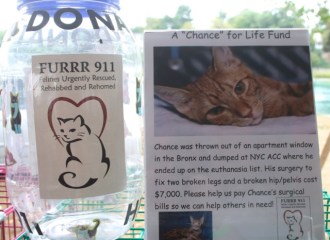
Please take the "chance" to help this little guy.
Chance’s story. Photo by A. Bogdanovic

This year,  FURRR 911 brought several young cats and kittens to the event. Based in Westchester County, NY, FURRR 911 specializes in rescuing, rehabilitating and re-homing young cats and kittens most in need of help. Their stories are heartbreaking and heartwarming.

There’s Chance. He was thrown out of a building in New York City. And there’s TumbeLina, who was born with a disorder that affects her balance. There’s another little kitten who is missing an eye. And then there are those who were simply born into feral colonies.

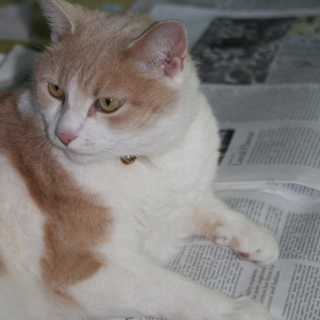
They are all bundles of cuteness. They are all in need of good homes. And to be honest, if I didn’t have my hands full with Eli (a big bundle of cuteness in his own right) I probably would have adopted one or two.

As it stands, I can only hope that some of them will end up in good homes. In fact, I hope that all of the dogs and cats available for adoption will end up in homes where they know nothing but love and kindness. They deserve nothing less.

In NY and NJ, a bomb by any other name is still a bomb

This vintage typwriter is our featured image.

BOMB (noun) — “an explosive device fused to detonate under specified conditions” Merriam-Webster.

BOMB (verb used with object) — “to explode by means of a bomb or explosive” Dictionary.com

BOMB (verb used without object) — “to explode a bomb or bombs Dictionary.com

If the circumstances weren’t so serious, the mainstream media’s reaction to the weekend bombing that injured 29 people in New York City would have been laughable. Instead it was just sad.

Rather than focusing on the matter at hand, the media obsessed over:

  • Donald Trump’s use of the word “bomb” in connection with the incident.
  • Whether he used the term prematurely.
  • If and when Hillary Clinton used the same term.
  • Whether the use of the term was appropriate, no matter who said it or when.

Well, here’s a newsflash (sarcasm fully intended): When something goes “boom” and then disintegrates into a billion pieces that fly through the air damaging property and hurting lots of people in the process, it is pretty safe to say it was a bomb.

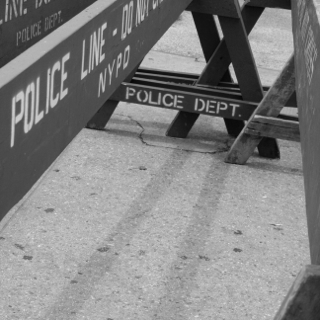
Black and white photograph of New York Police Department barriers taken by Alexandra Bogdanovic
NYPD barriers. Photo by Alexandra Bogdanovic

Of course I suppose one could also argue that by definition an explosion also goes “boom.” However an explosion can be triggered by almost anything. A gas main leak, faulty wiring or even a bomb.

As a former police reporter, I understand why the media initially referred to the incident as an explosion and hesitated to call it something else. I also understand why the media was legally obligated to use words such as “alleged” and “apparent” in the immediate aftermath of the incident.

But I digress. Once all the talk about the use of the word “bomb” got old, the media-fueled speculation turned to whether or not the bombings in Chelsea and Seaside Park, New Jersey, were terrorist acts, whether they were linked, who was responsible and so forth.

Meanwhile, local, state and federal law enforcement officials — who are routinely castigated by the mainstream media — were doing their jobs. A comprehensive investigation, including analysis of evidence found within a few blocks of the Chelsea bomb blast — resulted in the arrest of a New Jersey man on Monday morning.

Ahmad Khan Rahami, 28, the suspect in the bombings, is now facing multiple charges stemming from the gun battle that transpired before police took him into custody.

Score one for the good guys…