Yet another good reason to stop smoking

This vintage typwriter is our featured image.

I know it’s hard to believe, but another year is almost over. That means it’s almost time to start thinking about New Year’s resolutions. And for many smokers, that means it’s time to start thinking about quitting — again.
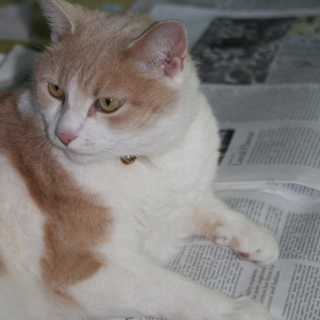
Eli, the In Brief Legal Writing Services mascot.
In Brief Legal Writing Services mascot Eli catching up on the latest news. Photo by Alexandra Bogdanovic

Of course, there’s always plenty of incentive to quit. Smoking is a filthy, dangerous habit that affects not only smokers, but everyone around them. It even affects their pets.

According to published reports, dogs and cats  inhale secondhand smoke directly, and ingest chemical particles from smoke while grooming. Exposure to the material can worsen existing health conditions and cause new illnesses in our pets.

The U.S. Food and Drug Administration (FDA) says the ways in which secondhand smoke affects dogs depends largely on the length of the dog’s nose.

Because more toxins tend to get trapped there, dogs with longer noses, such as greyhounds and Dobermans are more likely to get nose cancer, the FDA says. On the other hand, breeds with comparatively smaller noses are at greater risk of getting lung cancer from exposure to secondhand smoke.

Cats that live with smokers are also at risk for serious and potentially fatal illness, but for different reasons. Because they are obsessive about cleanliness, cats can ingest toxic residue from tobacco smoke while grooming.

“Studies show that cats living in smoking households have a two to four-times increased risk of an aggressive type of mouth cancer called oral squamous cell carcinoma. The cancer is often found under the base of the tongue, where the thirdhand smoke particles tend to collect after grooming,” the FDA says. There is currently no known cure.

Citing additional research, the FDA says that cats “that live with people who smoke more than one pack of cigarettes a day have three times the risk of developing lymphoma, a cancer of the body’s immune system similar to non-Hodgkin’s lymphoma in people.” Most cats with this type of cancer live for just a few months.

So there you have it. If you don’t care about your own health, and you don’t care if smoking affects the people around you — quit for your pet. You’ll both be better off.
Curbing the use of comfort pets: an emotional issue

This vintage typwriter is our featured image.

Earlier this year, I teamed up with a client and one of her colleagues to co-research and co-write an article about the use of Service Animals and Emotional Support Animals (ESAs).

The article appeared “Animal Law” edition of the Maryland Bar Journal. You can find it here. Because it’s a fairly long piece, I totally understand if you don’t have time to read the whole thing. In fact, I’d be happy to hit the high points for you.

Eli, the In Brief Legal Writing Services mascot.
In Brief Legal Writing Services mascot Eli catching up on the latest news. Photo by Alexandra Bogdanovic

Basically, we began by describing Services Animals and ESAs, and discussed the rules and regulations governing their use. We also touched on some of the controversies stemming from their use. Most importantly, we shared ideas about how to accommodate everyone’s needs without resorting to costly and ineffective litigation.

Little did I know how timely that article would turn out to be. Since its publication this summer, I have seen countless stories about the same topics in the mainstream media. In fact, I found this one just a couple of weeks ago. It’s about someone taking a duck on a plane.

Yes, you heard me. A duck! I’m sorry. That’s utterly ridiculous. I’ve heard of people being allowed to take service dogs on planes (and even that causes problems sometimes). But a duck?

Yes, it sounds crazy. But apparently it’s not all that unusual. In fact, if a passenger has proper documentation, it seems like almost anything goes.

“We have seen service monkeys, even comfort pigs,” TSA spokesperson Mike McCarthy told the media. “There really isn’t much that would surprise our officers,” he added.

There’s no doubt that service animals, Emotional Support Animals and therapy animals help people cope with and overcome serious physical and psychological issues. And I suppose there’s no rule that says that a service animal, Emotional Support Animal or therapy animal must be a dog or cat. Horses have “worked” as therapy animals for years.

I can’t say for sure but I would venture to guess that most reasonable, open-minded people don’t mind if someone travels with a service animal or ESA — as long as there is a legitimate need. From what I’ve seen and heard, troubles arise when it is obvious that the person with the service animal or ESA abuses the rules.

Beyond that, there are other legitimate concerns. As someone who was once horribly allergic to dogs, cats (and just about every other animal you could possibly imagine), I am not to sure how I would have felt about being cooped up on an airplane with a dog nearby.

There are also people who are afraid of some animals — especially dogs. Who knows. Perhaps there are some people who are equally afraid of pigs, ducks, lizards and any other assortment of animals permitted on public transportation these days. Is it really fair to subject them to emotional distress just to accommodate someone else’s needs?

For the purposes of this blog, that is a rhetorical question. But it also warrants serious thought.

Unfortunately, there is no easy answer.

As long as people love animals — and as long as service animals, ESAs and therapy animals continue to help their human counterparts cope with physical and psychological challenges — the debate will continue.

My cat may not be my child — but he is still my boy

This vintage typwriter is our featured image.

In case you’ve missed it, there’s a debate raging across the Internet. And believe it or not, it’s got nothing to do with the election. It’s not about Democrats or Republicans or conservatives or liberals or Hillary or Trump.  In fact, it’s got nothing to do with politics whatsoever.

But it’s heated. Because this debate pits pet owners against non-pet owners and animal lovers against non-animal lovers.

Eli, the In Brief Legal Writing Services mascot.
In Brief Legal Writing Services mascot Eli catching up on the latest news. Photo by Alexandra Bogdanovic

It all started not too long ago, when a New York Magazine writer penned an article claiming pet owners who think of themselves as “parents” to their dogs and cats are delusional. The headline simply read: Pets Are Not Children So Stop Calling Them That.

As someone who always wanted to have kids of my own but didn’t due to circumstances beyond my control — and as someone who has had pets for most of my life — I actually agree with him. But only to a point.

Personally I think that dressing companion animals in “costumes” resembling human clothing (for any reason other than to keep them warm in exceptionally cold weather) is taking things way too far. I feel the same way about transporting them in strollers and throwing parties to celebrate their birthdays. To me, there’s something about it that just isn’t right.

However, I strongly object to the author’s contention that, “In stark contrast to pets, children are always trying to outgrow, outflank, and outsmart their parents. Children are cunning and devious, with long memories and big plans. They don’t just grow, they develop.”

This comment shows a considerable lack of insight and a remarkable amount of stupidity.

I got my first cat when I was 10. She died when I was 27. So we literally grew up together. Her name was Tiger. She was a little Siamese cross with a huge personality.  And she was a peacemaker. Whenever there was drama in our house (and there was lots of it), Tiger would stand between the warring parties and cry her little lungs out. She didn’t stop making noise until we did. She wasn’t necessarily “cunning and devious,” but she was smart.

Then there was Heals. She came into my life a few months after I lost Tiger. She was a big, outgoing, happy-go-lucky cat. She was also adventurous and insisted on being outdoors, even after I moved twice in a short period. When we lived in West Harrison, she had a habit of wandering into one neighbor’s garage to say “hi.” I don’t know for sure, but I rather suspect she got a few treats there, too. So was she “cunning and devious?” Perhaps. Was she “trying to outflank and outsmart” me? I wouldn’t have put it past her. Was she intelligent? No doubt.

And now I’ve got Eli. My big, sweet, wonderful boy. He came into my life back in 2008. I adopted him from the Fauquier SPCA when I lived in Virginia — and it was clear from the beginning that he’d had a troubled past. He spooked easily and ran from anything he thought he could be hit with. Even soft toys seemed to pose a tremendous threat. He didn’t like men, or little kids and cringed at loud noises. At times, he acted out in ways that were clearly indicative of “fear aggression.”

So can I honestly say he has a “long memory?” Hell, yes. But with time and patience and love, I won his trust. And we now have an unbreakable bond. He is definitely my cat. And I am his number one person.

Like Tiger and Heals did before him, Eli counts on me for everything, but most importantly food, shelter, water, healthcare and a clean litter box. As long as he is alive, I am responsible for his well-being. And as long as he is alive, I will remain fiercely protective of him (as I was with Tiger and Heals).

Anyone who even thinks of putting a hand on him in anger or malice has to come directly through me. Yes, I would literally defend him with my life. I love him that much.

And in that regard, I am no different from any other parent.

Legal view on pets is actually changing…slowly

This vintage typwriter is our featured image.

Historically, the law has taken a pragmatic view of animals. Legally they’re not viewed as pets or companions or family members. Legally, animals are property. That’s all. Nothing more, nothing less.

This archaic philosophy — for lack of a better word — is still reflected in Connecticut law. As the Connecticut Humane Society notes, the state’s legal definition of animals includes “all brute creatures and birds.” Under CGS §53-247(a), criminal activity includes “overdriving, overloading, overworking, torturing, depriving of substance, mutilating, cruelly beating or killing, or unjustifiably injuring any animal.”

Eli, the In Brief Legal Writing Services mascot.
In Brief Legal Writing Services mascot Eli catching up on the latest news. Photo by Alexandra Bogdanovic

Judging by the language quoted above, the law can be traced to a time when most animals were literally “beasts of burden.” Fortunately a lot has changed since then. And the law is finally changing, too.

I’ve often blogged about one of the most significant developments — a law that permits the appointment of special advocates for animals in some cases. The law took effect here earlier this month.

As New London, CT, attorney Kean Zimmerman recently told The Connecticut Law Tribune, the passage of “Desmond’s Law” is a significant step in the right direction. But it’s just the beginning.

“Connecticut laws have not made the leap to consider pets more than property, but slowly judges and legislators are seemingly beginning to acknowledge the many intrinsic values pets have. This is especially true when it comes to a dissolution in which the ‘property’ cannot be divided,” Zimmerman said.

Meanwhile, divorce lawyers find themselves in search of creative solutions in cases where the parties don’t agree on what to do with the family pet(s).

“I’ve had parties agree that the family dog would go back and forth with the kids. I’ve had parties agree on financial contributions for the care of a pet,” New Haven attorney Renee Bauer told the Tribune.

The Animal Legal Defense Fund also offers tips for divorcing couples at odds over the family pet.

“Since animals are considered property in the eyes of the law, it may be helpful to offer proof that you were the one who adopted the animal, or if the animal was purchased, that you were the one who purchased the animal,” the organization recommends.

The person didn’t adopt or purchase the animal may still be able to show that he or she should continue to care for the animal, according to the ALDF. Relevant proof may include:

  • Receipts for veterinary care, licensing records.
  • Receipts for grooming, dog training classes, food, and other items purchased for the companion animal.

“If your neighbors saw that you were always the one who walked your dog or took him/her to the park, they may be useful witnesses who can confirm your consistent interaction with the animal and therefore be helpful to your case.”

In CT, repeat offenders in animal cruelty cases now face tougher punishment

This vintage typwriter is our featured image.

A Connecticut law now on the books provides for tougher penalties in some animal cruelty cases. Specifically, the law that took effect Oct. 1 ups the maximum punishment for repeat offenders.

Until recently, anyone convicted of malicious and intentional animal cruelty more than once was guilty of Class D felony. That meant the offender could be sentenced to no more than five years in prison. Now a “subsequent offense” is designated as a Class C felony, with a maximum sentence of 10 years in prison.

Eli, the In Brief Legal Writing Services mascot.
In Brief Legal Writing Services mascot Eli catching up on the latest news. Photo by Alexandra Bogdanovic

Putting it in “plain English” that means anyone found guilty of “maliciously or intentionally maiming, mutilating, torturing, wounding, or killing an animal” in separate cases no longer gets a slap on the wrist. However, someone convicted for the first time is still guilty of a Class D felony.

Penalties for animal neglect remain the same. If convicted, anyone who deprives an animal or animals of adequate “care, food and water” faces up to one year in prison, a $1,000 fine or both. Anyone found guilty of such activity more than once faces up to five years in prison.

There are exceptions to every rule. In Connecticut, people in certain professions, or who engage in certain activities, cannot be prosecuted under the state’s “malicious and intentional animal cruelty” law — as long as they are following “acceptable practices.” For example, veterinarians, people working in abattoirs, and farmers or ranchers are exempt. Researchers and hunters acting within legal parameters are also exempt.

Whether the exemptions are “fair” or “right” is a matter of opinion and can be debated at another time. Whether the laws pertaining to neglect should be changed is also a matter of opinion and a subject for future debate. The same can be said about whether the new law goes far enough.

All anyone can say for certain is that animal abuse and neglect is an American epidemic that must be addressed. Recently compiled statistics show that:

  • The media reports on roughly 1,900 animal abuse cases each year.
  • Most animal abuse cases involve dogs, and of the cases involving dogs, the majority involve pit bulls.
  • Neglect and abandonment are the most common forms of abuse.
  • Hoarding makes up 13 percent of animal cruelty cases.
  • Fighting makes up 9 percent of animal cruelty cases.

As someone who has personally witnessed the effects of animal cruelty as a pet owner (Eli was definitely abused before I adopted him) and as someone who volunteers at a local shelter, I have very strong feelings about the topic. As far as I am concerned there’s simply no punishment harsh enough for anyone who hurts an animal. None.

It’s the law: CT animal advocacy measure among those now in effect

This vintage typwriter is our featured image.

Some time ago, I blogged about Connecticut legislation drafted to permit lawyers and would-be lawyers to “represent” animals in certain cases.

Since my first post, Connecticut Governor Dannel P. Malloy signed the bill into law. I am now happy to report that he Act Concerning Support For Cats and Dogs that are Treated Cruelly officially took effect Oct. 1.

To refresh your memory, the law allows attorneys specializing in animal cruelty and neglect cases — and law school students with an interest in the subject — to “advocate for the interests of justice in certain proceedings involving animals.” There are three circumstances in which this can happen:

Eli, the In Brief Legal Writing Services mascot.
In Brief Legal Writing Services mascot Eli catching up on the latest news. Photo by Alexandra Bogdanovic
  • In animal cruelty or animal fighting cases
  • In “court proceedings stemming from an animal control officer’s seizure of a cruelly treated or neglected animal”
  • In “criminal cases involving the welfare or custody of cats or dogs.”

Qualified advocates (selected from lists kept by the Department of Agriculture) can now attend hearings, act as observers and provide relevant information to the judge or “fact finder.” In certain circumstances, they can also issue recommendations.

In accordance with the new law, any party involved in the case can request a special advocate’s services. The court can also appoint a special advocate.

The law is also summarized here.

New rules pertaining to human trafficking, bed bugs, child support, protection for victims of domestic violence, abuse in nursing homes, and medicinal use of marijuana also took effect Oct. 1.

Now that makes for a lot of blog fodder. So stay tuned…

Unsung heroes — going beyond the call of duty to rescue animals

This vintage typwriter is our featured image.

American cops are certainly getting a lot of bad press these days — and with good reason, some might say. But I recently came across two stories that show just how far some police and animal control officers will go to do the right thing.

Eli, the In Brief Legal Writing Services mascot.
In Brief Legal Writing Services mascot Eli catching up on the latest news. Photo by Alexandra Bogdanovic

The first story, which was widely publicized here in the greater New York City area, is one about some Port Authority police officers who rescued an injured dog on the George Washington Bridge.

Now, you don’t have to live anywhere New York City to know that the GWB is, well, terrifying. At the best of times its upper and lower decks are crammed full of cars and trucks driven by cranky New York drivers in a rush to get across the span. Then there are the drivers trying to cross the bridge who have no idea where they’re going. Put the two groups together, add in some construction (there’s almost always construction), lane closures (that New Jersey Gov. Chris Christie allegedly has no knowledge of) and you’ve got one giant cluster bleep.

Now I don’t know if there were actually any lane closures on the day in question. But chances are there was probably tons of traffic. In any case, just imagine being a poor little puppy stuck in the middle of all of that. And imagine how scared you’d be if you’d gotten hit by a car, too.

Fortunately for little Ronin, who found himself in heaps of trouble after he got away from the person walking him, Port Authority police officers Fred Corrubia and Jonathan Harder were on duty that day. According to published accounts, the officers — who were in the vicinity — responded to a report of an injured dog on the bridge, and brought him to safety. As if that wasn’t enough, the officers also took him to a local animal hospital, where he was treated for leg and paw injuries before being reunited with his owner.

In another recent act of bravery, animal control officers in Guilford, Connecticut, rescued a baby skunk. In media accounts chronicling the incident, officials said the little stinker (pun fully intended) was stuck in a courtyard at a local middle school. Rather than putting the children and the skunk through an unnecessary ordeal, the animal control officers used a humane trap to catch the skunk and then used an innovative method to remove it from the school grounds.

The skunk — which seemed healthy — reportedly emerged from the incident unscathed. And for the record, the animal control officers did, too.

Here’s one book every pet owner can use

This vintage typwriter is our featured image.

It has been a long time since I’ve written a post that falls into the “reading list” category. But this book is a must-read for every pet owner on the face of the planet.

In the interest of full disclosure, I haven’t read it yet. But it’s definitely on my list.

Eli, the In Brief Legal Writing Services mascot.
In Brief Legal Writing Services mascot Eli catching up on the latest news. Photo by Alexandra Bogdanovic

Written by a veterinarian, Dr. Nicholas Dodman, Pets on the Couch is packed with anecdotes about neurotic dogs, cats, birds and other animals with whom I am sure we can all relate. Or more accurately, I think we can all relate to their “parents.” But I’m sure you knew what I meant.

Now, none of my cats ever ate wine glasses (like a dog featured in the book) — although Heals did eat most of a rubber snake. I didn’t realize what she’d done until she started puking all over the place and I took her to the vet. The vet didn’t know what my cat had eaten until she did surgery. The surgery and ensuing stay at the animal hospital cost me approximately $2,000, but I didn’t have a choice. If Heals didn’t have the operation, she could have died.

I can’t honestly say that I’ve had an anorexic cat, either. And I’ve never had any dogs, or birds — although I did take care of both during my pet-sitting days. So maybe I can’t relate to all of the stories in Dodman’s book. But I as an animal lover and pet owner, I can relate to most of them. And that’s what matters.

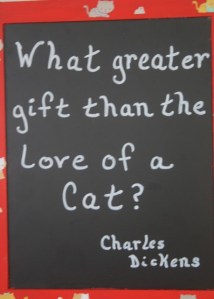
Charles Dickens quotation about cats.
Famous quotation about cats. Photo by Alexandra Bogdanovic

I also like Dodman’s reasons for writing the book.

“I have an ulterior motive for writing the book,” Dodman said. “It’s to educate people to the fact that animals have feelings and emotions similar to our own.”

Because Dodman believes that’s the case, he also believes that neuroses affecting various animals can be treated accordingly. Specifically, he recommends behavior modification, diet and exercise. When all else fails, he thinks drugs can be used to address the animal misbehavior that cause people to surrender or abandon their pets.

That’s where I draw the line. I would never, ever give Eli kitty cat Prozac. But I’d never give up on him, either.

The cutest kittens ever get another chance thanks to FURRR 911

This vintage typwriter is our featured image.

This has got to go down as one of the most turbulent weeks in recent American history. There were acts of terrorism in Minnesota, New York and New Jersey. Riots broke out in Charlotte after a yet another police shooting.

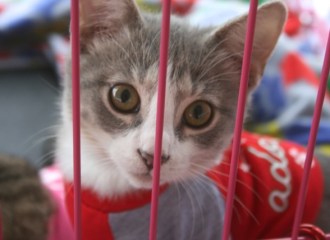
Cute Kitten, courtesy of FURRR 911. Photo by A. Bogdanovic
Bolt, a kitten rescued by FURRR 911, at Puttin’ On The Dog & Cats, Too 2016. Photo by A. Bogdanovic

But there was one day when thousands of people came together for a good cause in Greenwich, Connecticut. That was on Sunday. And I was there.

This was the fourth year that I had the honor and privilege of photographing the action in the demonstration rings at the Puttin’ On the Dog & Cats Too festival at Roger Sherman Baldwin Park. Hosted by Adopt-A-Dog, the local animal shelter where I volunteer, the event attracts pet owners and animal lovers from the Tri-State Area.

At the festival, pooches participate in various competitions including a costume contest. Their owners can check out the latest pet supplies and pet foods available from the vendors on site. Most importantly, the host organization along with other area animal rescue and welfare groups, get to introduce some of the dogs and cats available for adoption to the general public.

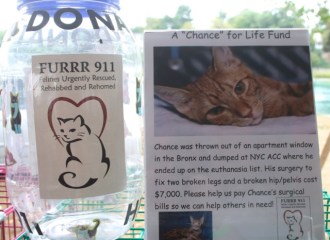
Please take the "chance" to help this little guy.
Chance’s story. Photo by A. Bogdanovic

This year,  FURRR 911 brought several young cats and kittens to the event. Based in Westchester County, NY, FURRR 911 specializes in rescuing, rehabilitating and re-homing young cats and kittens most in need of help. Their stories are heartbreaking and heartwarming.

There’s Chance. He was thrown out of a building in New York City. And there’s TumbeLina, who was born with a disorder that affects her balance. There’s another little kitten who is missing an eye. And then there are those who were simply born into feral colonies.

They are all bundles of cuteness. They are all in need of good homes. And to be honest, if I didn’t have my hands full with Eli (a big bundle of cuteness in his own right) I probably would have adopted one or two.

As it stands, I can only hope that some of them will end up in good homes. In fact, I hope that all of the dogs and cats available for adoption will end up in homes where they know nothing but love and kindness. They deserve nothing less.

Eli The Cat for president?

This vintage typwriter is our featured image.

Since I started my business and launched this site, I’ve made it a rule to refrain from discussing politics in this forum. It’s not that I fear voicing my opinion on controversial issues — just scroll through the archives and you will see that’s hardly the case. I just don’t think it’s appropriate.

But with Election Day looming — and two of the worst candidates in U.S. history seeking the single most important job in the world — I am officially diving head first into the cesspool otherwise known as presidential politics.

Eli, the In Brief Legal Writing Services mascot.
In Brief Legal Writing Services mascot Eli catching up on the latest news. Photo by Alexandra Bogdanovic

Unfortunately it’s too late to nominate my cat for president — but maybe I can organize a write-in campaign. Or maybe not.

But one thing’s for sure. It would definitely be worth a try… And no, I am not a crazy cat lady. There’s definitely a precedence for this.

According to a recent article on wthnh.com, a cat from Kentucky named Limberbutt McCubbins is “is officially registered to run as a democratic candidate for this year’s presidential race.”  And apparently McCubbins has some competition — from a Louisiana crawfish named Crawfish B. Crawfish.

I kid you not. I couldn’t make this stuff up.

Apparently, at least five other animals of varying species have sought public office over the years. And some of the bids have been successful.

Maybe Eli will join them someday. Maybe he won’t. But in any case, I think he’s content with the titles he already holds. You see around here, Eli is also known Sir Sheds A Lot, slayer of mice and guardian of the realm.

It suits him.