Judging by an article I just found, the old saying about the wheels of justice turning slowly doesn’t just apply to people. It applies to animals as well.
In Connecticut, it specifically applies to “dangerous” dogs that are “accused” of committing certain “crimes.” And as far as I am concerned, that’s just not right.
Founder/owner of In Brief Legal Writing Services, Alexandra Bogdanovic. Photo by N. Bogdanovic
You see these dogs — which are often acting on instinct, or training rather than malice — face the ultimate penalty for their alleged actions. Yes, there is a “dog death penalty here.”
Don’t get me wrong. There are some cases in which such a policy is definitely warranted — and many where it isn’t. But that’s not the point.
The point of this particular post is to address a different but related matter; namely the amount of time the state can or should keep a “dangerous” dog in “custody” before it is euthanized.
Currently, Connecticut “has no standards for determining when an animal should be euthanized, leaving it to the discretion of local animal control officers,” according to attorneys for a Connecticut dog owner whose Rottweilers have been living on what the media calls “a canine death row” for five years.
According to published reports, Kato and Kleo’s owner says they got out of their yard and bit a neighbor “only after they were attacked.” The state then ordered them to be put down.
Lawyers for plaintiffs in a recent federal class action lawsuit are now arguing that the lack of standards in such circumstances is a violation of dog owners’ rights. Specifically, they say it is “a violation of due process and an unreasonable seizure of property.”
I’m not a lawyer — but I happen to agree.
What do you think? Share your opinion in the comments section below.
I must admit, I’m a bit preoccupied this morning. I should be working, but I just can’t concentrate.
Eli is out of sorts, too. I can tell because he’s sleeping under my bed. And he only does that when he doesn’t feel well, or he’s upset, or he just doesn’t want to be bothered.
In Brief Legal Writing Services mascot, Eli the cat. Spring 2017. Photo by Alexandra Bogdanovic
Perhaps he’s still miffed about what happened yesterday. On what was arguably one of the most beautiful days of the summer here in Connecticut, he got stuck inside. By himself. All day. And to add insult to injury, no one said goodbye. No one left a fan on for him. And, most importantly, his number one person (yours truly) forgot to clean out his litter box before she left.
Trust me, he found a creative — and frankly disgusting — way to let the sanitation committee (yours truly) know that he was not happy about the latter.
What can I say? He’s a sensitive boy.
If I ever had any doubt about that — which I haven’t — he reminded me on Saturday. I was, once again, voicing my anguish, anger, unhappiness and disgust about our general contractor’s insistence on “boxing in” a set of pipes (that had previously been capped in the attic and were no longer going to be used). By doing so, he completely screwed up the portion of my brand new, open concept living area, where I was dreaming of having a little reading nook. I was also lamenting my mother’s decision to install two small closets and a sewing station there… but that’s another story.
Of course, Eli had no idea why I was so upset. He could just tell that I was unhappy by the tone (and volume) of my voice, and my body language. So he came over to me and offered what little comfort he could, rubbing his head on my leg. Please don’t be sad, he seemed to be saying. It will all be OK.
And in that instant, I relaxed. I actually felt my heart rate and blood pressure drop as I patted Eli and felt the steady thrum of his purr…
And that finally brings me to the point of this post, which was to share an interesting article I just found on marketwatch.com. In it, the author says that in our quest for happiness, spending money on pets is far more rewarding than spending it on material stuff.
Personally, I couldn’t agree more.
How about you? Share your thoughts about your pets and pet ownership in the comments section below.
When it comes to the stuff that makes me mad, I’ve learned to choose my battles. At this point, there’s little I can do about the state of my country or the state of its leadership. I can’t put an end to terrorism or injustice. And I certainly can’t do anything about human stupidity.
As much as I would love to, there’s no way that I can save all of the companion animals who have been abused, abandoned, or neglected. As much as I would love to, there’s no way that I can find and punish the people who mistreat or discard their pets without a second thought.
Puppy dog eyes…. Photo by Alexandra Bogdanovic
But for three years, I did what I little I could to help find “forever homes” for unwanted or abandoned pets by volunteering in the office at a local shelter. Although I had to stop doing so after I started In Brief Legal Writing Services, I’m still a volunteer photographer for Adopt-a-Dog in Greenwich, Connecticut.
Last weekend, I finally had a chance to visit the shelter and catch up with some old friends. I also had a chance to get the shots of the dogs that I’m sharing in this post. Hopefully these pups will soon be adopted, if they weren’t already.
In the meantime, you can learn more about Adopt-a-Dog by visiting their website. In the meantime, please feel free to let me know about shelters or rescue groups in your area that are doing great work. I’d be happy to do posts about them, too!
Hi there! Want to play? Photo by Alexandra Bogdanovic
This pup’s bib says it all! Photo by Alexandra Bogdanovic
Sorry I’ve been away so long. But living and working in a renovation zone has been keeping me pretty busy. In other words, I have not had much free time.
In Brief Legal Writing Services mascot Eli catching up on the latest news. Photo by Alexandra Bogdanovic
In the spare time that I have had, I’ve been struggling to find activities that allow me to escape from all of the stress and horrors of, well… living and working in a renovation zone. So I’ve been binge-watching a few TV shows, borrowing movies from my local library, and reading whenever I can.
Yes, I love to read. In fact, it’s something that I’ve loved to do since I was just a little kid. And for as long as I can remember, I’ve loved books about animals. I’ve also been known to enjoy a good mystery or two.
Here’s what I’ve been reading
So with all of that being stated, here’s what I’ve been reading.
Right now, I’m about three-quarters of the way through Live and Let Growl by Laurien Berenson. And so far, I really like it. I don’t love it. But I really like it.
It’s part of the “Melanie Travis Canine Mystery” series. As such, it’s what would usually be classified as a “cozy” mystery, which basically means that it’s a “who-done-it” without all of the mayhem and gore. And right now, that’s fine with me. I’ve got enough chaos in my life as it its.
But back to the point.
One of the reasons I like it so much is because the protagonist is from Connecticut. So I can relate. The other reason I like it is because of the setting. It’s set at a dog show in Kentucky horse country. Dogs…horses…mystery…intrigue… what’s not to love?
And now for some recommendations…
Don’t worry. I haven’t forgotten about all of my feline-loving friends out there. In fact, I’ve got some great recommendations for anyone who shares my passion for cats and books, or more specifically, cats and mysteries.
You simply must check out the Cat Who… series by the late Lillian Jackson Braun. This set of 20-plus books by Braun features an intrepid reporter (Jim Qwilleran) as the protagonist and his trusty Siamese sidekicks, Yum Yum and KoKo. Together they get in and out of their share of trouble while solving perplexing crimes.
Like Berenson’s books, these are “cozy” mysteries, so they’re suitable for readers of all ages.
Give them a try, and let me know what you think. Or you can share your thoughts about your favorite books in the comments section below. I’d love to hear about what you enjoy and the books on your summer reading list.
As a little kid, I always wanted a pet. But I couldn’t have one. For one thing, I was horribly allergic to just about everything. If I patted or got licked by a dog, I had an asthma attack or broke out in hives. If I got scratched by a cat, I got an antihistamine reaction.
When I was 10, everything changed. We got a cat. Her name was Tiger. We got her from some friends that were moving to Saudi Arabia. She was supposed to live in our attic.
In Brief Legal Writing Services mascot Eli catching up on the latest news. Photo by Alexandra Bogdanovic
And she was only supposed to stay with us long enough to eradicate the mice that were running rampant in our apartment. She never caught a mouse. And I had her for 17 years.
It’s a good thing our landlord was cool with it. That’s not always the case.
The case of the selective ‘no pets policy’
In an article I came across the other day, the author answered an interesting question about an allegedly selective “no pets policy.” Specifically, the reader who submitted the question to The New York Times “Ask Real Estate” page, wanted to know if his (or her) new landlord could make good on a threat to evict him (or her). The alleged threat to do so is based on a claim that the reader has a pet and is therefore in violation of his (or her) lease.
In this case, the reader lives in a “rent-stabilized apartment” in Brooklyn. His (or her) chihuahua has also lived there for the past 10 years.
Based on the information provided the short answer is “no.” You can read a more detailed explanation here.
In the same article, you can also learn why the new building owners are well within their rights to extend “pet friendly” leases to some new tenants, but not to others.
If there’s one thing scarier than getting kicked out of your home…
Being homeless is a frightening prospect for anyone. But if there’s one thing scarier for an animal lover, it’s being forced to choose between their home and their pet.
With that in mind, I’m including a list of resources below that you can consult if you or someone you know is facing eviction. Please keep in mind that this material is provided strictly for informational purposes and is not legal advice.
Not that’s it’s entirely unique — I have read about programs like this that have been implemented elsewhere before.
Founder/owner of In Brief Legal Writing Services, Alexandra Bogdanovic. Photo by N. Bogdanovic
But I’ve got to hand it to the city of Oswego, N.Y., for coming up with a program that promotes responsible pet ownership and gives pet owners — and their charges — help when it’s needed most.
As reported on syracuse.com, the city has opened a food pantry that will “supply food and other necessities for pets when owners fall on difficult financial times.”
What sets this pet pantry apart?
Like other “pet pantries” I’ve read about, Oswego’s will rely on donations in order to help struggling pet owners. What sets it apart, in my opinion, is that it won’t be open to everyone. In order to qualify for assistance, pet owners must meet certain criteria.
To be eligible, the animal’s owner “must license their pet, including spaying or neutering of the animals.” The stipulation”will help better control the population of dogs and cats within the city,” according to Oswego Mayor Billy Barlow.
A ‘win-win situation’ for Oswego residents and their pets
Oswego Animal Control Officer Caroline Anderson, who also spoke to the media, agreed.
“We receive calls every week from people who can no longer keep their pets due to financial hardship,” she said. “If we can help companion animals remain in their homes where they are loved while also battling animal overpopulation, it’s a win-win.”
She added that companion animals that have been spayed or neutered are less likely to be surrendered because they have behavioral issues. They are also less like to stray and tend to be less aggressive than animals who haven’t been spayed or neutered.
The city first came up with programs that encouraged residents to spay, neuter and license their pets in 2016. Prior to creating the initiative, the average number of dog licenses issued by the city was less than 300 per year. In 2016 it issued more than 1,000.
If you live in Oswego…
If you live in Oswego and are struggling to provide for your pet, you can visit the pantry from 4 to 7 p.m. Thursdays, or make an appointment. Be sure to bring proof of need and proof that your pet is licensed, and spayed or neutered. Proof of a current rabies vaccine is also required.
Since the pet pantry will be stocked with donations, residents are also encouraged to drop off supplies, including donated pet food, kitty litter, treats and flea/tick and heart worm preventives.
OK, so here’s the deal. Eli gets car sick. Big time. So I’m really happy that we no longer have to make 300-plus mile drives from Virginia to Connecticut when we go on vacation. The longest road trips we take these days are the five-minute variety (that’s how long it takes to get from our house to the vet). Of course, he’s never happy about the destination (unless it’s the return trip) but that’s beside the point.
In Brief Legal Writing Services mascot Eli catching up on the latest news. Photo by Alexandra Bogdanovic
Returning to the topic at hand, I’m really, really, really happy I’ve never had to fly with him. And I hope I never will — because he hates his cat carrier and I doubt he would be happy in the cabin. I also doubt the passengers would be happy about having him in the cabin — listening babies cry on planes is bad enough — listening to a cat yowl the whole time would be torture.
Having said that, I will sprout wings and fly myself before I ever let anyone put Eli in the cargo hold of any aircraft. I don’t care how safe it supposedly is. I’ve read too many horror stories: pets escape, pets get hurt, and pets die. So to reiterate, no, thank you very much. I am not trusting any airline with my cat. Ever.
All you need to know about flying with Fido or Fluffy
In the interest of full disclosure, recent incidents aboard and following United Airlines flights have renewed, if not prompted, my personal vehemence on this topic. I mean a guy getting dragged off an overbooked flight is bad enough, but a giant rabbit’s death after flying on the airline is beyond words.
If anything good has come out of the latter, it’s that the incident grabbed plenty of headlines and generated public awareness about flying with pets.
You can read a really good story about your rights and options as a pet owner, the precautions you should take, and more here. While researching the topic, I also found a comprehensive and informative story that specifically pertains to the transportation of pets in aircraft cargo holds.
For brevity’s sake, I won’t rehash both articles. But suffice it to say that when it comes to the pets that one writer described as “precious cargo,” there’s no such thing as being overly informed, or being too careful.
How do you feel about flying with your pet? Share your opinion by voting in the following poll.
Not too long ago, I did a post about Sir Patrick Stewart and his pit bull, Ginger. As you may recall, Stewart and his wife are fostering the dog, but can’t adopt her because breed specific laws in the U.K. are preventing them from taking her there.
Their story, which is heartbreaking and heartwarming, made me think about breed specific laws here. And I’ve come to the conclusion that the harshest of these rules and regulations — while well-intentioned — are worthless.
What is breed-specific legislation?
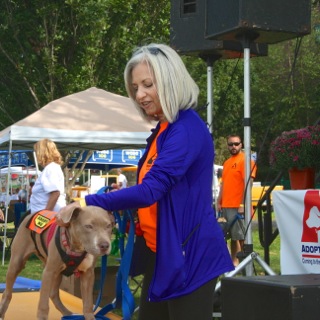
An Adopt-a-Dog volunteer with a dog up for adoption at the annual Puttin’ on the Dog show in Greenwich last September. Photo by A. Bogdanovic
According to the National Canine Research Council, breed-specific legislation (BSL) or breed-discriminatory legislation (BDL) is “a law or ordinance that prohibits or restricts the keeping of dogs of specific breeds, dogs presumed to be specific breeds, mixes of specific breeds, and/or dogs presumed to be mixes of one or more of those breeds.”
These rules and regulations include but are not limited to:
Complete bans
Mandatory spay/neuter
Muzzling
Liability insurance requirements
Mandatory micro-chipping and/or tattoos
Age requirements for those who own or walk certain types of dogs
Exclusion from some public places
Training requirements
Submission of photograph(s) and additional identifying information to the relevant authority/authorities.
Taking aim at ‘dangerous dogs’
Some of these laws are reasonable — and unfortunately, some are necessary. Those that promote responsible pet ownership, public education and awareness, can actually be effective.
But sadly, most of the harshest breed-specific laws are knee-jerk reactions to tragic incidents involving alleged dog “attacks.”
Because the victims are often children, the incidents resulting in permanent injuries or — in the most horrible circumstances — death, grab national headlines and there is a rush to judgment before all of the facts are known. Bowing to public pressure, ignorant but well-meaning lawmakers create sweeping laws that are designed to “protect” the public.
The reality is that these laws target entire groups of dogs based on the actions of a few. according to an article on onegreenplanet.org, the “dangerous dog” breeds often targeted by breed-specific laws are:
Pit bulls (not an actual breed)
American bulldogs
Mastiffs
Dalmatians
Chow Chows
German Shepherds
Doberman Pinscher
Other breeds also make the list, according to the article. In fact, the author maintains, some of these laws can even affect Chihuahuas. Personally, I find it sad, but not surprising. It seems these laws are designed any type of dog that has a tendency to bite.
That being stated, I’ve never been bitten by a Chihuahua. But I did get bitten by my ex-husband’s yellow Lab-cross. And I still have the scar to prove it…
Collateral damage
The saddest part of this whole situation is that a lot of these laws have drastic, if unintended consequences.
Pick me! An Adopt-a-Dog volunteer with a dog up for adoption at Puttin’ on the Dog in Greenwich. September 2015. Photo by A. Bogdanovic
Breed-specific laws create a huge burden for animal welfare and rescue groups in two significant ways. They force people to surrender or “dump” their dogs, and make those dogs harder to place. Trust me, I know. I volunteered with a rescue group for years (and still do, on a limited basis).
Worse yet, these laws result in needless, senseless, pointless deaths. Whole groups of dogs are slaughtered. Because they “look” dangerous. Because they belong to a breed prone to “aggressive tendencies.” Or for no reason, whatsoever.
Now here’s where I get really angry, and the post gets controversial.
What if we did this to people. What if we decided that a whole group of people was “dangerous” based on the actions of a few? And what if we decided to restrict where this entire “dangerous” race lived or made them wear identifying clothing, or worse yet, decided to wipe them off the face of the earth?
Oh, wait… humans have done something like that from time to time, haven’t we? Why not all that long ago, the President of the United States tried to prohibit entire groups of people from certain countries from coming here just because a few Muslim extremists from that part of the world have engaged in terrorism.
Many years ago, I saw Patrick Stewart star in a one-man theater production of A Christmas Carol. It was phenomenal. He was phenomenal. In fact, the performance moved me to tears…
And while that performance left no doubt that he is a fantastic actor, a recent news article left me with no doubt that he is much more. He is a fantastic human being.
Speaking as someone whose interactions with professional athletes made me cynical extremely cynical about celebrities, that’s saying a lot.
A man and his dog
The story to which I’m referring is the one about Stewart and Ginger. Ginger is a dog that Stewart and his wife are fostering. But she’s not just any dog. She’s a pit bull. And she’s clearly wormed her way into the actor’s heart.
As he tells the media: “I find that my relationship to the world and to the news every day in the papers and on the television has been changed by Ginger, because she has brought such a quality of patience and tolerance and fun into our lives, that it has, in a very short space of time, shifted my sense of where our world might be going. I literally find myself more optimistic than I was, and there is only Ginger to account for this. It is the impact of sharing my life for only seven or eight days with Ginger.”
Sadly, Stewart and his wife can’t adopt Ginger because U.K. laws make it all but impossible to bring her back there when they go home.
But what’s even more unsettling is the public reaction to the story.
Mixed reviews
There are few animals on the planet more polarizing than pit bulls. A lot of people love them, — no matter what. And a lot of people hate them — no matter what.
The story about Stewart and Ginger generated plenty of comments from people in both camps. The pro-pit bull people said Stewart’s relationship with Ginger just goes to show that these dogs are loyal, loving, and misunderstood. The anti-pit bull people said it doesn’t matter. As far as they’re concerned, all pit bulls are unpredictable, dangerous, killers.
An Adopt-a-Dog volunteer with a dog up for adoption at the annual Puttin’ on the Dog show in Greenwich last September. Photo by A. Bogdanovic
Personally I love pit bulls. For the most part, I think they’re great dogs. But they’re also big, strong, dogs. So I wouldn’t necessarily feel comfortable having one in a household with small children or the elderly. I wouldn’t necessarily feel comfortable having one in a household with an inexperienced owner, either. In my opinion, these aren’t necessarily the best dogs for beginners.
All of that being stated, I’m not a big fan of so-called breed legislation. I think it’s overkill.
All we really need to do to help pit bulls is to actively promote responsible pet ownership and forums for honest, open dialogue without fear of recrimination, without name-calling and without hateful rhetoric.
It’s not asking a lot — but sadly it seems it’s asking too much.
Yay! It’s sunny. It’s 70 degrees. It won’t get dark here until 7:29 p.m. And I’m… stuck inside, working. Actually it’s taken me the better part of an hour to come up with an idea for today’s post.
So I decided to go with the obvious. Warm weather and springtime safety tips for pet owners.
Exercise some common sense
When it comes to warm weather, pets and people aren’t all that different. We all want to be outside, having fun. And we can all get a bit carried away.
In Brief Legal Writing Services mascot Eli catching up on the latest news. Photo by Alexandra Bogdanovic
But while we are responsible — and know there are consequences for — rash decisions, our pets don’t. So it’s up to us to look out for them. It’s our responsibility to learn the signs that our furry friends are in physical discomfort or distress. Some of the symptoms are obvious, but because dogs and cats are also adept at hiding weaknesses, some aren’t so obvious. Don’t leave anything to chance… talk to your vet about what to look out for.
While you’re at it, have a frank discussion with the vet or another expert about your pet’s outdoor activities. If you’re going to let your cat romp around the neighborhood or leave your dog outside on its own for prolonged periods (something I personally recommend against) learn how to make the environment as safe and comfortable as possible. Find out:
How to create an “escape proof” yard.
What type of shelter to buy or build.
How to mitigate any hazards posed by other animals.
How to ensure your pet has access to food and water.
How to make sure your pet can be readily identified if it goes missing.
Taking these precautions is largely a matter of common sense. On the other hand, failing to take them could cause a lot of trouble. In Connecticut, for example, failing to provide proper shelter for an outdoor pet can result in animal cruelty charges.
Keep hazardous items out of reach
According to the ASPCA, a litany of springtime items pose a threat to our pets. These include:
Easter candy and decorations
The ingredients in lawn and garden chemicals,
The plants and flowers that will soon appear in our gardens
household cleaning products that we’ll use to get rid of winter funk
Keeping these items out of reach is key to keeping our pets safe at this time of year. But if you do have reason to believe your pet has swallowed a harmful substance, it is crucial to call your own vet or the ASPCA Poison Control Center at (888) 426-4435.
A cat may be able to land on its feet, but that doesn’t mean it won’t get hurt
Before you yield to temptation and throw the windows wide open, the ASPCA also recommends checking all of the screens. Make sure they aren’t ripped or torn, and make sure they are well secured, the organization recommends. This is especially important for cat owners — after all, your cat may be able to withstand a fall from a significant height — but that doesn’t mean he or she will come out of it completely unscathed.








 In Brief Legal Writing Services