In Brief Legal Writing Services mascot Eli catching up on the latest news. Photo by Alexandra Bogdanovic
We’ve all seen the heartbreaking pictures and news footage of pets rescued from house fires or natural disasters. And we’ve all seen the heartwarming images of firefighters, paramedics and EMTs rendering First Aid to those hurt and scared cats and dogs.
What you may not know is that in most states, the pet owners can — and do — sue the first responders if their pets die. That’s because the laws in those states prohibit anyone except for licensed veterinarians from treating sick and injured animals.
That’s about to change in Ohio. According to published reports, a law that takes effect there later this summer allows firefighters, paramedics and EMTs to treat injured pets without fear of legal retaliation.
The new law also applies to the treatment of police dogs and companion animals.
“It’s another layer of protection for the good guys,” Cory Smith, director of public policy for companion animals at The Humane Society of the United States, told the Associated Press.
While lawmakers in Ohio –and elsewhere — take steps to protect the first responders who choose to treat injured pets as well as people, another group wants to make sure they are well equipped to do so.
According to an article on iheartdogs.com, the group — Project Breathe — provides fire departments and other first responders with oxygen masks designed specifically for pets. To date, the non-profit organization has donated almost 14,000 masks to U.S. and Canadian fire departments. Training is also provided.
Use of the masks has reportedly saved more than 100 pets.
Sadly, that number is dwarfed by other statistics, however. Some estimates indicate that half a million pets are affected by house fires each year, and 40,000 die.
For information about how to keep your pet safe, visit:
In Brief Legal Writing Services mascot Eli catching up on the latest news. Photo by Alexandra Bogdanovic
A few weeks back, I mentioned that my cat, Eli, is extremely sensitive. And in that regard, nothing’s changed.
But I did learn something interesting the other day. Or more accurately an article in The New York Times confirmed something I’ve always suspected: animals might not understand everything we say, but they definitely understand our tone of voice.
I guess that’s why volunteers read to dogs at the ASPCA in New York City.
“As long as you read in a nice soothing voice, they enjoy it,” Hildy Benick, 69, a volunteer who has been with the reading program since shortly after it started, told the Times.
Victoria Wells is the senior manager of behavior and training at the ASPCA. She started the reading program in 2013, and says it is a great way to help dogs that have to relearn how to trust people.
“You know within each session the progress that they’re making,” she told the Times. “In the beginning of the session, the dog might be in the back of their kennel cowering, and then they move forward, lie down, relax; their tail might wag.”
Like their counterparts in New York City, the animals awaiting adoption in Phoenix are good listeners. And apparently they’re not too picky about which reading material their human pals share. If you think about it, that’s saying a lot, considering some of the college kids that volunteer at the shelter often read from their text books, according to Whitney Fletcher, Director of Volunteers & Special Events at AAWL & SPCA.
“As you read out loud, you are focusing on something other than the animal,” she says. “In turn, the animal grows accustomed to your presence and voice, which is calming. Dogs and cats find the rhythmic sound of a voice very comforting and soothing.”
If it works with shelter animals, there’s no reason why it shouldn’t work with our dogs and cats, too. So the next time you curl up with a good book, try reading to your pet and see what happens. He (or she) just might enjoy it.
It is simply mind-boggling. There’s just no other way to put it.
Last week, authorities in Monmouth County, New Jersey, reportedly rescued 276 dogs from one home. According to multiple media accounts, some of the dogs had never been outside, some were trapped in walls and some were literally having puppies.
“When the Monmouth County SPCA Law Enforcement Division realized that we were facing an historical hoarding event, we knew that we would need to call on all our partners in animal welfare, law enforcement and emergency responders,” the agency’s police chief and executive director Ross Licitra said.
Personnel from at least five separate animal rescue, animal welfare and law enforcement agencies rallied to the cause. But even with such a massive response, it took workers 15 hours to free all of the animals.
Help Wanted
The Monmouth SPCA is now turning to the community for help, and there are several ways you can do so.
In Brief Legal Writing Services mascot Eli catching up on the latest news. Photo by Alexandra Bogdanovic
Even if you don’t live in New Jersey, you can donate to help cover the costs of caring for these dogs. You can find a link to a special donation page and additional information about where to send your payment here.
The agency is also welcoming inquires about fostering some of the dogs.
“Dogs in our care, especially in cases like this, have a much easier time adjusting to their new surroundings in a home environment rather than in a shelter,” the organization says.
If you live nearby and are interested in providing a temporary home for one of these dogs, you can send an email to: Fostering@monmouthcountyspca.org.
Finally, you can help by donating items on the shelter’s wish list. This list includes:
blankets
towels
sheets
small/medium dog crates
dog toys
Science Diet dog food
Purina One wet puppy food
For more information about where you can drop off your donations, click here.
Finally, the Monmouth County SPCA stresses that the dogs are not yet available for adoption and it will take at least one to two weeks to determine which, if any, will be.
“The dogs we currently have need to be medically cleared, spayed/neutered, and assessed behaviorally before they will be ready to meet potential adopters,” the agency says.
In the meantime, those of you who do live in or near Monmouth County are encouraged to meet some of the SPCA’s shelter animals currently available for adoption.
It’s Sad But True
According to the ASPCA, animal hoarding occurs when someone “is housing more animals than he or she can adequately care for.” Specifically, it is defined by “an inability to provide even minimal standards of nutrition, sanitation, shelter and veterinary care—often resulting in animal starvation, illness and death.”
While extreme hoarding cases make national headlines and grab our attention, the ASPCA says there as many as 900 to 2,000 new animal hoarding cases in the United States every year. Collectively, these incidents may involve as many as 250,000 animals of varying species.
For more information about animal hoarding, including warning signs and what to do if you suspect someone you know may be overwhelmed, click here.
And please remember that no one can save all of the companion animals in need of homes in the United States. But together we can make a big difference for a few.
Last week I urged you not to leave your pets — or your kids alone in the car this summer.
Founder/owner of In Brief Legal Writing Services, Alexandra Bogdanovic. Photo by N. Bogdanovic
But I didn’t tell you what you should do if you see an unsupervised child or animal in a hot car.
To be honest, there are a couple of reasons for that. First, and most importantly, I don’t want anything I write to be construed as legal advice. For one thing, I am not a lawyer so I am not qualified to dispense it. As a paralegal I can’t dispense it. And aside from all that, we live in an extremely litigious society and I would really rather not get sued.
If I could tell you what to do, here’s what I’d say. “It depends.”
It’s The Law… In Ohio
In Ohio, citizens will soon be able to take immediate action in order to “rescue” an unsupervised child or animal from a hot car. Specifically, the new law that reportedly takes effect later this summer allows a civilian to break into a vehicle in order to free a companion animal or child without fear of reprisal — but only in very specific and very limited circumstances.
The language in Ohio SB215 regarding the removal of a child and the removal of an animal is similar. So for brevity’s sake I’ll share the information regarding pets.
The new law recently inked by Ohio Gov. John Kasich stipulates that a vehicle owner can not sue someone who breaks into their car to remove an animal for damages if the person who does so:
has checked to see if the door is locked before forcing his or her way into the vehicle
has reason to believe the animal is in grave and immediate danger
has made a legitimate effort to alert authorities before breaking into the car or alerts them as soon as possible afterwards
has made a legitimate effort to inform the vehicle owner of what has transpired in writing after forcing his or her way into the car
has stayed with the animal in a “safe location” until authorities arrived
and has not used unnecessary force to break into the vehicle
Anyone who uses excessive force or tries to aid the animal in a manner not specified by the law automatically loses the protection otherwise afforded by it.
As of last year, laws in other states, such as Arizona and California allow certain authorities to use “reasonable” force to remove or rescue animals from motor vehicles. Similar provisions were in place in the following states in 2015:
Delaware
Illinois
Maine
Maryland
Minnesota
Nevada
New Hampshire
New York
North Carolina
North Dakota
Rhode Island
South Dakota
Vermont
Washington
The New York law also prevents qualified individuals from being sued. In Tennessee, anyone who acts within the scope of the law is also protected.
For more information on the applicable laws in your state, visit your state legislature’s website.
Patriotic Colors. Memorial Day Ceremony in Warrenton, Va., May 2011. Photo by Alexandra Bogdanovic
Happy Memorial Day, everyone. I hope you are enjoying the last day of your three-day weekend. I hope you’ve had fun celebrating the unofficial start of summer, and I hope you celebrated it responsibly. But most importantly I hope you’ve stopped to reflect upon the true meaning and significance of Memorial Day.
Today is not about blockbuster sales, blockbuster movies or backyard barbecues. It is a time to remember those who made the ultimate sacrifice for our country in armed conflicts around the world. It is a time to reflect on their patriotism, sense of duty and courage. It is also a time to remember the families that had to go on after suffering the unspeakable loss of their loved ones.
Remembering America’s Fallen War Dogs
But there is another group we seldom hear about that should not be forgotten. These are the American military animals — mostly (but not all) dogs — that were also killed in action.
In an effort to learn more about the unsung heroes of the U.S.A.’s armed forces, I came across several websites, including eagleid.com. This page pays tribute to “The War Dogs of the United States Military.” Its contents brought me to tears.
Memorial Day Wreath. Warrenton, Va., 2011. Photo by Alexandra Bogdanovic
Apparently there was a time, not too long ago, when the American military regarded its dogs the much in the same way it viewed tanks, planes, submarines, guns and bombs. These dogs — living creatures — were “relegated to the status of military equipment instead of personnel.” Among other things, this once meant that the dogs that survived the horrors of war were simply discarded (left behind or put to sleep) once they served their “purpose.” It also meant that the geniuses in charge of the U.S. armed forces historically refused to recognize the part that the dogs killed in action and those that survived played in this country’s military campaigns. According to the author of the article on the Tribute to War Dogs of the United States Military page, the rationale for this was that honoring canine warriors would be “demeaning to servicemen.”
Luckily the public and the “servicemen” themselves roundly castigated the idea. And as so often happens when the establishment is called out in the court of public opinion, significant changes ensued. Most importantly, military dogs are no longer put down or abandoned once their tour(s) of duty end. From what I understand, they either join their handlers once their handlers return to civilian life or are put up for adoption.
Increased media coverage in recent years has also heightened public awareness about the work that military dogs do and the bond between them and their human partners. News about the death of our war dogs is no longer ignored. Military dog handlers who receive honors for their efforts are quick to share credit with their canine partners. Internet stories about dogs grieving for their fallen handlers and troops angered by the loss of their dogs are now commonplace.
Rest In Peace, Brave Warriors
American Flag. As seen at Memorial Day ceremony in Warrenton, Virginia. May 2011. Photo by Alexandra Bogdanovic
In addition to information about the history of U.S. war dogs, eagleid.com provides a list of the U.S. military dogs that have served in armed conflicts since the Civil War (including those presumed missing or left behind). There are too many to list here, so I will include those designated on the site as “killed in action.” They are:
Yes, it’s hot outside. At least, that’s the case here in the northeast. So as we get ready for the Memorial Day weekend and the unofficial start of summer, I am begging you guys to do me a huge favor. Please, whatever you do, do not leave your pets — or your kids — in the car by themselves.
I don’t care if you’ll “only be gone for a couple of minutes.” I don’t care if you leave the windows open. It doesn’t even matter if you parked in the shade.
Leaving your pet in a parked car by itself is a recipe for disaster — and in some states it’s also against the law.
Yes, It’s Criminal
Founder/owner of In Brief Legal Writing Services, Alexandra Bogdanovic. Photo by N. Bogdanovic
For people in my line of work, certain websites are invaluable. In fact, animallaw.info is the first place I check when I’ve got an especially challenging assignment. With just a few clicks of a mouse I can find just about anything I need — which often saves a lot of time. So naturally that’s the first place I checked when I wanted to find out more about state laws prohibiting people from leaving their animals in parked cars.
According to an article by Rebecca F. Wisch that I found there, leaving an animal in a parked car was illegal in 19 states as of 2015.
“Most of these laws provide that the animals must be confined or unattended in a parked or stationary vehicle,” Wisch says. “Further, the laws add that in order for a person to violate the law, the conditions have to endanger the animal’s life. Some of the statutes specifically state that extreme hot or cold temperatures, lack of adequate ventilation, or failing to provide food and drink meet this definition. Other laws are more vague and just require that the conditions are such that physical injury or death is likely to result.”
In other words, don’t push your luck if you live in one of the following states:
Arizona
California
Delaware
Illinois
Maine
Maryland
Minnesota
Nevada
New Hampshire
New Jersey
New York
North Carolina
North Dakota
Rhode Island
South Dakota
Tennessee
Vermont
Washington
West Virginia
A Closer Look
In at least seven of the states with existing laws, leaving an animal in a parked car is a misdemeanor. This typically means punishment upon conviction includes fines, up to a year in jail, or both. In other states, it is a petty misdemeanor, violation or infraction carrying lesser penalties upon conviction. A noticeable exception is New Hampshire, where a “second or subsequent offense” is a Class B felony.
“Even without a local or state law, this action could still constitute cruelty under some circumstances,” Wisch says.
If all of that’s not enough to make you think twice, consider this. How would you like it if someone locked you in a boiling hot car against your will?
As a general rule, I try not to “plug” products and services (other than my own) here at In Brief Legal Writing Services. There’s just something about it that doesn’t sit well with me.
That being stated, some rules are meant to be broken — every so often. And since I know a lot of you have pets, I felt compelled to share a really cool article I just found. It’s about a mobile app, which, in my humble opinion, is a must-have not only for pet owners, but for anyone who cares about animals.
Here’s The Deal
A description on the FurAlert website says the free app (which is available at both the App Store and Google Play) is similar to the Amber Alert system used in cases involving missing children. But instead of sending a message to other users about a missing kid, FurAlert lets you send one about a missing pet.
Here’s how it works once you’ve downloaded it. The first and most important step is to create a “profile” for your pet(s). This will include a picture and other relevant information, such as age and breed. You can also select the contact information you’d like to include. Then, if your pet is lost or runs away, you can open the app and report him or her missing. Other users in your area will be notified and receive the information in your missing pet’s profile. If one of them finds your pet, they can then contact you using the cell phone number or email address you provided.
How Cool Is That?
Think about it. Microchipping is great. Eli was “chipped” when I adopted him, and I wouldn’t have it any other way. It gives me some piece of mind to know that there’s a way to reach me if he gets lost. But the truth is, not everyone knows about microchipping and lost animals don’t always get scanned.
In Brief Legal Writing Services mascot Eli catching up on the latest news. Photo by Alexandra Bogdanovic
Here’s another tool that can be used in addition to microchipping to defy the odds and help reunite you with your dog or cat.
“Time and distance are the enemy when your pet is lost and the best resource you have at that moment are the people who happen to be nearby,” FurAlert Founder Cory Donovan says on his company’s website. “But you likely don’t know them and they don’t know you need help. So, what if we could quickly mobilize pet owners to help each other in an emergency! Almost 70 percent of U.S. homes have a pet, so the majority of us have that in common.”
Keeping that idea in mind, Donovan says FurAlert is designed for two important purposes. The first is to “reduce the number of pets that are injured, killed or permanently lost.” The second is to “alleviate some of the anxiety that pet owners feel when their pet is missing.”
I know. It is so cool, it almost sounds too good to be true. But there’s also a wealth of information on FurAlert’s FAQ page, so you’ll probably find the answers to your questions there.
Founder/owner of In Brief Legal Writing Services, Alexandra Bogdanovic. Photo by N. Bogdanovic
I’ve heard a woman’s jewelry says a lot about her. It’s a reflection of her personal taste, style and even her socioeconomic status. Think about it. With one glance at a woman’s jewelry, you can tell if she is engaged, married, or if she has children — if you know what to look for. Sometimes you can also learn a lot about her interests, passions or hobbies.
For the last few months, I’ve worn two charms on two simple, sterling silver necklaces. One is a small black diamond charm in the shape of a paw. The other is a plain sterling silver gavel. Collectively, these simple pieces symbolize two of my greatest passions: animal welfare and justice.
Score One For The Good Guys
My interest in these subjects is both personal and professional. So I have been monitoring the progress of a Connecticut bill that I blogged about soon after it was introduced earlier this year. I am now thrilled to announce that the Connecticut legislators passed HB5344.
With Gov. Dannel Malloy’s signature, Public Act No. 16-30, An Act Concerning Support for Cats and Dogs that are Neglected or Treated Cruelly will take effect in October.
As it stands, the act allows for the appointment of a “separate advocate to represent the interest of justice” by court order or request in certain cases. Specifically, these appointments can be made in animal cruelty cases or any other criminal cases involving “the welfare or custody of a cat or dog.”
The advocate in such cases will be a lawyer or law school student who either specializes in or is interested in animal law. Once appointed, he or she will be responsible for:
Monitoring the case
Consulting with anyone who has pertinent information about the case
Attend hearings
Present relevant information or make recommendations to the court based on his or her findings
The Commissioner of Agriculture is tasked with keeping a list of volunteers interested in serving in this capacity. The inclusion of law school students is subject to existing rules regarding the practice of law.
What Does This Mean?
Simply stated, this means that dogs and cats who are mistreated or neglected will have someone with specialized skills and knowledge looking out for them in court. It means that prosecutors and judges will have additional resources to aid in the successful resolution of animal cruelty cases. It means these cases will be less likely to slip through the cracks. Most importantly, it means the offenders are more likely to be convicted.
I have never laid a hand on my cat in anger. And I never will. But someone once did. That much is for sure.
I adopted Eli from the Fauquier SPCA when he was two. I’ve had him for eight years. So how can I be so sure that someone harmed him when he was little?
In order to understand, you must first understand the family dynamics at play, and my relationship with Eli. Basically, he’s my best friend. He’s my therapy cat. I’m his “number one person.” He counts on me for everything. Food, shelter, and most importantly, a clean litter box. He trusts me and he loves me. When I’m home, he’s never too far away. He sleeps on my bed at night and on any old t-shirt or pair of sweats that still has a trace of my scent during the day.
In Brief Legal Writing Services mascot Eli catching up on the latest news. Photo by Alexandra Bogdanovic
When I lived in Virginia, it was just the two of us. That’s when we really established that wonderful bond. But when I moved back home, Eli had to get used to living with my mom, too. It took a little while for the two of them to get to know each other and establish their own boundaries. Now they get along famously. My mother is officially Eli’s “number two person.”
Having said all of that, it’s been fairly easy to figure out that poor old Eli was either abused or lived in a really dysfunctional environment before I got him. I’ve watched him over the years. Here’s what I’ve discovered. He is very sensitive. He runs from anything he thinks he can be hit with — even a relatively harmless toy, like shredded cloth tied to the end of a stick. He is very skittish around some people — especially kids and men. He doesn’t like it when someone approaches him too quickly and he hates loud voices.
In fact, angry voices are definitely a trigger. It doesn’t matter if the anger is directed towards him or towards another person. Either way, it makes him really upset. How do I know? For one thing, he meows. And this is a cat who never says anything unless he’s cranky. If he can’t get his point across that way, he resorts to stronger tactics. He uses his teeth. Yes, he bites.
That’s exactly what he did the other day. I was expressing my opinion about the outcome of a soccer game. And because I wasn’t pleased with the result, I was not exactly speaking softly. The next thing I knew, Eli — who I jokingly refer to as a pit bull in a cat costume — was sinking his teeth into my foot. Repeatedly. And since I didn’t have any shoes or socks on, it hurt. A lot.
I told him, in no uncertain terms, that I wasn’t happy about his behavior. Undaunted, he bit me some more. He even tried to jump onto the bed to get at my hands and arms. I rebuked him again — this time using a sterner voice to let him know he had been a very, very, very bad boy. After a few minutes I walked away and thought about what happened.
“You know,” I told my mother, who was in the room and witnessed the whole episode, “I think he was trying to protect you. I think he thought I was mad at you and that I was going to hurt you. ”
Eli under the Christmas Tree. Christmas 2013.
If that was indeed the case, it begs a different question. We all know that abuse directed at our pets takes a huge toll on them. But what happens when they witness humans harming one another? How big a toll does it take on our companion animals when they see us physically or verbally harming each other?
I am sure someone has done some sort of research on this. I’m sure their findings are available in a report somewhere. But to be honest, I haven’t found any information about this issue anywhere online.
The Peacemaker
All of that being stated, I do know how it affected one cat. That was Tiger. She was my first cat — the cat I grew up with. And she was a peacemaker.
Anytime there was a family argument — and trust me, we had plenty — my tiny, Siamese-tabby cross got right in the middle of it. She would literally stand between the warring parties and cry until she got our attention. Once she had it she would end the debate by giving us the dirtiest look. It’s almost is if she were saying, What is wrong with you? Knock it off. Stupid people!
If that’s actually what she was saying, she was right.
“A better question would be: Should everyone be allowed to have pets?”
With the state of American politics these days, I’ve come across plenty of reading material that has simultaneously left me speechless and sent my blood pressure through the roof. But when I found this story I didn’t know whether to laugh or cry — and it has nothing to do with politics.
The Miami Heraldarticle I discovered was just one of dozens written about a new book called Run, Spot, Run: The Ethics of Keeping Pets. In it, the author, Jessica Pierce, questions whether it is ethical for people to have pets.
“When we see our cats gazing wistfully out the window, or watch a goldfish swim lazy circles in a bowl, we can’t help but wonder: are we doing the right thing, keeping these independent beings locked up, subject to our control,” she asks in the Herald. “Is keeping pets actually good for the pets themselves?”
As you all know, I have a cat and love animals as much as — or maybe more — than most. But with all due respect to Pierce, this is one of the most ridiculous, stupid, idiotic things I have ever heard. I am not quite sure if it is an extreme case of political correctness, an extreme case of anthropomorphism or both.
A More Relevant Question
In her book, Pierce admits that most people do treat animals well but claims others “take them for granted,” or “think they are disposable.”
Sadly it is true that many people neglect, abuse, and abandon companion animals that require love, food, shelter and medical care in order to thrive. So to me, the pertinent question is not whether it is ethical to have pets, but whether everyone should be allowed to have them.
In Brief Legal Writing Services mascot Eli catching up on the latest news. Photo by Alexandra Bogdanovic
Clearly the answer to that question is a resounding, “no.”
Some people shouldn’t have pets because they are selfish. Some people shouldn’t have pets because they are irresponsible. Some people shouldn’t have pets because they are emotionally incapable of having them, and others shouldn’t have pets because they are financially incapable of having them.
Then there are the people who shouldn’t have pets because they are just plain evil. These are the people who have dogs and either engage in or sanction dog fighting. These are people who take advantage of dog breeds with aggressive tendencies. These are the people who leave their pets locked up in cages, crates or carriers all day. These are the people who abuse, abandon and neglect companion animals. These are the people who run puppy mills. These are the people who believe in killing animals for fun.
Taking Proper Precautions
I didn’t get any of my cats from a pet store, so I don’t know if there are screening processes in place for people who do that. Correct me if I’m wrong, but from what I’ve heard and read, I don’t think there is. If there isn’t, maybe it is time to rethink that.
I’m also unfamiliar with what’s involved with getting a purebred animal directly from a breeder. I assume that legitimate breeders do what they can to make sure puppies, kittens, and other animals end up in good homes. Again, feel free to let me know if this is the case.
As far as adopting from a shelter or rescue group goes, I can only speak from personal experience. When I adopted Eli from the Fauquier SPCA in 2008, I had to fill out some pretty extensive paperwork and pay an adoption fee before I could bring him home.
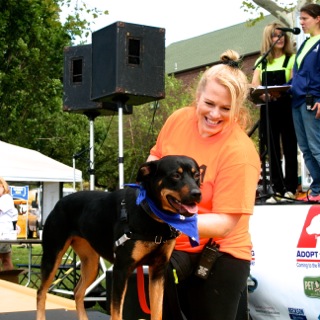
Pick me! An Adopt-a-Dog volunteer with a dog up for adoption at Puttin’ on the Dog in Greenwich. September 2015. Photo by A. Bogdanovic
At the local animal shelter where I volunteer, there is a comprehensive screening process in place to ensure successful matches. Prospective adopters must fill out and submit an application which includes specific information. References are required and checked before an adoption goes through. In the interest of full disclosure, specific information about each dog — including their background, age and compatibility with children and other animals — is also listed on the shelter’s website.
As Far As I’m Concerned…
Personally, I’ll never feel guilty about having a pet. In fact, with so many dogs and cats in need of a good home, the only thing I’ll ever feel badly about is that there’s no way to save them all.





 In Brief Legal Writing Services