Connecticut gets it right with animal advocacy law

This vintage typwriter is our featured image.

I don’t care if people are leaving Connecticut in droves. I love it here.

Eli, the In Brief Legal Writing Services mascot.
In Brief Legal Writing Services mascot Eli catching up on the latest news. Photo by Alexandra Bogdanovic

I mean honestly, what’s not to love? I’ve got Long Island Sound as a summertime playground. The greatest city in the world is just a short train ride away. If I want to go to the world’s coolest flea markets, they’re just a short car ride away. The possibilities are endless…

Having said all of that, I can’t honestly say I’m always proud of living here. The state economy is a disaster. State leadership under Gov. Dannel Malloy is a joke. The cost of living is obscene. The traffic is a nightmare. The infrastructure is crumbling.

Without going into too much detail, locally things aren’t much better.

Giving credit where it’s due

But I’ve got to give Connecticut lawmakers credit for one thing… and only one thing. They definitely got it right when they came up with a bill that allows advocates with an interest and/or expertise in animal law to provide courtroom assistance in animal cruelty and neglect cases. I also applaud for Malloy for having the courage to sign it into law.

As those of you who follow this blog faithfully know, I’ve been following developments and blogging about this particular law for some time. But because it is the first of its kind in the United States, “Desmond’s Law” is now attracting national attention.

Here’s where you can learn more:

Silencing the critics

Of course there are more than a few people who don’t like or don’t care about animals. And they probably don’t think this is a good idea. I am sure they think that, at a time when criminal courts are already overburdened, humans should come first.

Well’s here’s what I have to say about that. There is clear evidence that people who are prone to hurting animals are also prone towards engaging in violence against people. So anything that can be done to stop people from hurting animals, and ensuring that they’re punished to the fullest extent of the law when they do is fine with me.

Just saying…

For tenants with pets, fear of eviction is real

This vintage typwriter is our featured image.

As a little kid, I always wanted a pet. But I couldn’t have one. For one thing, I was horribly allergic to just about everything. If I patted or got licked by a dog, I had an asthma attack or broke out in hives. If I got scratched by a cat, I got an antihistamine reaction.

When I was 10, everything changed. We got a cat. Her name was Tiger. We got her from some friends that were moving to Saudi Arabia. She was supposed to live in our attic.

Eli, the In Brief Legal Writing Services mascot.
In Brief Legal Writing Services mascot Eli catching up on the latest news. Photo by Alexandra Bogdanovic

And she was only supposed to stay with us long enough to eradicate the mice that were running rampant in our apartment. She never caught a mouse. And I had her for 17 years.

It’s a good thing our landlord was cool with it. That’s not always the case.

The case of the selective ‘no pets policy’

In an article I came across the other day, the author answered an interesting question about an allegedly selective “no pets policy.” Specifically, the reader who submitted the question to The New York Times “Ask Real Estate” page, wanted to know if his (or her) new landlord could make good on a threat to evict him (or her). The alleged threat to do so  is based on a claim that the reader has a pet and is therefore in violation of his (or her) lease.

In this case, the reader lives in a “rent-stabilized apartment” in Brooklyn. His (or her) chihuahua has also lived there for the past 10 years.

Based on the information provided the short answer is “no.” You can read a more detailed explanation here.

In the same article, you can also learn why the new building owners are well within their rights to extend “pet friendly” leases to some new tenants, but not to others.

If there’s one thing scarier than getting kicked out of your home…

Being homeless is a frightening prospect for anyone. But if there’s one thing scarier for an animal lover, it’s being forced to choose between their home and their pet.

With that in mind, I’m including a list of resources below  that you can consult if you or someone you know is facing eviction. Please keep in mind that this material is provided strictly for informational purposes and is not legal advice.

Oswego food pantry caters to pets when owners can’t

This vintage typwriter is our featured image.

Now this is a good idea.

Not that’s it’s entirely unique — I have read about programs like this that have been implemented elsewhere before.

Alexandra Bogdanovic
Founder/owner of In Brief Legal Writing Services, Alexandra Bogdanovic. Photo by N. Bogdanovic

But I’ve got to hand it to the city of Oswego, N.Y., for coming up with a program that promotes responsible pet ownership and gives pet owners — and their charges — help when it’s needed most.

As reported on syracuse.com, the city has opened a food pantry that will “supply food and other necessities for pets when owners fall on difficult financial times.”

What sets this pet pantry apart?

Like other “pet pantries” I’ve read about, Oswego’s will rely on donations in order to help struggling pet owners. What sets it apart, in my opinion, is that it won’t be open to everyone. In order to qualify for assistance, pet owners must meet certain criteria.

To be eligible, the animal’s owner “must license their pet, including spaying or neutering of the animals.” The stipulation”will help better control the population of dogs and cats within the city,” according to Oswego Mayor Billy Barlow.

A ‘win-win situation’ for Oswego residents and their pets

Oswego Animal Control Officer Caroline Anderson, who also spoke to the media, agreed.

“We receive calls every week from people who can no longer keep their pets due to financial hardship,” she said. “If we can help companion animals remain in their homes where they are loved while also battling animal overpopulation, it’s a win-win.”

She added that companion animals that have been spayed or neutered are less likely to be surrendered because they have behavioral issues. They are also less like to stray and tend to be less aggressive than animals who haven’t been spayed or neutered.

The city first came up with programs that encouraged residents to spay, neuter and license their pets in 2016. Prior to creating the initiative, the average number of dog licenses issued by the city was less than 300 per year. In 2016 it issued more than 1,000.

If you live in Oswego…

If you live in Oswego and are struggling to provide for your pet, you can visit the pantry from 4 to 7 p.m. Thursdays, or make an appointment. Be sure to bring proof of need and proof that your pet is licensed, and spayed or neutered. Proof of a current rabies vaccine is also required.

Since the pet pantry will be stocked with donations, residents are also encouraged to drop off supplies,  including donated pet food, kitty litter, treats and flea/tick and heart worm preventives.

For more information, click here.

What you should know before flying with your pet

This vintage typwriter is our featured image.

OK, so here’s the deal. Eli gets car sick. Big time. So I’m really happy that we no longer have to make 300-plus mile drives from Virginia to Connecticut when we go on vacation. The longest road trips we take these days are the five-minute variety (that’s how long it takes to get from our house to the vet). Of course, he’s never happy about the destination (unless it’s the return trip) but that’s beside the point.

Eli, the In Brief Legal Writing Services mascot.
In Brief Legal Writing Services mascot Eli catching up on the latest news. Photo by Alexandra Bogdanovic

Returning to the topic at hand, I’m really, really, really happy I’ve never had to fly with him. And I hope I never will — because he hates his cat carrier and I doubt he would be happy in the cabin. I also doubt the passengers would be happy about having him in the cabin — listening babies cry on planes is bad enough — listening to a cat yowl the whole time would be torture.

Having said that, I will sprout wings and fly myself before I ever let anyone put Eli in the cargo hold of any aircraft. I don’t care how safe it supposedly is. I’ve read too many horror stories: pets escape, pets get hurt, and pets die. So to reiterate, no, thank you very much. I am not trusting any airline with my cat. Ever.

All you need to know about flying with Fido or Fluffy

In the interest of full disclosure, recent incidents aboard and following United Airlines flights have renewed, if not prompted, my personal vehemence on this topic. I mean a guy getting dragged off an overbooked flight is bad enough, but a giant rabbit’s death after flying on the airline is beyond words.

If anything good has come out of the latter, it’s that the incident grabbed plenty of headlines and generated public awareness about flying with pets.

You can read a really good story about your rights and options as a pet owner, the precautions you should take, and more here. While researching the topic, I also found a comprehensive and informative story that specifically pertains to the transportation of pets in aircraft cargo holds.

For brevity’s sake, I won’t rehash both articles. But suffice it to say that when it comes to the pets that one writer described as “precious cargo,” there’s no such thing as being overly informed, or being too careful.


How do you feel about flying with your pet? Share your opinion by voting in the following poll.

Life with a scary smart cat

This vintage typwriter is our featured image.

Official disclaimer: I am not a crazy cat lady. For one thing, I only have one cat. For another, I harbor no illusions that he is my “child,” and I do not treat him as such. Eli is definitely a cat.

Having said that, after living with him for more than nine years, I’ve come to the conclusion that he’s a genius. Seriously. This is one scary smart cat.

How do I know? Simple. Through personal observation, that’s how.

Anecdotal evidence

The other day for example, my 11-ish, (possibly) Birman/American Shorthair mix, was clearly looking for something when he came into the living room. He’d already eaten, but I knew there were some leftovers on his saucer and asked him if he wanted his “crumbs.” He promptly went to the spot where he usually eats, and didn’t find his saucer there. So he came and sat in front of me.

Eli, the In Brief Legal Writing Services mascot.
In Brief Legal Writing Services mascot Eli catching up on the latest news. Photo by Alexandra Bogdanovic

“Go on,” I told him. “Go and find your crumbs.” I didn’t point him in any particular direction. I didn’t tell him where they were. I simply told him to go find them. And he did.

In past posts, I’ve shared how I taught Eli to sit, so I won’t do so again. However, it’s interesting to note that while he does sit on command, he usually sits when he wants to. To me, this is a sure sign of intelligence. He thinks about it. If it’s in his best interest to plop his butt on the floor, that’s what he does. If he doesn’t feel like it, I can tell him to sit until the cows come home and it won’t make a bit of difference. Like I said, Eli is definitely a cat.

A few other things of interest:

  • If I tell Eli to go to his “number two person,” he goes to my mom.
  • If she tells him to find his “number one person,” he comes to me.
  • If I ask him to “show me out,” he goes to the door.
  • He comes when he’s called (if it suits him)

Room for debate

Of course, there’s always room for debate. And there’s been plenty of debate about just how intelligent our pets are. There’s been plenty of debate about how much they really understand, how much they remember and how much self-awareness they truly have.

Skeptics say that dogs and cats don’t really understand what we’re saying. They say that our pets only understand body language and tone of voice.

Personally I believe that our pets do understand those things. I know for a fact that they understand and appreciate the love and kindness that we share with them. As living, breathing creatures, they need those things.

Don’t we all?


Patrick Stewart story puts renewed emphasis on pit bull plight

This vintage typwriter is our featured image.

Many years ago, I saw Patrick Stewart star in a one-man theater production of A Christmas Carol. It was phenomenal. He was phenomenal. In fact, the performance moved me to tears…

And while that performance left no doubt that he is a fantastic actor, a recent news article left me with no doubt that he is much more. He is a fantastic human being.

Speaking as someone whose interactions with professional athletes made me cynical extremely cynical about celebrities, that’s saying a lot.

A man and his dog

The story to which I’m referring is the one about Stewart and Ginger. Ginger is a dog that Stewart and his wife are fostering. But she’s not just any dog. She’s a pit bull. And she’s clearly wormed her way into the actor’s heart.

As he tells the media: “I find that my relationship to the world and to the news every day in the papers and on the television has been changed by Ginger, because she has brought such a quality of patience and tolerance and fun into our lives, that it has, in a very short space of time, shifted my sense of where our world might be going. I literally find myself more optimistic than I was, and there is only Ginger to account for this. It is the impact of sharing my life for only seven or eight days with Ginger.”

Sadly, Stewart and his wife can’t adopt Ginger because U.K. laws make it all but impossible to bring her back there when they go home.

But what’s even more unsettling is the public reaction to the story.

Mixed reviews

There are few animals on the planet more polarizing than pit bulls. A lot of people love them, — no matter what. And a lot of people hate them — no matter what.

The story about Stewart and Ginger generated plenty of comments from people in both camps. The pro-pit bull people said Stewart’s relationship with Ginger just goes to show that these dogs are loyal, loving, and misunderstood. The anti-pit bull people said it doesn’t matter. As far as they’re concerned, all pit bulls are unpredictable, dangerous, killers.

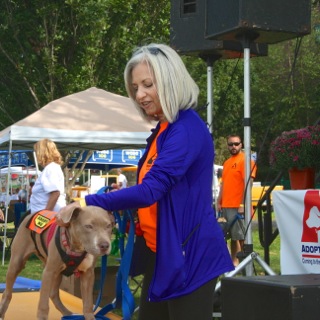
Take me home! A dog up for adoption and an Adopt-a-Dog volunteer. Photo by A. Bogdanovic
An Adopt-a-Dog volunteer with a dog up for adoption at the annual Puttin’ on the Dog show in Greenwich last September. Photo by A. Bogdanovic

Personally I love pit bulls. For the most part, I think they’re great dogs. But they’re also big, strong, dogs. So I wouldn’t necessarily feel comfortable having one in a household with small children or the elderly. I wouldn’t necessarily feel comfortable having one in a household with an inexperienced owner, either. In my opinion, these aren’t necessarily the best dogs for beginners.

All of that being stated, I’m not a big fan of so-called breed legislation. I think it’s overkill.

All we really need to do to help pit bulls is to actively promote responsible pet ownership and forums for honest, open dialogue without fear of recrimination, without name-calling and without hateful rhetoric.

It’s not asking a lot — but sadly it seems it’s asking too much.

Put a pet trust in place, just in case…

This vintage typwriter is our featured image.


Alexandra Bogdanovic
Founder/owner of In Brief Legal Writing Services, Alexandra Bogdanovic. Photo by N. Bogdanovic

Just call me old-school.

In addition to the calendars on my phone and iPad, I still keep a wall calendar in my home office. And to be honest, I’ve never been happier about turning the page.

Yes, March was a tough month here at In Brief Legal Writing Services. There was the anniversary of my father’s death; the loss of an old friend; and an unspeakable family tragedy that left us reeling. Collectively these incidents serve as a reminder that life — the wild and crazy and wonderful and wacky ride we’re all on while we’re here — is so incredibly short.

No one will live forever…

Collectively, it was also a reality check. A big one. After all no one likes being reminded about their own mortality. No one like to think about “what will happen if… or what will happen when….” No one really wants to think about putting their affairs in order. So it’s easy to procrastinate. You swear you’ll do it tomorrow and then tomorrow becomes the next day and the next thing you know it’s a week later… so you start all over.

But as any good lawyer will tell you, making your wishes known through a will or trust is essential. If done properly, the creation of a written, legally binding directive regarding the provisions for your loved ones in the event of permanent disability or death, will give everyone peace of mind.

True, there is a lot to consider. And depending on your circumstances, these considerations may go well beyond “who gets what.” For pet owners, a critical question that is often overlooked is, “what will happen to the animal(s).”

What is a pet trust?

A recent article on forbes.com addresses the issue. Specifically it discussed the importance of creating a “pet trust.”

Basically, a pet trust is a legal mechanism that allows an owner to have a certain amount of money set aside for the care of his or her animal(s) in the event of catastrophic illness/injury or death. It also allows the owner to designate someone to manage the trust and/or care for the animal(s). It can also detail how the animal’s or animals’ needs should be addressed.

Because pet trusts are governed by individual state laws, experts strongly recommend that pet owners discuss the matter with qualified attorneys during the estate planning process.

You can find information about individual state laws regarding pet trusts here.

Don’t leave your pet’s future to chance…

Each situation is different, so a pet trust might not be the right option for you. But unless you know beyond a shadow of a doubt that  friend or relative is willing to assume responsibility for your pet(s) in the event that you can no longer care for the animal(s), please, please, please make some sort of provisions for their care. Don’t leave it to chance.

Good news for Tennessee pet owners

This vintage typwriter is our featured image.

Once upon a time, there were limited options for the anguished owners of lost or missing pets. They could make posters, pin them on utility poles around town and hope. In a best-case scenario, the owner and their pet would be reunited after a Good Samaritan who had seen the poster found the cat or dog wandering in the neighborhood; or the stray ended up on someone’s doorstep and they called the number on its tag.

Eli, the In Brief Legal Writing Services mascot.
In Brief Legal Writing Services mascot Eli catching up on the latest news. Photo by Alexandra Bogdanovic

Luckily, advances in technology have changed all of that. Today many pets are microchipped, so it is easier to identify the animal and its owner. The Internet and social media platforms allow owners to notify huge numbers of people about their missing dog or cat. On the flip side, these tools also allow people who have found missing or lost pets to try to find their rightful owners.

Of course there are also all sorts of apps that have been specifically designed to ensure that lost dogs and cats are safely returned to their owners.

And now the Tennessee Department of Health has come up with another solution…

Web-based resource uses info from rabies tags

According to information on a Tennessee TV station’s website, the state health department has created a new tool that lets someone who has found a dog or cat locate its owner by using the information on the animal’s rabies tag.

“Those who find stray pets wearing TDH rabies tags can now use this tool on the TDH website to search for and identify the veterinarians who vaccinated the animals, who can then help with information to find the owners,” NewsChannel9 reports.

The only downside to this is that the health department isn’t the only agency that issues rabies tags. So even if a stray dog or cat has one, it could very well be from another agency.  In fact, that’s likely to be the case in Tennessee municipalities that have independent  licensing protocols.

If someone finds an animal with a rabies tag that’s issued by an agency other than the health department, however, they should call the phone number provided. That way, the issuing agency can help reunite the dog or cat with its family.

Beat the odds

According to the ASPCA, approximately 710,00 stray dogs and cats that end up in shelters are reunited with their owners. Of those, most are dogs (620,000). The agency estimates that only 90,000 stray cats in shelters are returned to their rightful owners.

American Humane Association estimates cited on petfinder.com indicate that millions of American dogs and cats are lost or stolen each year. Furthermore, “one in three pets will become lost at some point in their life.”

What can’t be quantified or qualified is the heartache pet owners experience when their dog or cat disappears… or the joy when they’re reunited.

Wolf-dogs, exotic cats and a firefighter who went beyond the call of duty

This vintage typwriter is our featured image.

A recent search for blog fodder resulted in so many cool articles, I thought I’d touch on all of them in one post rather than doing individual posts on each one. It’s more timely this way. Hopefully it will be just as informative.

Think carefully before you get a wolfdog, or a wolf-dog…

In an article on a Denver TV station’s website, Anica Padilla asked whether wolf-dogs (or wolfdogs) make good family pets.

Padilla’s article was a follow-up to a previous story about the confiscation of an alleged wolf hybrid by local authorities.

The general consensus reached by the experts cited in the latest story is that wolf hybrids (aka wolfdogs or wolf-dogs) are wonderful animals. But they doesn’t mean they’re good pets. Getting one as a family pet is definitely not a good idea.

Because they’re not (and never will be) completely tame, wolf hybrids have different needs than the average dog. They’re generally bigger, more energetic and have a different way of bonding with people.

There are other traits that make wolf hybrids harder to care for than a golden retriever, poodle or chihuahua. And depending on where you live, it may be illegal to have one.

I speak from experience. No, I never had a wolfdog. But as a reporter in Virginia, I spent more than my share of time writing about a woman who got in trouble with the state for breeding them. I don’t remember the specifics, but I do remember that it wasn’t much fun…

Now that’s no ordinary cat

Eli, the In Brief Legal Writing Services mascot.
In Brief Legal Writing Services mascot Eli catching up on the latest news. Photo by Alexandra Bogdanovic

On a similar note, some residents in a Paterson, New Jersey, neighborhood got quite a surprise when they spotted an unusual cat last week.

According to published reports, one witness described it as “something like a puma.” Another admitted that she didn’t know what kind of cat it was. She just knew it wasn’t an ordinary house cat.

As it turned out, she was right. It was definitely not an ordinary cat. It was an “exotic” cat called a Savannah. A Savannah is a cross between a domestic cat and an African wildcat called a serval.

Apparently this one escaped when its owner left the window open, but there was never any cause for alarm, one man told the media.

“The cops know him, everyone knows him,” the man said. “He’s always on the window. Real nice cat.”

Although they can get quite big, a local animal control officer told the media that ownership of Savannahs is legal in New Jersey “as long as they’re at least one percent domestic cat.”

Santa Monica’s bravest go above and beyond to save a dog

Since everyone can use something to make them smile — especially on a Monday — I just had to share this feel good story about some California firefighters.

According to media accounts, it took a truly heroic effort, but Santa Monica’s bravest were able to save a 10-year-old dog from certain death last week.

Nalu, a Bichon Frise/Shih Tzu mix belonging to a Santa Monica woman, lost consciousness and was in grave danger when firefighter Andrew Klein found him trapped inside her burning apartment.

The drama continued outside, where Klein and another firefighter administered emergency medical treatment. Working together, it reportedly took them 20 minutes to revive the little dog.

Within a couple of days after his ordeal, Nalu seemed to be well on the road to recovery.

“He was essentially dead, so to see him kissing people and walking around wagging his tail was definitely a good feeling,” Klein told the media.

“He’s very happy, and we’re very happy, too.”

For what it’s worth, so am I.

ASPCA vet offers insight into forensic veterinary science

This vintage typwriter is our featured image.
Alexandra Bogdanovic
Founder/owner of In Brief Legal Writing Services, Alexandra Bogdanovic. Photo by N. Bogdanovic

Sometimes, the most interesting information on the Internet can be found in another blog. So when I came across this Q&A on the American Society for the Prevention of Cruelty to Animals (ASPCA) website, I thought it was definitely worth sharing.

In the post, the ASPCA’s director of veterinary forensics shared a glimpse into the world of forensic veterinary science and explained its importance.

Animal CSI

I suppose you could think of it as crime scene investigation in animal cruelty and similar cases. Of course, that’s not what Dr. Rachel Touroo said. But I think it’s the best way to sum up what she does.

Here’s how she explained it.

“A Forensic Veterinarian’s job is to identify, collect and assess evidence from animals and their environment.  I use veterinary medical knowledge to put together the pieces of a puzzle to try to answer the questions asked of me by law enforcement and the courts in an unbiased and objective manner.”

Because her responsibilities are so varied, Touroo said she faces different challenges every day. One day she might be in the lab, the next day she might be in the field and the day after that she might be teaching.

“Frequently, I can also be found in my office drafting a forensic veterinary statement of my findings from the latest case, or in a classroom teaching third-year veterinary students how to look for signs of intentional cruelty,” Touroo said. “I’m also called upon to testify as an expert witness in cases across the country.”

Rewarding and important work

Touroo has a background in “animal welfare” and got involved in forensic veterinary science when she took a brand new job in Virginia. As she recalls, the state needed a veterinarian to “specifically address puppy mills and animal fighting in the state due to recent undercover puppy mill investigations and a highly publicized dog fighting case.”

“I had no idea what veterinary forensic sciences was when I accepted the position, but I quickly found myself immersed in the discipline,” Touroo said.

For Touroo, the work is rewarding and important. Citing the link between violence committed against animals with violence committed against people, Touroo says by doing her job properly she can not only prevent further cruelty to animals but keep people safe, too.

“While I love what I do, it is disheartening to know this job is necessary. I choose to focus on the impact we have and the positive outcomes. It’s incredibly uplifting to see an animal rescued from abuse and neglect find a loving home,” Touroo says. “If I had my way, I would put myself out of work, but until that time comes, I’m proud to be a voice for these victims.”