Burial Or Cremation? Planning For A Pet’s Death

This vintage typwriter is our featured image.

Last week, I did a post about a woman who had a memorial service for her dog. The question I asked at the time — which none of you felt compelled to answer — is whether it is appropriate, or whether it is over the top?

Today I’m posing a different, but very difficult question. What have you done when a pet has died in the past, or what do you plan to do after the death of the dog or cat you now have? Will you bury him (or her) under a shade tree in the backyard? Will you have him (or her) laid to rest in a pet cemetery? Will you request his or her ashes and keep them in an urn?

Speaking from personal experience

As many of you know, I had two cats before I adopted Eli (or more accurately, he adopted me). Tiger was the first. She was a small American shorthair/Siamese mix (as far as anyone could tell). She came into my life by chance when I was 10 — and we were only supposed to keep her until she got rid of the mice in our house. She died peacefully in my lap 17 years later, at the ripe old age of 20 — give or take.

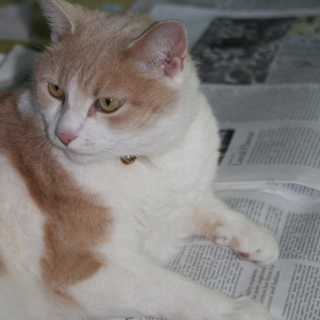
In Brief Legal Writing Services Mascot, Eli.
Eli The Cat. Photo By Alexandra Bogdanovic

We wrapped her in her favorite blanket and tucked her into a shoe box (yes, she really was that small when she passed) with some of her favorite toys. Then we dug a hole in her favorite spot in the backyard, and that’s where we laid her to rest in a quiet, but dignified manner.

That was more than 20 years ago. Today our old house and the backyard are gone — replaced by ugly, expensive townhouses that are way too big for the tiny little corner lot perched atop a hill. I hope Tiger’s ghost comes back to haunt anyone dumb enough to live there, but I guess only time will tell.

Anyhow, Heals — a big, fearless orange and white tabby with a penchant for finding trouble — came into my life several months after Tiger died. I hadn’t really been thinking about getting another cat at the time, but a friend found and couldn’t keep her. Thinking about her being sent to the local pound — and an unknown fate — broke my heart. So I agreed to take her.

Heals, named after my favorite NHL goalie, quickly became my best friend and constant companion through marriage, divorce, and multiple moves. In September 2007, approximately three months after she was diagnosed with an aggressive cancer, I took Heals to the vet and did the hardest, but best thing for her. Her suffering ended on a cold, steel table in a Virginia veterinarian’s office. She was approximately 14 years old, and I’d had for 11 years.

Today her ashes remain in a small but beautifully crafted wood box. I keep it on the bookshelves in my office, along with the copy of her paw print taken by the vet. I take comfort in knowing that — in a way she is still with me — and she is at peace.

A search for the perfect urn

Apparently I was lucky. Another woman, who detailed her experience after her dog’s death in a recent article was decidedly less satisfied with the plain, poorly crafted wooden urn that initially contained her dog’s remains.

“My dog was exquisite, a cantankerous bundle of love and light. She was not a default font. She also wasn’t a teardrop urn with paw prints running along the side. She wasn’t a box with a ceramic dog on top that looked nothing like her,” Jen A. Miller wrote on self.com. She wasn’t a cheap bracelet that held her ashes either. She was my dog, and she was dead. She deserved a better final resting place than that ugly box.”

Miller’s quest to find the perfect urn for her beloved pup finally ended when she found a couple that handcrafts wooden pet urns. The urns are sold on the online marketplace, etsy.com.

“When I opened the urn, it smelled like my grandfather’s woodshop. He loved Emily, who was a rambunctious terrier but would sit quietly and calmly on his lap when he asked during the last years of his life,” Miller wrote.

Pet cemeteries and other options…

In her article, Miller also delves into the inception and expansions of pet cemeteries in the United States. She also mentions taxidermy as another way to memorialize pets — although she doesn’t seem very fond of the idea. Truthfully, neither am I. In fact, I would never consider it.

Come to think of it, I would never consider tossing my dead pet in the dump, either. Or donating its body to science.

Frankly, both options make me cringe.

It’s Time To Start Thinking About Traveling With Your Pets This Summer

This vintage typwriter is our featured image.

As I write this, the view from my office is pretty depressing. It is a cold, damp, dreary spring day and the little taste of nice weather we got last week is nothing but a fading memory. But somewhere in the United States, the sun is shining and it is actually warm. And that can only mean one thing. Summer is almost here, and it is time to start thinking about traveling with your pet. So here are a few things to keep in mind.

Getting there

Flying in the lap of luxury

Not too long ago, I came across this really cool story about the new service for pets and their owners offered by the private jet charter company, VistaJet. It’s called VistaPet, and it sounds awesome — if you can afford it.

Because a lot of its members fly with their pets, the company says it created the program to facilitate the experience. Benefits include an inflight care package called a pochette. Basically this is a travel bag containing pet care items, such as bio-organic good, treats, toys, shampoos and wipes  for use during and after the flight.

On certain flights, pets can feast on gourmet meals featuring “prime cuts of fresh meat and fish.” For instance, the company says a “typical meal” could include  “an entrée of roast tenderloin, baked salmon or roast chicken served with steamed, roasted or raw vegetables and whole grain brown rice.”

The company also says its Cabin Hostesses will offer  “natural flower essences” that can be  mixed with your pet’s drinking water to help them relax during the flight.

But that’s not all. Through its partnership with The Dog House, VistaJet  also offers help for dogs that are afraid of flying. The month-long course, which is only available for pets belonging to members,  helps canine participants cope with common experiences while traveling such as the smell of jet fuel, the noise generated by jet engines, cabin air pressure and turbulence.

Speaking of turbulence, VistaJet cites regulations stipulating that pets — who can otherwise hangout on handmade “sleep mats” must be on their leashes or in carriers “during take-off, landing and any turbulence.” However, the rule does not apply to Guide Dogs.

If you recently hit a mega-lottery and you want to learn more about VistaJet and the VistaPet program, you can learn more here.  If you’re already a VistaJet member but you’ve never flown with your pet before, the company recommends calling customer service. Here’s the information you should have on hand:

  • Type of pet
  • Breed
  • Weight
  • Microchip info
  • (Your) passport details
  • Information about your pet’s most recent rabies vaccine
  • Information about your pet’s treatment (if any) for tapeworm and other parasites
  • Flight history

Pet friendly accommodations (for the rest of us)

VistaJet says it can also arrange pet-friendly accommodations and excursions. But even if — like me — you’re still in the, “I wish I could afford to charter a private jet” stage, you can still take your pet on vacation. All it takes is a little planning and a willingness to go someplace fairly close (so you don’t have to subject your pet to a cross-country drive or a near-death experience on a commercial flight). Amtrak train photo by Alexandra Bogdanovic

You can find plenty of information about pet-friendly hotels online. But here are a few things to keep in mind about this important aspect of your trip.

  1. Be sure to book a room on the first floor or near an exit if at all possible.
  2. Don’t leave your pet in the hotel room by itself unless absolutely necessary.
  3. If you do have to leave your pet in the room, take proper precautions
  4. If you are traveling with your dog, make sure it’s on a leash in common areas of the hotel
  5. Remember, courtesy goes a long way; make sure you cleanup any “accidents” in the room thoroughly and promptly.
  6. Be sure to take your pet to the vet and/or groomers before the trip to ensure they’re in good health and aren’t likely to shed all over the room.
  7. Follow applicable hotel rules about outdoor areas where your pets are allowed to relieve themselves.
  8. If you’re traveling with a cat, the bathroom (in your hotel room) is usually the best place to put the litter box.
  9. Don’t forget to let your pets get some exercise.
  10. Have fun!

And on that note, happy travels, everyone!

Is A Memorial Service For A Pet Appropriate?

This vintage typwriter is our featured image.

One of the biggest challenges when it comes to blogging three days per week is that there is a never-ending quest for interesting material. Fortunately I signed up for google alerts a long time, which makes things a little bit easier.

And thanks to google alerts, I recently came across a detailed article about a woman who arranged a full-blown memorial service — for her dog. Personally, I think it is completely over the top, if not a little bit crazy. But I will let you draw your own conclusions.

Rest in peace, Angus

As reported by the Associated Press, Suzanne Shaw organized the service for her rat terrier, Angus, when it became apparent that his time here was coming to an end. But it wasn’t easy. In fact, she couldn’t find a funeral home to accommodate her request until she contacted Michael Farrow at Mercadante Funeral Home & Chapel in Worcester, Massachusetts.

Eli, the In Brief Legal Writing Services mascot.
In Brief Legal Writing Services mascot Eli catching up on the latest news. Photo by Alexandra Bogdanovic

Farrow initially suggested an outdoor ceremony at a setting such as a park or Shaw’s backyard. But she made it clear that she had something else in mind — and Farrow decided to help.

“We talked and after a little while he started to work with me,” Shaw told the media.

In the end, Shaw, family, friends and even complete strangers honored Angus at a memorial service that included live bagpipe renditions of “Danny Boy,” and “Amazing Grace.” Rev. Bruce Plumley, who works at the funeral home, presided at the service.

“A pet is different for each and every one of us and holds a special place in our lives,” Plumley reportedly said during the service. “We often don’t realize until they are ill or gone just how much they had been loved and have given love to us. For many of us our pets are a treasure, and when we lose them, they have left a place that cannot be filled.”

Even so, the Humane Society of the United States (HSUS), says mourning the loss of the pet is a unique and personal experience that isn’t always understood.

“Some people still don’t understand how central animals can be in people’s lives, and a few may not get why you’re grieving over ‘just a pet,'” the HSUS says.

But Dr. Shaw (yes, she holds a Ph.D.) has a message for any “haters.”

“I didn’t have a Go Fund Me for this,” she told the media. “I’m paying for it and it’s what I want to do. They have their opinions, thank you, but they need to stay in their own lane. I do know that people might have a reaction to that but this is private … I’m burying my child, that’s what I’m doing.”

Tips for coping with the death of a pet

According to the HSUS, pet owners struggling to cope with the loss of a beloved companion animal may feel isolated and alone. However, the organization notes that there are “many forms of support.” These include counseling services, hotlines, local or online groups, books, videos, and magazine articles specifically devoted to helping people grieving the loss of a pet.

The HSUS also provides the following tips:

  • Acknowledge your grief and don’t be afraid to express it.
  • Don’t hesitate to reach out to others who can help.
  • Put your feelings in writing.
  • Ask your veterinarian or local humane society for information about local support groups or referrals to such groups.
  • Prepare a memorial for your pet.

You can learn more here.


Alexandra Bogdanovic is a paralegal and the owner/founder of In Brief Legal Writing Services. She is also an award-winning author and journalist whose interests include animal welfare and animal law. All opinions expressed in this forum are her own. Any information pertaining to legal matters is intended solely for general audiences and should not be regarded as legal advice.

Just In Time For National Pet Day: My Favorite Quotations About Animals

This vintage typwriter is our featured image.

In my line of work, it seems like I’m always scrambling to meet one deadline or another. And lately I’ve been so busy writing for everyone else that I’ve barely had time to write my own blog.  In fact, that’s why I’m not posting this article until now.

But as the saying goes — better late than never. Or… putting a positive spin on it, maybe I should say, the early bird gets the worm. After all, National Pet Day isn’t until Thursday (April 11). And in honor of that occasion, I’ve decided to follow PARADE magazine’s lead and share some of my favorite quotations about pets.

My top 10 favorite quotations about cats

  1. “Time spent with cats is never wasted.” — Sigmund Freud, Austrian Psychoanalyst
  2. “You cannot look at a sleeping cat and feel tense.” — Jane Pauley, American Journalist
  3. “I love cats because I enjoy my home; and little by little, they become its visible soul.” — Jean Cocteau, French Director

    Truth about cats.
    Truth. As seen at the cat adoption tent. Puttin’ on the Dog festival, 2017. Photo by Alexandra Bogdanovic
  4. “I believe cats to be spirits come to earth. A cat, I am sure, could walk on a cloud without coming through.” — Jules Verne, French Author
  5. “Indeed, there is nothing on this earth more peaceful than a sleeping, purring cat.” Jonathon Scott Payne, American Author
  6. “Recruit your pet as a study partner. Cats are usually more than happy to do this—in fact, you may have trouble keeping them off keyboards and books—and dogs will often serve as well. Few things are more relaxing than having a warm, furry creature next to you as you study.” — Stefanie Weisman, American Academic Expert and Author
  7. Dogs come when they’re called; cats take a message and get back to you later.” —Professor Mary Bly
  8. “Books. Cats. Life is Good.” — Writer and artist Edward Gorey
  9. A cat has absolute emotional honesty: human beings, for one reason or another, may hide their feelings, but a cat does not.” — Writer Ernest Hemingway
  10. “Authors like cats because they are such quiet, lovable, wise creatures, and cats like authors for the same reasons.” — Author Robertson Davies

My top 10 favorite quotations about dogs

  1. “There’s a saying. If you want someone to love you forever, buy a dog, feed it and keep it around.” — Dick Dale, American Musician
  2. “A dog is the only thing on earth that loves you more than you love yourself.” — Josh Billings, American Comedian
  3. “Dogs are our link to paradise. They don’t know evil or jealousy or discontent.” — Milan Kundera, Czech Writer
  4. “Dogs don’t make judgments about physical appearance or abilities, and they don’t care how big your house is or what you do for a living. They care about the quality of your character and your capacity to love.” — Elizabeth Eiler, Reiki Master and Author
  5. “Dogs are the most amazing creatures; they give unconditional love.” — Gilda Radner, American Actor/Comedian
  6. “The average dog is a nicer person than the average person.” — Andy Rooney, American Journalist
  7. “Dogs laugh, but they laugh with their tails.” — Max Eastman, American Author
  8. “You know, a dog can snap you out of any kind of bad mood that you’re in faster than you can think of.” Jill Abramson, American Newspaper Editor
  9. “If I could be half the person my dog is, I’d be twice the human I am.” — Charles Yu, Taiwanese-American Author
  10. “There is no psychiatrist in the world like a puppy licking your face.” — Ben Williams, American Jazz Musician

My top 10 favorite quotations about pets

  1. “Sometimes losing a pet is more painful than losing a human because in the case of the pet, you were not pretending to love it.” — Amy Sedaris, American Author
  2. “Pets reflect you like mirrors. When you are happy, you can see your dog smiling and when you are sad, your cat cries.” — Munia Khan, Bangladeshi Poet
  3. “Sometimes, your pet picks you.” — Julie Wenzel, American Author
  4. “Pets understand humans better than humans do.” Ruchi Prabhu, Indian Author
  5. “Over the years I’ve come to appreciate how animals enter our lives prepared to teach and far from being burdened by an inability to speak they have many different ways to communicate. It is up to us to listen more than hear, to look into more than past.” — Nick Trout, British-Born Veterinarian and Author

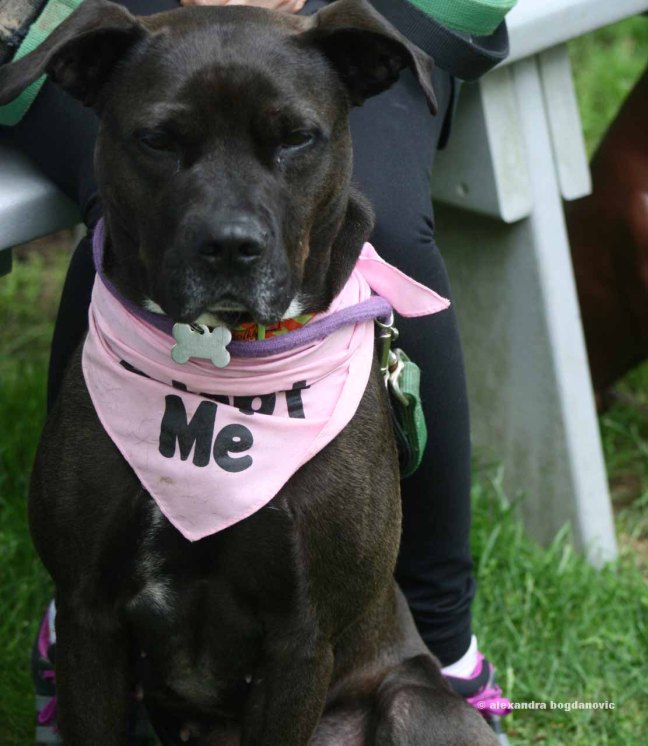
    A dog available for adoption at Adopt-a-Dog. Photo by Alexandra Bogdanovic
  6. “The greatness of a nation and its moral progress can be judged by the way its animals are treated.” — Mahatma Gandhi, Indian Social Activist
  7. “Pets have more love and compassion in them than most humans.” — Robert Wagner, American Actor
  8. “You cannot share your life with a dog…or a cat, and not know perfectly well that animals have personalities and minds and feelings.” — Jane Goodall, British Anthropologist
  9. “Until one has loved an animal, a part of one’s soul remains unawakened.” — Anatole France, French Poet
  10. “If having a soul means being able to feel love and loyalty and gratitude, then animals are better off than a lot of humans.”  — James Herriot, British Writer

What about you? Are there any quotations about dogs, cats, or any pets that you like? If so, feel free to share them in the comments below.

The Best Anti-Aging Product… Is A Pet

This vintage typwriter is our featured image.

A long, long time ago…. back in the 16th century, the world-renowned explorer Juan Ponce de Leon set out to find the Fountain of Youth. He found Florida.

Since then, our ongoing quest for eternal youth through fitness, nutrition, serums and potions fueled the creation of multi-billion dollar global businesses — and yielded mixed results.

Now I won’t deny that a healthy lifestyle is key to combating the aging process. But if you’ve been looking for a “miracle in a bottle,” you can forget about it. If you are concerned about growing old gracefully all you need… is a pet.

Survey reveals importance of companion animals as we grow older

According to a recent article on webmd.com, the extrapolated data from latest National Poll on Healthy Aging indicates that more than half of American adults age 50 to 80 have a pet — and most of them say pet ownership has significant benefits.

There was too much excitement at Puttin' on the Dog for these little kittens!
We’re pooped! Hurricane Harvey kittens at Puttin’ on the Dog, 2017. Photo by Alexandra Bogdanovic

Specifically:

  • 88 percent of survey participants said their pet helps them enjoy life
  • 86 percent said their pet makes them feel loved
  • 79 percent said their pet reduces their stress
  • 73 percent said owning a pet gives them a sense of purpose
  • 65 percent said it helped them connect with other people
  • 62 percent said it helped them stick to a routine

Furthermore, more than 60 percent of all survey participants said their pet helps them stay physically active, with nearly 80 percent of dog owners saying that is the case. Finally, nearly 60 percent of participants said “their pets help them cope with the physical and emotional symptoms of aging,” and more than 30 percent said having a pet “their pets take their mind off their pain.”

Then again…

However, not all of the survey participants have or want pets; and some of those who do voiced significant concern about pet ownership.

  • Roughly 42 percent of survey participants who don’t have pets said they “didn’t want to be tied down by the responsibility of owning an animal.”
  • 23 percent said they didn’t want a pet because of the associated expenses.
  • 20 percent said they “didn’t have time.”

Of those who have pets, more than 50 percent said pet ownership complicates travel and similar activities, and “one in five said pet care puts a strain on their budget.” Alarmingly, 6 percent reported falls or injuries caused by their pets.

“The vast majority of our respondents did experience positive effects on their health and well-being from their pets, but we did verify there are some less common negative effects associated with having pets as well,” said Mary Janevic, an assistant research scientist with the University of Michigan School of Public Health.

An important note about methodology

The findings are based on responses from a “nationally representative sample” of 2,051 adults, aged 50 to 80.  The University of Michigan’s Institute for Healthcare Policy and Innovation conducted the survey; and  the AARP and Michigan Medicine, the University of Michigan’s academic medical center sponsored it.

Tragic Discovery Made In Virginia Beach Cat Hoarding Case

This vintage typwriter is our featured image.

This truly breaks my heart. There’s no other way to put it.

Last month, authorities that tried to execute a search warrant in connection with alleged cat hoarding at a woman’s Virginia Beach home made a horrific discovery. According to published reports, they found more than 100 dead cats in her freezer.

Alexandra Bogdanovic
Founder/owner of In Brief Legal Writing Services, Alexandra Bogdanovic. Photo by N. Bogdanovic

“Our hearts go out to the animals inside the home,” Meghan Conti, a Virginia Beach Animal Control official, told the media. “But they also go out to the resident. This isn’t just your everyday owner — this is someone who really has some concerning problems.”

Authorities, who were forced to wear masks to combat the overwhelming odor of cat urine, also found more than 20 living cats at the residence. However, there is no guarantee that they can be re-homed. Their fate is uncertain because the surviving felines seemed “wild and untamed,” leading Conti to believe that they may be feral.

Media accounts also indicate that this was not the owner’s first brush with the law. Four years ago, she was convicted of illegally entering an animal control office to release cats. The media did not provide any insight into her punishment — if any — in that case.

Based on published reports, it is also unknown if she will be prosecuted in connection with this case.

Virginia animal care and cruelty laws

However, Virginia Code Section 3.2-6503(A), which regulates the care of companion animals by their owners, stipulates that each owner must provide adequate food, water and clean shelter. Owners must also make sure that their pets get adequate exercise, sufficient care, treatment, and transportation; appropriate veterinary care; and sufficient space in the primary enclosure for the particular type of animal depending upon its age, size, species, and weight.

Under Virginia Code Section 3.2-6503(B), failure to comply with any or all of these provisions is a Class 4 misdemeanor, punishable by a maximum fine of $250. A second or subsequent violation for failing to provide adequate food, water, clean shelter or veterinary care is a Class 2 misdemeanor punishable upon conviction by up to six months in jail, a maximum fine of $1,000, or both. A second or subsequent violation for failing to ensure that their pet gets sufficient exercise; provide sufficient space in the primary enclosure; or to provide sufficient care, treatment and transportation is a Class 3 misdemeanor. As such, it is punishable upon conviction by a maximum fine of $500.

Furthermore, Virginia Code Section 3.2-6570(A), pertaining to animal cruelty stipulates in pertinent part that someone is guilty of the offense if: they deprived any animal of necessary food, drink, shelter or emergency veterinary treatment; or if they deliberately inflict “inhumane injury or pain not connected with bona fide scientific or medical experimentation” on any animal. The offense is a Class 1 misdemeanor, punishable upon conviction by up to one year in jail, a maximum fine of $2,500, or both.

It is easy to pass judgment and almost impossible to understand…

For most of us, it is easy to pass judgment based on shocking news accounts of animal hoarding. And it is almost impossible to understand why anyone engages in this activity.

According to the Anxiety and Depression Association of America (ADAA), animal hoarding is generally defined as, “the compulsive need to collect and own animals for the sake of caring for them that results in accidental or unintentional neglect or abuse.”

The ADAA also notes that several factors contribute to animal hoarding. These typically include:

  • poor decision-making and organizational skills
  • intense emotions,
  • strong attachment to animals
  • the overwhelming desire to “save” animals

“All hoarding leads to a sad outcome, but the saddest of all is the animals who die in an environment of neglect, filth, and stressful overcrowding as innocent prisoners of well-intentioned but misguided love,” the ADAA says. “These animals are innocent victims, enduring tragic lives with people who are equally trapped.”

Statistics provided by the ADAA indicate that:

  • 3,500 animal hoarders come to the attention of authorities each year.
  • Hoarding affects at least 250,000 animals each year.
  • The vast majority of animal hoarders have diseased, dying, or dead animals on the premises.
  • Most animal hoarders who come to the attention of authorities are single, widowed, or divorced women (although community-sampling studies find an equal ratio of males to females).
  • Up to 40 percent of people who hoard things also hoard animals.
  • All hoarders relapse without treatment

Iowa Takes Significant Step Towards Animal Cruelty Crackdown

This vintage typwriter is our featured image.

Happy Monday, everyone. In the interest of starting the workweek on a positive note, I wanted to share some good news. So here goes…

Alexandra Bogdanovic
Founder/owner of In Brief Legal Writing Services, Alexandra Bogdanovic. Photo by N. Bogdanovic

Last week, Iowa legislators took an important step towards strengthening the state’s animal cruelty laws. Specifically, the House unanimously passed a bill calling for tougher sanctions for people convicted of abusing, neglecting, torturing or abandoning animals.

As it now stands the bill defines animal abuse as  failure to provide an animal with access to food, clean water, clean shelter, veterinary care and adequate grooming.

The punishment for a first offense would be two years in prison. A second offense would be a felony carrying a maximum punishment of five years in prison.

Animal torture is defined as the intentional infliction of harm that results in prolonged suffering or death. The maximum sentence upon conviction would also be five years in prison.

Finally, the punishment upon conviction for animal abandonment would be 30 days in jail; a year in jail if the animal is hurt; or two years if it seriously hurt.

The bill, which excludes some wild animals and farm animals is now headed to the state Senate.

Why is this so important?

For years, critics have regarded Iowa as one of the worst puppy mill states.  Today, Iowa reportedly has “thousands of dogs in more than 200 large-scale breeding operations.”

In fact, news about the passage of the bill came just two days after the Associated Press reported that he owner of a “northern Iowa dog breeding operation” had been charged with 17 counts of animal neglect.

The AP cites Worth County court records indicating that authorities allegedly found Samoyed dogs in “inhumane conditions” when officials  on Nov. 12 and on other occasions.

The records also indicated 17 dogs had “fur matted by feces, skin conditions leading to fur loss, painful wounds, intestinal parasites and other maladies.” Furthermore, they detailed the conditions in the kennels, where the dogs allegedly went without food and their only source of water were containers packed with ice.

According to the AP, the accused owner has “denied any wrongdoing and told officials she didn’t think the dogs needed additional care.”

On top of which, Iowa ranked 48th in a 2018 Animal Protection Laws Ranking Report issued by the Animal Legal Defense Fund (ALDF). Only Mississippi and Kentucky fared worse in the report, which was based on 19 aspects of animal protection.

Something to aim for

In the same report, Illinois, Oregon, Maine, Colorado and Massachusetts ranked as the top five states for animal protection. Remarkably, Illinois claimed the number one ranking for the 11th consecutive year. Oregon, Maine and Colorado also kept their top rankings.

“Every year, we see more states enacting broader legal protections for animals,” ALDF’s Executive Director Stephen Wells said. “We have a long way to go until animals are fully protected under the legal system as they deserve, especially in the lowest-ranked states.…But as this year’s Ranking Report shows, step by step we as a nation are improving how the law treats animals.”


When It Comes To U.S. Pet Stats, Consider The Source

This vintage typwriter is our featured image.

Here’s the thing about “facts.” They can be manipulated — and it happens all of the time. An individual or group with a specific agenda either does a study or commissions one that will prove their point or advance their cause. And the sad thing is that most Americans take these “facts” on face value.

Of course there are always exceptions to the rule. Call me a cynic, a skeptic, or just an ex-journalist. But I don’t take anything on face value — even U.S. pet statistics. So I wasn’t all that surprised when I recently came across an interesting article questioning the validity of the data.

When the numbers don’t add up

The Washington Post article compared and contrasted U.S. pet ownership data for 2016 published by the American Pet Products Association (APPA) and the American Veterinary Medical Association (AVMA).

The APPA indicated that 68 percent of U.S. households owned some sort of pet that year, and that dogs (90 million) and cats (94 million) accounted for most of the pets. On the other hand, the AVMA reported only 57 percent of households had pets at the end of that year, and that the “overall pet population” during the time in question included included 77 million dogs and 58 million cats.

So what’s the big deal? Well, if you think about it, a lot of people base business and personal decisions on these statistics. As the Washington Post article notes, information about pet ownership and the types of people have is can potentially influence actions taken by pet companies, veterinarians, veterinary schools, not to mention millions of others.

Consequently, the use of vastly disparate data is bothersome to Andrew Rowan, a former chief executive of the Humane Society International and a longtime scholar of pet demographics. As he told the Post: “You can’t really make public policy decisions in the absence of data.”

There was too much excitement at Puttin' on the Dog for these little kittens!
We’re pooped! Hurricane Harvey kittens at Puttin’ on the Dog, 2017. Photo by Alexandra Bogdanovic

The Post article also suggests that more reliable data is available. Specifically, it cites the Simmons National Consumer Study, which conducts annual household surveys.  For 2018, it found that  53 percent of U.S. households owned pets, including at least 77 million dogs and 54 million cats.

Another source of pet ownership identified in the Post story is U.S. Census Bureau’s American Housing Survey, which asked about pet ownership in 2013 and 2017. According to the Post, it “most recently reported that 49 percent of households included pets.”

How the Internet influences the outcome

In addition to examining the discrepancies in the APPA and AVMA data, the Post story addresses how these organizations came up with these numbers. Apparently the use of “opt-in” online surveys plays a significant part in the outcome — even though some experts have questioned their accuracy and recommended against their use.

Within this context, it is interesting to note that the APPA and AVMA  both relied on traditional mailed surveys until fairly recently, and the results changed significantly once they switched to Internet surveys.

An APPA representative quoted in the Post story confirmed that the organization “believes the switch from mail to web was responsible for the large increase,” and said “researchers sought to combat bias by tracking which types of people completed the survey.”

An AVMA representative also told the Post that its most recent report is “more sophisticated” than prior studies “because it targeted non-pet owners and weighted better for factors like geography and gender.”

An exercise in critical thinking

With all of that being stated, here’s how I evaluate any given set of “facts:”

  1. I consider who is presenting the “facts”
  2. I consider their agenda or objective
  3. I draw my own conclusions

It’s really not that hard. It’s simply an exercise in critical thinking.

New Dating App Caters To Dog People: What’s Not To Love?

This vintage typwriter is our featured image.

From what I’ve heard, dating in the digital world isn’t easy. For one thing, you never know who you’re really talking to online. It could be your soul mate. Or it could be a serial killer. You just never know.

Personally, I’m in no hurry to find out. For one thing, I am happily divorced after a colossal betrayal by the person I believed to be the love of my life (and I met him back in the good old days — before the Internet was even a thing). Secondly, I am way too busy to be bothered. And thirdly, I have a zero-tolerance policy for BS or stupidity of any kind. So you get the picture.

A dating app for dog people

Anyhow, I digress. The point of all of this is that I just came across a really cool article in my weekly quest for blog fodder. As reported by Narcity, a (relatively) new dating app called Dig App is about to launch in Miami.

Adopt-a-Dog volunteer with her charge at Puttin' on the Dog.
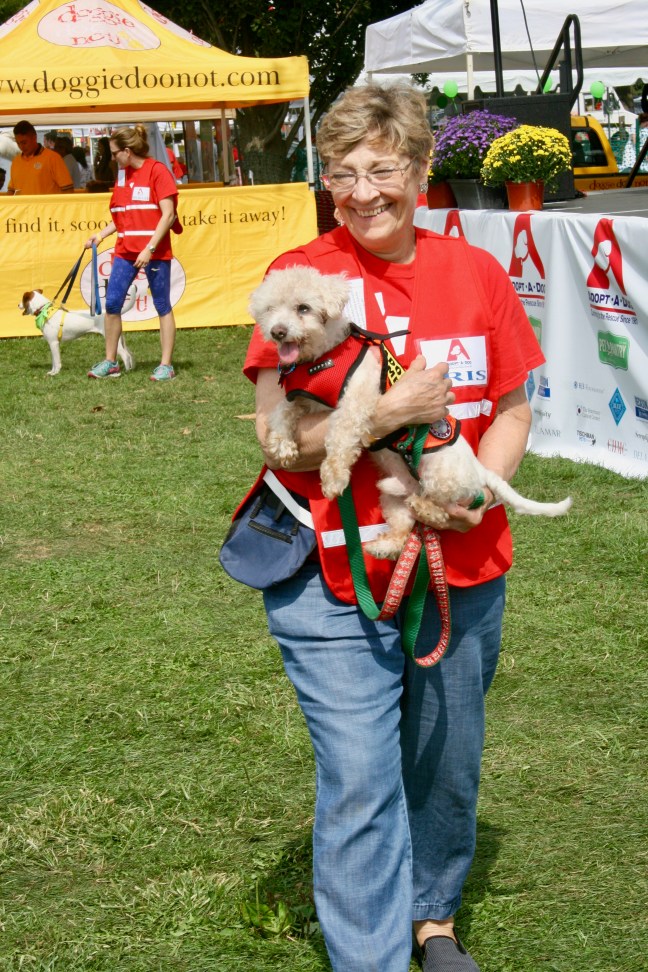
Take me home! A senior dog steals the show in the first parade at the Puttin’ on the Dog festival. Photo by Alexandra Bogdanovic

So what’s the big deal? How is it different from all of the other dating apps out there? Well, this one specifically caters to dog people. That’s right. If you love dogs, you can use this app to connect with other like-minded singles.  As for the rest… Well, I’ll just skip the predictable puns about puppy love.

Details, details…

Created by a New Orleans-based company, Dig App is also available in New York City and other major markets including San Francisco, Boston, Chicago and Los Angeles.

According to its website, Dig will soon be launching in Atlanta, Nashville and Denver, too.

Even though they created the app because they were “being duped by fake dog lovers too many times,” co-founders Leigh and Casey Isaacson stress that the app isn’t limited to people who have dogs. You just have to like them — and be honest about it.

“[Leigh and Casey] created Dig because being a dog lover isn’t just another box to check off on a long list of your attributes,” Dig’s website states. “It’s a way of life for a growing number of single people, and it’s crucial to know that up front when dating.”

Consequently, Dig allows users to connect with other singles who enjoy spending time with dogs even if they don’t have one, or search for dogs according to size. The app also allows users to “help plan dog friendly dates, learn tips and tricks, and connect dog lovers with local dog friendly businesses.”

Users must be at least 18 and those that have dog businesses are not allowed to promote them on their profiles. However, there are other options for such promotions on the app.

You can get Dig from the Apple Store or Google Play. You can also learn more here.

In my humble opinion

I must confess, this sounds intriguing, especially since I do love dogs. If I weren’t so busy (and so cynical), I may even be tempted to check it out. In the meantime, Eli and I have a very important question. Where’s the dating app for cat lovers?

Just a thought…

There Is No Punishment Harsh Enough In Kitten Drowning Case

This vintage typwriter is our featured image.

As many of you know I was a police reporter for more than 20 years. In my career I covered everything from the aftermath of 9/11 in the New York City suburbs to homicides, courthouse shootings and airplane crashes. So I’ve seen a lot of nasty stuff. To this day, I can’t forget those things. I never will.

And to this day, nothing makes my blood boil more than an animal cruelty case. As far as I’m concerned, there is no punishment harsh enough for anyone who deliberately hurts or kills an animal. I mean think about it. If someone is sick and twisted enough to hurt or kill an animal, they probably won’t think twice about hurting or killing a human being.

Alleged kitten killer arrested

So if what I recently about Junsong Zhang, 21, of Queens, New York, is actually true, they should just lock him up and get rid of the key. Now.

According to published reports, Zhang killed two kittens on January 22, 2019. He allegedly did so by putting them in a cage, putting the cage in the bathtub, turning on the tap, and leaving for nearly an hour.

As Zhang reportedly told authorities, the animals were “lying in the water and not breathing.” So he allegedly put them in a plastic bag and took them to the Animal Medical Center in Manhattan.

Eli, the In Brief Legal Writing Services mascot.
In Brief Legal Writing Services mascot Eli catching up on the latest news. Photo by Alexandra Bogdanovic

In a criminal complaint cited by the New York Daily News, a forensic veterinarian said both kittens were “healthy, and that one kitten had torn nails on its right front paw, left front paw and right back paw.”

A postmortem assessment confirmed that the kittens had drowned. They were just seven months old.

New York City prosecutors told the media that Zhang intended to “cause extreme physical pain” to the animals. As a result, he was arrested earlier this month and charged with two counts of aggravated animal cruelty.

Zhang was reportedly “released under supervision” and ordered to surrender his passport pending future court appearances.

Possible punishment upon conviction

Under Section 353-a of New York’s Agriculture and Markets Law, someone is guilty of aggravated cruelty to animals when he or she, “intentionally kills or intentionally causes serious physical injury to a companion animal with aggravated cruelty.” In this context, aggravated cruelty is defined as conduct that: “(i) is intended to cause extreme physical pain;  or (ii) is done or carried out in an especially depraved or sadistic manner.”

Aggravated cruelty to animals is a felony in New York. The maximum punishment upon conviction is two years in prison.

And as far as I’m concerned, that’s just not good enough.