Yes, pot really can kill your pet

This vintage typwriter is our featured image.

As long as it exists, it will cause controversy. Is it a gateway drug or a cure for all that ails us? Should it be legalized — or not?

One thing is for sure. Marijuana might not kill you. But it can kill your dog.

Finn’s brush with death

According to published reports, Finn, a boxer-blue heeler mix almost died after eating a cookie that had marijuana in it.

Apparently the pup inadvertently got a hold of the pot-laced pastry at a party a few months back. His owner, Candace Braden, found him in obvious medical distress the next morning and rushed him to the vet.

“I was pretty much having a nervous breakdown,” Braden told the media. “It’s really scary to see your baby like that.”

Fortunately, the vets were able to induce vomiting, and Finn made a full recovery.

Large doses are lethal, fatalities are rare

According to media accounts, large amounts of marijuana are lethal for dogs because of the way the drug affects them.

Eli, the In Brief Legal Writing Services mascot.
In Brief Legal Writing Services mascot Eli catching up on the latest news. Photo by Alexandra Bogdanovic

“The lethargy and fogginess that might make a pot brownie fun for a human can render a dog incapable of basic functions. In rare cases … a dog can undergo gradual paralysis and die,” according to published reports.

Even so, fatalities are uncommon. And in some cases, when it is administered properly, medical marijuana can help dogs and cats that are suffering from certain ailments.

However, and this is important, the medical marijuana created and prescribed by some vets has a different chemical composition than “ordinary” marijuana. Specifically, it has less THC, the agent that causes the “high” in both people and animals.

Better safe than sorry

As we all know, medical marijuana can help people, too.

But the bottom line is that our pets often have a knack for getting into trouble. Hell, my cat, Healsie, ate rubber snake once. And Eli would eat an entire spider plant if I let him. So I guess it’s a good thing we don’t live in Colorado.

According to published reports, “veterinarians at Fort Collins Veterinary Emergency and Rehabilitation, about 60 miles north of Denver, see between five and 10 cases per week of marijuana toxicity in dogs.”

The Colorado media also “cited a 2012 study in which researchers found a positive correlation between marijuana toxicity cases in dogs and medical marijuana licenses in the state.”

No matter where you live, if you have pets, please safeguard all of your medication. And if you choose to use marijuana for other reasons, make sure you keep it somewhere out of Fluffy or Fido’s reach.

After all, it’s better to be safe than sorry.

For some New Yorkers a dog or cat just won’t do

This vintage typwriter is our featured image.

For some reason, some New Yorkers insist on taking pet ownership to another level. A dog or cat just won’t do. Gerbils, hamsters, ferrets or birds don’t cut it, either.

These New Yorkers only go for unusual pets — whether it’s illegal to have them or not. And in most cases, it is.

Life in the concrete jungle

According to a recent New York Post article, the city has responded to nearly 400 exotic animal complaints since January 2016.

Eli, the In Brief Legal Writing Services mascot.
In Brief Legal Writing Services mascot Eli catching up on the latest news. Photo by Alexandra Bogdanovic

Most of the complaints (more than 150) were about people keeping roosters in the concrete jungle. There were 36 complaints about snakes and 30 about turtles.

In one case, a Queens man came to the city’s attention after his neighbors reported that he had roosters.

The man, Mark Singh, denies he did anything wrong, however.

“You feed chickens and they give you eggs. So why not keep chickens?” he wondered. “ One of my neighbors nursed baby raccoons for two years — and they have rabies,” Singh told the Post.

In another case, city health inspectors responded to a report of a Staten Island man who was allegedly keeping venomous snakes as pets. The accused, Gregory Johnson, said he had a permit to keep them.

“The city’s Health Code forbids keeping any animals that are “naturally inclined and capable of inflicting harm” on humans. Rooster keepers face fines of $1,000,” the Post reported.

Exotic pet complaints — by the numbers

According to the Post, the number of reports about illegal pets made to a New York City tip line made from January 1, 2016 to date is roughly the same as those made during the same time period for 2015-2016.

However, there have been more complaints in the Bronx and Queens, and fewer complaints in Manhattan, Brooklyn and Staten Island.

In addition to banning potentially harmful animals, the city’s Health Code identifies illegal pets as “any native or exotic wildlife whose possession or sale is prohibited because they are designated as protected or endangered pursuant to any federal, state or local law, regulation, or rule.”

Any animal classified as an illegal pet by the New York Health Department “cannot be sold, given, received, kept, harbored or exhibited in New York City” unless they are kept in an approved facility.

Some of the animals that can be kept as pets include dogs, cats, gerbils, hamsters, guinea pigs, domesticated rabbits and fowl or small birds such as parakeets, parrots, canaries and finches. However, it is only legal to keep these animals as pets as long as “possession of the animal is not otherwise prohibited by law, including federal, state and local laws regulating domestic animals and livestock or protecting wildlife and endangered species.”

For more information about illegal pets in New York city, click here.

Who says cops don’t have a sense of humor?

This vintage typwriter is our featured image.

A pig dressed like a cop. Now there’s something you don’t see every day. Even in New York City.

So it shouldn’t come as a surprise that a recent sighting of one generated a lot of attention. It even made the news.

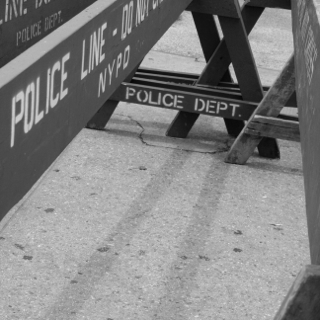
Black and white photograph of New York Police Department barriers taken by Alexandra Bogdanovic
NYPD barriers. Photo by Alexandra Bogdanovic

As News 4 reported,  the little pig spotted by the Apple Store in Soho “belonged to a young woman,” and its outfit “seemed fit for purpose, with utility pockets and identifying badge.”

Apparently some bystanders — including some of New York’s Finest, — enjoyed meeting the little guy.

Witnesses told the media that  the NYPD officers “were amused by the curly-tailed member of the force.”

“They were all laughing,” one witness said.

“There were lots of people entertained by this little piggy.”

The letter of the law

It’s a good thing the officers had a sense of humor. After all,  having a pet pig is against the law in New York City. It’s also illegal to keep sheep, goats and “most farm animals” as pets in Gotham. City regulations also prohibit the ownership of:

  • Venomous spiders including but not limited to tarantulas and black widows
  • Various monkeys and apes
  • Large/predatory birds
  • Various large and venomous snakes including vipers
  • Various types of lizards
  • Various reptiles and amphibians
  • Wild/predatory dogs and cats
  • Squirrels, racoon and bats
  • Venomous insects

In other words, you can’t keep a wild, exotic, or potentially dangerous animal as a pet in New York City. And with good reason.

Some people just don’t get it…

But some New Yorkers just don’t get it. Or if they do, they don’t care.

According to published reports, the city’s Health Department issued nearly 300 tickets to offenders in one five-year period.

Administrative judges preside in cases when New Yorkers accused of keeping banned pets choose to fight the tickets. And many do. But losing can be costly, with fines ranging from a few hundred bucks to a few grand.

Of course, we all have choices. But as far as I’m concerned, it’s always better to be safe than sorry.

ASPCA vet offers insight into forensic veterinary science

This vintage typwriter is our featured image.
Alexandra Bogdanovic
Founder/owner of In Brief Legal Writing Services, Alexandra Bogdanovic. Photo by N. Bogdanovic

Sometimes, the most interesting information on the Internet can be found in another blog. So when I came across this Q&A on the American Society for the Prevention of Cruelty to Animals (ASPCA) website, I thought it was definitely worth sharing.

In the post, the ASPCA’s director of veterinary forensics shared a glimpse into the world of forensic veterinary science and explained its importance.

Animal CSI

I suppose you could think of it as crime scene investigation in animal cruelty and similar cases. Of course, that’s not what Dr. Rachel Touroo said. But I think it’s the best way to sum up what she does.

Here’s how she explained it.

“A Forensic Veterinarian’s job is to identify, collect and assess evidence from animals and their environment.  I use veterinary medical knowledge to put together the pieces of a puzzle to try to answer the questions asked of me by law enforcement and the courts in an unbiased and objective manner.”

Because her responsibilities are so varied, Touroo said she faces different challenges every day. One day she might be in the lab, the next day she might be in the field and the day after that she might be teaching.

“Frequently, I can also be found in my office drafting a forensic veterinary statement of my findings from the latest case, or in a classroom teaching third-year veterinary students how to look for signs of intentional cruelty,” Touroo said. “I’m also called upon to testify as an expert witness in cases across the country.”

Rewarding and important work

Touroo has a background in “animal welfare” and got involved in forensic veterinary science when she took a brand new job in Virginia. As she recalls, the state needed a veterinarian to “specifically address puppy mills and animal fighting in the state due to recent undercover puppy mill investigations and a highly publicized dog fighting case.”

“I had no idea what veterinary forensic sciences was when I accepted the position, but I quickly found myself immersed in the discipline,” Touroo said.

For Touroo, the work is rewarding and important. Citing the link between violence committed against animals with violence committed against people, Touroo says by doing her job properly she can not only prevent further cruelty to animals but keep people safe, too.

“While I love what I do, it is disheartening to know this job is necessary. I choose to focus on the impact we have and the positive outcomes. It’s incredibly uplifting to see an animal rescued from abuse and neglect find a loving home,” Touroo says. “If I had my way, I would put myself out of work, but until that time comes, I’m proud to be a voice for these victims.”

Good news about animal adoption from the ASPCA

This vintage typwriter is our featured image.

We’ve all seen them. In fact it seems like they flash across our TV screens all too often. It’s hard to ignore those heartbreaking images of abused and neglected dogs, cats, puppies and kittens.

We’ve all heard the pleas from the American Society for the Prevention of Cruelty to Animals (ASPCA) and similar animal rescue groups. Make a donation. Sponsor a pet. Adopt don’t buy. Do the right thing.

But recently the ASPCA shared some good news on TODAY. People across the country are actually heeding the call. They’re doing the right thing.

More new homes, fewer deaths for shelter animals

New ASPCA data reveals that the number of dogs and cats that end up in U.S. shelters has dropped significantly in the past six years. Specifically, the animal welfare organization says the number of dogs and cats American shelters is approximately 6.5 million (3.3 million dogs and 3.2 million cats). Back in 2011, the total number of dogs and cats in American shelters was roughly 7.2 million.

Cute Kitten, courtesy of FURRR 911. Photo by A. Bogdanovic
Bolt, a kitten rescued by FURRR 911, at Puttin’ On The Dog & Cats, Too 2016. Photo by A. Bogdanovic

The good news doesn’t end there, however.

More people are adopting pets from shelters now than they did six years ago. The ASPCA estimates that 3.2 million dogs and cats are now adopted from shelters each year, as opposed to 2.7 million in 2011.

Better yet, fewer shelter are animals are being euthanized. The ASPCA’s data analysis back in 2011 revealed that 2.7 million unclaimed shelter animals were killed each year. Today the annual death toll stands at roughly 1.5 million.

Finally, the ASPCA says, more “lost” pets that end up in shelters are reunited with their rightful owners today than in the past (approximately 710,000 per year now as compared to 649,000 in 2011).

Awareness plus action equals success

The ASPCA attributes the success to:

  • A significant change in the way Americans view companion animals
  • Changes in adoption procedures
  • Changes in certain laws
  • Changes in technology
  • Greater availability of affordable spay/neuter clinics
  • More assistance for people who struggle to care for their pets

Pet ownership is a responsibility, not a right

Clearly the reduction in the number of euthanized shelter animals is a huge step in the right direction. But there is still a long way to go until we get to the point where there are no needless deaths.

Finding a humane way to curb the feral animal population in the United States is also an ongoing concern.

In order to address both issues, people must realize that pet ownership is a responsibility. It is not a right. No one is entitled to have a dog, cat, puppy or kitten. In fact, there are some people who should never have dogs, cats, puppies, kittens, or any other pets, for that matter.

Companion animals rely on people for food, shelter, medical care, and most importantly, love. Providing all of that is a tremendous responsibility. But it’s worth it.


Federal appeals court sides with New York City on pet law

This vintage typwriter is our featured image.

By siding with New York City regarding a 2015 law that restricts pet sales, the U.S. 2nd Circuit Court of Appeals took a big step towards protecting dogs, cats and their owners.

Eli, the In Brief Legal Writing Services mascot.
In Brief Legal Writing Services mascot Eli catching up on the latest news. Photo by Alexandra Bogdanovic

According to recent reports, the law opposed by the New York Pet Welfare Association “said pet shops could only obtain dogs and cats from federally licensed breeders with clean recent animal welfare records, and could not sell dogs and cats at least eight weeks old and weighing two pounds unless they were sterilized.”

Proponents say the law promotes the sale of healthy dogs and cats. By stipulating that pets are spayed or neutered before they are sold, it helps ensure that they don’t add to the number of unwanted dogs and cats in the city by having puppies and kittens.

Two for two

The New York Pet Welfare Association (NYPWA) — which represents those most affected by the measure — has voiced strenuous objections, however. Specifically, it claims the 2015 law “unconstitutionally burdened commerce by favoring in-state animal rescuers and shelters over out-of-state breeders, and was pre-empted by state veterinary medicine laws.”

At the end of a 29-page document in which he summarized and analyzed the arguments made by both parties, Judge Edward Korman found the New York Pet Welfare Association’s claims lack merit.

“The Sourcing and Spay/Neuter Laws address problems of significant
importance to the City and its residents. It appears that the City has enforced them for more than a year, with no apparent ill effects,” Korman wrote. “Because the challenged laws are not preempted by either state or federal law, and do not offend the Commerce Clause, we Affirm the district court’s order dismissing NYPWA’s complaint.”

The U.S. District Court for the Eastern District of New York also sided with the city in a ruling issued two years ago.

Undaunted, the NYPWA is now considering another appeal. In the meantime, as a spokesman for New York City’s Law Department told the New York media, proponents are savoring their second victory.

“We are pleased that the court upheld this common sense legislation, which helps ensure that cats and dogs are humanely sourced and that consumers can make informed choices when bringing pets into their homes,” Nick Paolucci told Reuters.

New warnings about human greed and stupidity’s toll on wildlife

This vintage typwriter is our featured image.

Anyone who knows me or reads this blog on a regular basis knows I am hardly a “sit around the campfire and sing Kumbaya” kind of girl. If anything, I am a cynic. I am a skeptic and I am a realist. I do not suffer fools gladly.

I have no patience whatsoever for Communists, socialists, climate change alarmists, environmental alarmists, extremists on either side of the political spectrum, or social justice warriors. Especially social justice warriors.

Alexandra Bogdanovic
Founder/owner of In Brief Legal Writing Services, Alexandra Bogdanovic. Photo by N. Bogdanovic

In fact I have little to no tolerance for anyone who engages in scare tactics and emotional blackmail to achieve their own agendas. It insults my intelligence.

So I take nothing at face value. Whenever I read, listen to or watch the news, I keep the following questions in mind: What’s the end game? What is the news outlet that is reporting the story trying to accomplish? What are the subjects of the story trying to accomplish?

It is called critical thinking.

The consequences of human stupidity and greed

Having said all of that, even the most hardened cynic has a heart. And as you all know, I have a huge soft spot when it comes to animals. It doesn’t matter whether they’re wild or tame. I love them.

So it should not come as a surprise that the following New York Post headline grabbed my attention: Terrifying prognosis for life on earth.

The recent article detailed the findings of a new report “commissioned for the a Biological Extinction conference.” The report found that “half of all animals on Earth will be extinct by the end of the century, and one in five are already at risk.”

Experts say human stupidity and greed are key factors in the assessment.

“We grab all the fish from the sea, wreck the coral reefs and put carbon dioxide into the atmosphere. We have triggered a major extinction event. The question is: How do we stop it?” Biologist Paul Ehrlich, of Stanford University in California, told the media.

Greed in the form of poaching is also to blame, according to the report.

As the New York Post reports, “There are, for example, only 5,000 black rhinos left in the wild. Hunters kill and bag them because their horns worth more than $120,000 per pound and are used in Chinese medicine.”

An exercise in critical thinking

Clearly this story is meant to tug at the heartstrings. Perhaps it is meant to make us think, or perhaps it is meant to scare us. Perhaps it is meant to do all three.

But as I take emotion out of the equation and concentrate on objective analysis, I am left with the following questions:

  1. Which “experts” crafted this report?
  2. What are their credentials or qualifications?
  3. Where are they from?
  4. How was the report funded?
  5. Is more research necessary?
  6. Has more funding been requested?
  7. What happened at the Vatican conference on “how to prevent extinction”?

Something else to keep in mind is that all data and statistics can be manipulated. Did the experts who crafted this report do so to further their own agenda?

Think for yourself

Until I actually read the report (which I plan on doing whenever I have some free time) the preceding questions will remain unanswered.

For now it should go without saying that all actions have consequences, and that if we continue to rape our planet’s natural resources, the consequences will likely be dire.

Some  might argue, and rightfully so, that we are already paying a steep price for our stupidity and greed.

What do you think?

Hartford reaches settlement with owners of slain St. Bernard

This vintage typwriter is our featured image.

Eleven years ago, a couple of cops shot and killed a St. Bernard because it growled at them. And they did it in front of a little girl.

This wasn’t a pit bull or a Rottweiler or a Doberman. It was a St. Bernard. And no, it wasn’t Cujo. It was a family pet. And the cops shot it in front of a little kid.

Alexandra Bogdanovic
Founder/owner of In Brief Legal Writing Services, Alexandra Bogdanovic. Photo by N. Bogdanovic

To me there is no excuse. There is no justification. And there is not enough money in the world to make up for what they did.

But recently, after a lengthy court battle, the Harris family finally got justice for themselves and Seven, their slain St. Bernard.  Specifically, the Connecticut city of Hartford reached a settlement with the family and agreed to pay them more than $800,000, which “includes damages and legal costs.”

To me an apology would have meant more. But in my opinion, a man who is capable of shooting a dog in cold blood isn’t capable of the human decency, much less the compassion and humility necessary to make a proper apology.

Paws up, don’t shoot!

Police claim Seven “growled” and “sprinted at them” when they showed up at the Harris house without a warrant in 2006.

According to news reports, Sgt. Johnmichael O’Hare and Sgt. Anthony Pia went to the residence after a gang member told them that ” two guns were stashed in an abandoned car in the backyard of (Glenn) Harris’ home.”

The officers didn’t find what they were looking for and were about to leave the yard when Seven acted on instinct. That’s when O’Hare shot and killed him.

According to published reports, “Harris’ daughter, who was nearby, claimed she saw O’Hare put the third bullet in Seven’s head, and that he then told her: ‘Sorry Miss. Your dog isn’t going to make it.'”

See you in court

Glenn Harris took matters into his own hands in 2008. That’s when he filed a lawsuit against the officers alleging constitutional violations and intentional infliction of emotional distress.

But as we all know, the wheels of justice turn very, very slowly. In this case it was four years from the time Harris filed the suit until a jury returned its verdict. When it did, it sided with the cops.

Luckily the story didn’t end there.

In 2012, the 2nd Circuit Court of Appeals in New York revisited the matter. And it reached a different conclusion. Specifically, Judge Rosemary Pooler found that the officers did nothing wrong when they followed up on the tip, However she also said they did not have the right to set foot on the property without a warrant.

If only the cops had figured that out in the first place…

This New York law is for the dogs (and cats)

This vintage typwriter is our featured image.

Technically it’s not a law… yet. At this point, it’s still a proposed law, or more accurately a bill.

Some say that it has little chance of being passed. I say it will be a horrible injustice if it doesn’t.

Eli, the In Brief Legal Writing Services mascot.
In Brief Legal Writing Services mascot Eli catching up on the latest news. Photo by Alexandra Bogdanovic

The legislation that I’m referring to is called “Kirby and Quigley’s Law,” and it would punish anyone who hurts or kills a companion animal during the commission of another crime. Punishment upon conviction would be a $5,000 fine and two years behind bars in addition to incarceration for the original crime.

‘Poster pups’

According to media accounts, Denise Krohn, whose dogs were shot and killed when someone burglarized her home last year, “hopes to gain some measure of justice by making her pets the poster pups” for the bill.

“It’s just not right,” Krohn told the New York media. “I don’t care about the TVs and other stuff. What hurts us every day is losing our dogs.”

What makes matters worse for  Krohn is knowing that the perpetrator(s) will likely go unpunished for killing her dogs as things now stand. As the police working the case reportedly told her, “if someone is caught, they would likely get 25 years in jail for burglary, but no additional punishment for killing the dogs.”

On the other hand, if “Kirby and Quigley’s Law” does pass, experts that spoke with the New York media said it would become “one of the toughest animal-cruelty charges” in the United States.

Jim Tedisco is the New York state senator who introduced the legislation in 2012 — long before the burglars that targeted Krohn’s home killed her dogs. His impetus for doing so was another case, in which drug smugglers used dogs to move their product. Although the perpetrators in that case were ultimately convicted on drug charges, they were never charged with animal cruelty.

“Attorneys said it had nothing to do with cruelty, they were just smuggling heroin,” Tedisco told News 4 New York. “What this bill does is make it clear that if you harm a companion animal while committing another crime, you face an additional penalty.”

A reluctant advocate

Passage of the bill is hardly a slam dunk. Critics, including State Assemblyman Joseph Lentol, say it is unnecessary. Existing cruelty laws are sufficient, they maintain.

Krohn begs to differ. She’s reportedly written numerous letters to state lawmakers — and  the retired teacher vows to keep it up until “Kirby and Quigley’s Law” becomes a reality.

“I never thought of myself as an animal activist,” she said. “I just want to do what’s right.”

How a New York story about a big bunch of bull ended badly

This vintage typwriter is our featured image.

If there’s one thing the NYPD is used to it is dealing with a whole bunch of bull. But this was different.

According to media accounts, a “rogue bull” that recently escaped from a slaughterhouse in Queens, N.Y., led cops on a “wild chase” that ended badly — for the bull.

Footage shot from a TV news helicopter showed just how wily and determined the bull was. Just when it seemed the police had him trapped, the bull managed to elude them. At one point, he dodged an officer who had “jumped atop an emergency response vehicle.” At other times, the bull showed its prowess by “ducking under yellow caution tape” as it “galloped down the middle of a street and onto a sidewalk.”

Black and white photograph of New York Police Department barriers taken by Alexandra Bogdanovic
NYPD barriers. Photo by Alexandra Bogdanovic

I suppose it would be a stretch to call it a “police-involved shooting.” But the animal, who evaded law enforcement and civilians during its mad romp through the Jamaica and South Ozone Park neighborhoods, reportedly had several tranquilizer darts in its flank by the time the chase ended.

The bull was alive when the pursuit ended in someone’s back yard. However, he died while he was being transported to an unknown destination. The cause of death was “not clear,” according to published reports.

The urban jungle

This wasn’t the first time an animal has given the NYPD a run for its money.

“Cows escaped slaughterhouses at least twice last year, in January and April,” according to media accounts. But I’m happy to report that one of those cases had a happy ending. The escapee got a second chance at life when it ended up at an animal shelter owned by comedian John Stewart.

“In December, a white-tailed buck who was granted a last-minute reprieve from euthanasia after a days-long back and forth between the city and state died in Harlem,”  an NBC-TV affiliate reported. “The one-antlered buck died while state officials from the Department of Environmental Conservation were arranging relocation. The city blamed the state for its death; the state blamed the city.”

Leave it to a bunch of politicians to “pass the buck.”