Blog

The folly of forced tolerance: analyzing the fallout from HB2

This vintage typwriter is our featured image.

The pressure on North Carolina Gov. Pat McCrory shows no signs of letting up. If anything, it’s growing.

Since HB2, which prevents municipalities in the state from creating their own rules to protect members of LGBT community, became law last week, McCrory has faced considerable corporate and public backlash. The ACLU also jumped into the fray by filing a lawsuit in response to the new law earlier this week.

Now Connecticut Gov. Dannel Malloy has piled on by prohibiting publicly funded travel to the Tar Heel State.

“This law is not just wrong, it poses a public safety risk to Connecticut residents traveling through North Carolina,” Malloy said in a Hartford Courant story published yesterday. Essentially, the law puts everyone who goes there at risk, as well as those who live there, Malloy added.

According to published reports, New York Gov. Andrew Cuomo has also taken steps to prevent “all nonessential, publicly funded travel” to North Carolina.

Yesterday, McCrory indicated that he’s had enough and fought back by calling his critics a bunch of hypocrites. If you haven’t already, you can read exactly what he had to say  in Politico by clicking the link in the preceding paragraph.

Sad But True

No one is disputing that it is the government’s job to protect vulnerable citizens. Sadly, no one can deny that we need tough laws to combat hate crimes and other heinous behavior that has no place in a civilized society.

From what I’ve read — and trust me, I’ve read a lot over the last week or so — I don’t think McCrory is denying any of that, either. It seems to me that the issue at the heart of the matter is not whom to protect, but how to protect everyone. What can be done — or more importantly — what should be done to balance LGBT rights with the general public’s rights?

Wrong Answer

Clearly North Carolina lawmakers came up with an imperfect solution — and McCrory didn’t do himself any favors by signing such a flawed bill into law.

Alexandra Bogdanovic
Founder/owner of In Brief Legal Writing Services, Alexandra Bogdanovic. Photo by N. Bogdanovic

As far as I am concerned, the state has every right to regulate what transpires in its own facilities. So if the state wants to pass laws prohibiting transgender individuals from using restrooms that match their gender identities in state-owned buildings, so be it. If the state wants to pass laws calling for the creation of “gender neutral” restrooms in state-owned buildings, fine.

But allowing the state to prohibit individual municipalities from creating and enforcing their own rules regarding who can use which bathrooms is ridiculous.

If North Carolina communities are even remotely like those that I covered as a government reporter in New York, Connecticut and Virginia, each one has a town council, a city council or a similar governing body. Among other things that governing body, working with the mayor or town manager,  and municipal attorney is tasked with creating the rules and regulations (ordinances) for that community. Whenever a new rule is proposed, there is a series of public discussions. During those discussions — usually held at regularly scheduled meetings or special hearings — residents  can share their comments, concerns and opinions. Representatives from other groups that could potentially be impacted by the new rules — can also speak during that time.

In other words, it is an incredibly comprehensive process where everyone has an opportunity to have their say before the governing body votes on the matter. And that’s exactly as it should be.

A Losing Battle?

Figuring out how to balance the rights of the LGBT community with those of the general public is a dilemma that local and state lawmakers across the country have already grappled with, and it is one that more will face as the push for LGBT rights continues.

Figuring out how to put an end to the ignorance and hate that plagues so much of this country is another matter altogether. The only way to start is to encourage an open, honest and objective dialogue. That means taking emotion out of the equation. And therein lies the problem. Human beings are inherently emotional animals. Hate is an incredibly powerful emotion. So is fear.

So our options are limited. But I firmly believe the following:

  • We can and should continue to put laws on the books to discourage hateful people from acting on their feelings.
  • We can and should continue to ensure that harsh penalties are in place for those who do.
  • We can and should create and fund programs that promote understanding, compassion and tolerance.
  • We can and should instill those values in our children.
  • Instead of focusing on our similarities, we can and should learn to respect each others’ differences — even if we don’t understand them.
  • We can and should lead by example.

Regretfully I also believe that at the end of the day, we can’t morally or legally force anyone to exercise tolerance, compassion or understanding if they lack the basic desire or ability to do so.

And as far as I’m concerned, to think otherwise is sheer folly.


Uproar over HB2 hits close to home

This vintage typwriter is our featured image.

I haven’t spoken to my ex-husband in years. But at times like this — when controversy erupts over LGBT rights — I can’t help but think of him. Or should I say, her?

Long Before There Was Chaz or Caitlyn…

For those of you who don’t know, my ex-husband, Adam, is transgender. So he’s Audrey now. Or more accurately, she’s Audrey now.

I learned the truth about the person I once considered my best friend and soul mate shortly after our second wedding anniversary. By that time we had been together for the better part of 10 years. And no. Until that point I never had a clue.

Book Cover

Never in my wildest dreams would I have ever imagined that the person I planned to have children and grow old with would have such a devastating, heartbreaking secret. As Adam and I exchanged vows during our nationally televised, fairy-tale wedding at the Hampton Classic Horse Show, I had no reason whatsoever to think we would be divorced less than three years later.

That’s exactly what happened, though.

After we agreed to go our separate ways, Adam moved to another part of the country where he continued his transition. Eventually he went overseas to have surgery to complete the process. When he returned, he was no longer the man I married.

Eventually I rebuilt my own life. I moved to Virginia, where I spent more than eight years working at what had once been one of the best suburban newspapers in the state. It was during that time that I also decided to share my story in my memoir, Truth Be Told: Adam Becomes Audrey.

I want to be crystal clear about that. I wrote my book in order to tell my story. Not Audrey’s story. Mine.

That being stated, I also had a lot of unanswered questions. I told Audrey as much while I was writing the book. I asked if I could interview her — if she wanted to share her perspective. She refused.

So Much for That

That was years ago and I haven’t spoken to her since. Quite frankly, there’s nothing left to say.

So I have no idea what she thinks about North Carolina House Bill 2 and the backlash that it has triggered.

To be honest, I am not all that sure what I think about the issue, either.

On the surface it seems simple. No one should be fired due to their sexual orientation or gender identity. Transgender people should be allowed to use restrooms matching their gender identity, individual communities should be allowed to pass laws that allow them to do so, and the state should not be able to enact legislation that bars municipalities from doing so.

But of course, it’s not that simple. It never is.


For more information about HB2, see:

ACLU Sues Over Controversial Transgender Bathroom Law

N.C. governor signs bill repealing Charlotte transgender bathroom law

Tech Giants Join Rebuke of Law Blocking LGBT Rights


Professional juries? Idea yields mixed verdict

This vintage typwriter is our featured image.

My mother is my hero. It goes without saying that she is always looking out for me. So whenever she comes across something interesting that she thinks I might be able to blog about, she passes it along.

Recently, she found a fascinating article in the September 2015 issue of The Costco Connection, of all places. And believe it or not, the topic was the merit of professional juries. You can view the article here.

And The Survey Says…

As you can see, this is a pretty controversial idea. Some people like it and some people don’t.

Those who support the idea say use of professional juries — made up of either retired judges and lawyers or others specially trained in the nuances of the law — would improve the American justice system in two significant ways. First, proponents argue that well-trained and knowledgeable jurors would eliminate the need for jury selection and comprehensive jury instructions, making civil and criminal trials a lot quicker. They also claim that professional juries made up of people well versed in the law would be more likely to render fair and appropriate verdicts.

Those who are against it say that paid juries would likely be “employed” by the government and that this would compromise their objectivity. They also argue that even though jurors now called to serve may not be familiar with legal issues, they nevertheless bring a wealth of expertise to the task. Finally, some say there is no constitutional basis for the use of professional juries.

From Where I Sit

Although I wasn’t surprised that this is a contentious issue, I was surprised to see that it’s not a new debate. A quick search of the Internet yielded articles dating back to 2009. I’m sure if I looked some more I could find information about the issue dating back further than that.

Alexandra Bogdanovic
Founder/owner of In Brief Legal Writing Services, Alexandra Bogdanovic. Photo by N. Bogdanovic

But in all of the articles I read, I didn’t see anything written by proponents or opponents that addresses a basic problem with the current jury system. Whether anyone cares to admit it or not, the fact is that most people now see jury duty as a burden. To the vast majority of Americans, jury duty is something to avoid, or something to “get out of.”

Trust me, as a former cops and courts reporter who covered my share of significant civil and criminal trials, I have heard plenty of excuses from prospective jurors. Some honestly act as if they would rather have an excruciating dental procedure without anesthesia than serve on a jury.

To me there is a second, and perhaps even more important issue. It is true that jurors who do serve now bring considerable expertise to the task. But they also bring overwhelming personal bias to it. And no matter what they say during voir dire, (when attorneys ask questions during jury selection) putting those biases aside is easier said than done. It’s just human nature.

All of that being stated, I’d rather take my chances with a professional jury. How about you? Leave a comment and let me know.

A worthwhile investment: Americans spend billions on pets

This vintage typwriter is our featured image.

“The pet humanization trend is alive and well and continues to drive growth at the premium end of the market.” – Bob Vetere, president and CEO of the American Pet Products Association

It’s old news by now. But as far as I’m concerned, it’s something that definitely bears repeating.

Last year, Americans spent a record-setting $60.28 billion on our pets. The total amount falls just a little bit short of the target set by the American Pet Products Association (APPA), but it is impressive nevertheless.

Money Matters

A breakdown provided by the APPA shows that we spent the most on pet food ($23.05 billion); followed by supplies and over-the-counter medications ($14.28 billion). Veterinary care accounted for $15.42 billion in expenditures. But the area that reflected the greatest growth in spending compared to 2014 was “other services.”

In a March 17 press release, the APPA explained just what this category covers. Items classified as “other services” include grooming, boarding, walking, training, pet sitting, exercise and yard services. Americans spent $5.41 billion on this sort of stuff last year, as compared to $4.84 billion in 2014, reflecting an 11.8 percent increase.

On the other hand, data provided by the APPA shows we bought fewer pets than we have in the past. The amount spent on “live animal purchases” dipped from $2.15 billion in 2014 to $2.12 billion last year.

Vetere said there are several explanations for the decline. One may be a “decline in pet types available from shelters or breeders.” Another is a “growing number of pet sale bans.” Finally, pets are living longer due to “improved healthcare,” Vetere added.

In My Humble Opinion

Personally, I would love to get another pet. But right now that’s simply out of the question. For one thing, Eli is definitely an “only child.” He’s also a handful.

Eli, the In Brief Legal Writing Services mascot.
In Brief Legal Writing Services mascot Eli catching up on the latest news. Photo by Alexandra Bogdanovic

As many of you know, he had a cancer scare earlier this year. Diagnosis and treatment required several trips to the veterinarian — including one for the surgical removal of a small tumor on his back — in just a few weeks. Needless to say, this wasn’t exactly inexpensive — but it was definitely worthwhile. I am happy to say that the type of tumor he had was fairly benign and is unlikely to recur. I am also happy to say he’s made a complete recovery and is back to his feisty self.

Frankly I’ve lost count of how much we spend on food, cat litter, etc. I’ve also forgotten how much we spent on a live-in pet sitter when we went out of the country for three weeks last year — but that wasn’t exactly inexpensive either.

But at the end of the day, Eli is happy and healthy. And as far as I am concerned, that’s priceless.


Blogging for a good cause

This vintage typwriter is our featured image.

It’s official.

If all goes according to plan, the first entry for our brand new blog, Paws for Thought, will appear on Adopt-a-Dog’s website March 31. Of course, a lot could happen to delay or even derail the project between now and then. Then again, there’s always the chance that everything will go smoothly. Personally, nothing would make me happier.

Coming to the Rescue

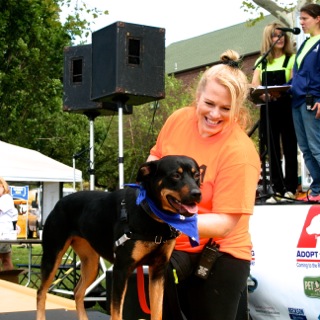
Take me home! A dog up for adoption and an Adopt-a-Dog volunteer. Photo by A. Bogdanovic
An Adopt-a-Dog volunteer with a dog up for adoption at the annual Puttin’ on the Dog show in Greenwich last September. Photo by A. Bogdanovic

For those of you who haven’t heard of the organization, I can tell you that it’s one of the most awesome non-profit organizations for which I have ever had the pleasure of volunteering. Based in Armonk, N.Y., its mission is to rescue, provide shelter and then and find “forever homes” for dogs of all ages and breeds.

Doing so is more than a full-time job for the staff at Adopt-a-Dog. It is a labor of love.

The happiness and well-being of each dog that comes to the shelter is paramount, so each one is carefully evaluated upon arrival. With assessments in hand, the staff then ensures that each dog’s needs are fully addressed. Among other things, that means making sure that all of the dogs get proper medical care and those that have behavioral issues get to work with a trainer. All of the dogs get to participate in “enrichment activities” with volunteers and staff.

Prospective adopters had lots of dogs to choose from at the annual Puttin on the Dog show in Greenwich last fall. Photo by A. Bogdanovic
Pick me! An Adopt-a-Dog volunteer with a dog up for adoption at Puttin’ on the Dog in Greenwich. September 2015. Photo by A. Bogdanovic

Anyone interested in adopting a dog is also thoroughly “vetted” before they can bring their new friend home. The process usually begins when someone comes to an event or visits the adoptions page on the organization’s website to see if there are any dogs they’d like to meet. Sometimes they phone the shelter to see if any puppies are available or if they are interested in a specific breed. In any case, they must fill out an application and make an appointment to come to the shelter in order to meet the dog(s).

As part of the application process, prospective adopters must provide references, all of which are checked. In some cases — usually when the applicant has another pet — staff will conduct home visits before the adoption is finalized.

Help Wanted

If you ask anyone at Adopt-a-Dog, they’ll quickly admit that well-trained volunteers are key to the shelter’s success. While most volunteers help out at the shelter itself, a lot also lend a hand at special events. Some, like me, volunteer in multiple capacities. I do administrative office tasks at the shelter once per week, and do reference checks at adoption events when needed. I also photograph special events like the annual Howl and Prowl costume contest and Puttin’ on the Dog show here in Greenwich. Now I’ll also be doing some Pro Bono blogging.

One way or another it all adds up to a lot of hard work. But it’s also a blast, and I wouldn’t have it any other way.

Come take a look at the ‘big picture’

This vintage typwriter is our featured image.

I rarely mix business and pleasure.  Or should I say, I try not to mix the two. So — even though this blog can sometimes be a bit snarky — there are certain things that are out-of-bounds. Forbidden topics include religion, politics (especially anything having to do with Donald Trump) and, well, blatant self-promotion. I will talk about Eli, but I won’t plug my book here. Nor will I discuss any other extracurricular activities.

Of course, having said all of that, there are exceptions to every rule.

So for the next couple of days, I’m taking a break from writing about murder, mayhem, animals, the nanny state, fantasy sports and our judicial system. Instead I’ll focus on a couple of things that might help you get to know me a little better. And who knows, you may even find them interesting.

An official invitation

First of all, I’d like to invite any of you who live in the New York City area to the opening reception for a group photography exhibition in a couple of weeks. It will be held from 6 to 8 p.m. April 3, at the Art and Sound Gallery in Greenwich, Connecticut.

You are cordially invited to a group photography exhibition featuring photos by Alexandra Bogdanovic, founder and owner of In Brief Legal Writing Services
Invitation to opening reception for a gallery event including photos by In Brief Legal Services Owner/Founder Alexandra Bogdanovic.

Located on the Greenwich side of Mill Street near the Byram River bridge, the gallery is actually just a short walk from the Port Chester train station — so all you have to do is jump on the train if you don’t want to drive. Plus the owner, curator and exhibitors are really cool, so you will definitely have a good time. And just as importantly — okay maybe even more importantly — you’ll get to see some of my work.

Yes, when I’m not working on research, writing or editing projects here at In Brief Legal Writing Services, I am an amateur photographer — among other things.

Picture this

To begin with, I was born in Bronxville, N.Y., and raised in Greenwich, so I am definitely a child of the New York City suburbs. Even so, I’ve always identified with the City, and think of myself as an (unofficial) New Yorker.

Now I channel my passion for the single greatest city on the face of the planet through my photography. I see something new every single time I go there, even if I go to the same places over and over again. The time of day, time of year and the weather all make a huge difference in the types of pictures I can get. It’s always challenging and it’s always fun. I never get bored.

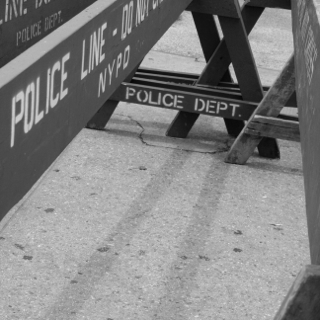
Black and white photograph of New York Police Department barriers taken by Alexandra Bogdanovic
NYPD barriers. Photo by Alexandra Bogdanovic

Out of all the places I go in New York City, Times Square is probably my favorite place to shoot. I think I’m drawn to it because I love big, bold, graphic images — but my interest in photography isn’t limited to urban settings. I also love beach and nature photography, automotive photography and travel photography. In addition to the Big Apple, I’ve shot in Barcelona, Belgrade, Munich,  Virginia the Hamptons, Greenwich, Rye, N.Y., and rural Australia. Last year I documented a train trip up and down the east coast, from New York City to Orlando, Florida.

My work has been shown at the Rye Nature Center in 2003, and at the Byram Library in Greenwich last year.

At any rate, it’s kind of ironic that I love photography so much, since it’s something I really started doing as part of my job back when I was a reporter at papers with limited resources. But on the other hand, it’s an interest and passion I share with my mother. It’s also a fantastic creative outlet. When I am behind the camera, I can relax, forget all about any stress or drama I’ve got going on at work or in my personal life and focus on the task at hand.

The Martha Moxley murder and her killer’s fate: a personal perspective

This vintage typwriter is our featured image.

In the fall of 1975, a heinous crime rocked Greenwich, Connecticut. A teenage girl was brutally murdered in Belle Haven, an especially private and wealthy neighborhood in what consistently ranks as one of the wealthiest communities in the country.

A cautionary tale

I grew up not far from there. But as a kid, I was blissfully unaware of what had happened on the other side of the tracks — or more accurately — on the “right” side of I-95, just a few short miles away. As the years went by and the case remained unsolved, my friends and I spent countless hours playing on our own street, less than a five-minute drive away from the spot where someone had beaten Martha Moxley to death with a golf club.

At some point — probably in my early teens — I learned all about the girl who was killed on “Mischief Night,” the night before Halloween when teens egg cars, houses and decorate their neighborhoods with toilet paper. Adults used Martha’s story as a cautionary tale, warning us not to go out on Mischief Night, or not to stay out too late if we did. Being teenagers — and more accurately being teenage girls — we also swapped stories, gossiped and speculated about the  unknown killer and unsolved crime.

‘Super Cop’ comes to town

As a young reporter my first “real” newspaper job in Greenwich in the 1990s, I worked with one of Martha’s closest friends. As you can imagine, that gave me a whole new perspective on the matter. It was no longer just a brutal and senseless crime that rocked my town; it was a brutal and senseless crime that directly affected someone I knew.

Alexandra Bogdanovic
Founder/owner of In Brief Legal Writing Services, Alexandra Bogdanovic. Photo by N. Bogdanovic

Given that, you can also imagine my reaction when, as a reporter for the same paper, I witnessed  former LAPD Detective Mark Fuhrman’s arrival in town. Although I wasn’t the police reporter at the time (I had happily given the beat to a colleague) I do know the Greenwich police — long frustrated and embarrassed about their inability to solve the Moxley case — weren’t exactly happy about it, either.  Apparently Fuhrman got what he wanted — and then he wrote a book. In it, he identified Michael Skakel, who is related to the Kennedys, as the “prime suspect” in the case.

The wheels of justice

As so often happens, especially in big cases, the wheels of justice seem to turn very, very slowly — until something happens to speed things up. In this case, it just so happened that a grand jury investigation was authorized in 1998, the same year that Fuhrman’s book was released.

The grand jury investigation itself took more than a year. As a result, Skakel turned himself in to authorities in January, 2000. Two years later, he was tried and convicted of murder, and he was ultimately sentenced to 20 years to life in prison.

He remained in prison for more than 10 years, until a judge ruled that his attorney made mistakes that resulted in a wrongful conviction.

According to a Hartford Courant account, however, prosecutors now want Skakel “back in prison.”

So do I.

CT law would protect daily fantasy sports players

This vintage typwriter is our featured image.
Alexandra Bogdanovic
Founder/owner of In Brief Legal Writing Services, Alexandra Bogdanovic. Photo by N. Bogdanovic

Not too long ago, it seemed sports fans in the Tri-State Area couldn’t watch a game or tune in to their favorite radio talk shows without being barraged by ads urging them to participate in daily fantasy sports contests.

But, as so often happens when any activity attracts an immense following, government officials began to take notice. Much debate ensued about the legitimacy of the contests — and whether winning them requires luck or skill. A whole bunch of proverbial poop really hit the fan back in November, when New York Attorney General Eric Schneiderman said participation in the contests is tantamount to illegal gambling in the state.

While Schneiderman’s stance — aimed at preventing the companies that run the contests from doing business with state residents — set the stage for a legal showdown, lawmakers in a neighboring state are considering a different approach.   Specifically, a  bill currently making its way through Connecticut’s legislative process would “protect consumers who play daily fantasy sports contests from unfair or deceptive acts or practices.”

Not a chance

Among other things, the bill  includes definitions of a “daily fantasy sports contest,” and a “contest of chance.” It also charges the Commissioner of Consumer Protection with adopting rules that:

  • Stipulate that daily fantasy sports contests are not “contests of chance”
  • Set the minimum age for participants at 21
  • Include measures to protect consumer deposits
  • Ensure “truthful advertising” regarding the activity
  • Guarantee “the integrity of all daily fantasy sports contests offered in this state”
  • Include safeguards for “problem gamblers”

Listen up

At a public hearing of the General Law Committee held earlier this month, several speakers voiced concerns and suggested changes to the initial language.

One of them, Chris Grimm, testified on behalf of two well-known fantasy sports companies and the Fantasy Sports Trade Association. He began by pointing out that more than 50 million Americans have played fantasy sports for more than three decades, making the activity “our new national past time [sic].”

Whether they play in the traditional season-long format or the newer daily or weekly format, participants put their skills to the test, Grimm stressed.

“It is not enough to know the most popular teams and their most recognizable stars,” Grimm said. “Fantasy players need to understand scoring systems, the particular strengths of different players, the type of offensive schemes  that they play in and the quality of their matchups [sic].”

Sarah Koch, the assistant director of government affairs at Draft Kings, also spoke in favor of the bill, but suggested some changes including:

  • Writing certain protections into the law itself
  • Insertion of language that “ensures fantasy sports competitions are based solely on statistics and not on outcome or finishing position” to avoid inadvertently “opening the door to sports betting”
  • Removing the word “daily” from the definition of fantasy sports in the bill to “provide legal clarity for all fantasy sports encompassed by the definition”
  • Clarification of the legal status of fantasy contests by inserting language indicating it does not “constitute gambling under the applicable penal code”
  • Dropping the age restriction from 21 to 18

Tamara Petro, the executive director of the Connecticut Council on Problem Gambling, also addressed the committee.

“This bill largely represents preparedness for a substantial expansion if CT [sic] legalizes daily fantasy sports, which is a very lucrative, multi-billion dollar business,” she said. “We propose that the new era of gambling in CT [sic] necessitates a sustainable framework for Responsible Gambling [sic] and consumer protections, and that the State [sic] has a responsibility to provide this while looking to expanded gambling for revenue.”

Advancing animal advocacy

This vintage typwriter is our featured image.

A new rule currently pending review by the Connecticut General Assembly’s Joint Judiciary Committee calls for additional advocacy for neglected and abused animals.

Speaking up for those who can’t

As proposed, Connecticut House Bill 5344 would allow “a separate advocate” to be appointed “to represent the interests of the animal” or “the interests of justice” in certain cases.

The person selected from a list of qualified volunteers kept by the Commissioner of Agriculture would:

  • Monitor the case
  • Obtain information that would assist the judge or fact finder through consultations with relevant individuals
  • Review relevant records
  • Attend hearings
  • Issue relevant recommendations

Passion and professionalism

The selection of an advocate selected in a case specified under the new rule could be made by the court itself or at the behest of a lawyer or party involved in the case. The advocates would either be attorneys “with knowledge of animal issues and the legal system” or law students from schools that “have students or anticipate having students with an interest in animal issues and the legal system.”

Participating students would be bound by specific guidelines pertaining to legal interns set forth in the Connecticut Practice Book. The “book”  includes the Rules of Professional Conduct, Rules for the Superior Court and Code of Judicial Conduct for Connecticut lawyers.

Personal perspective

Well, here’s another “no-brainer.”

Eli, the In Brief Legal Writing Services mascot.
In Brief Legal Writing Services mascot Eli catching up on the latest news. Photo by Alexandra Bogdanovic

As evidenced by numerous articles on the subject, animal law is a growing discipline requiring a specific skill set. Allowing a separate advocate with the necessary knowledge and/or passion for and interest in the work to do the “heavy lifting” in  cases involving “the welfare or custody of an animal” benefits everyone involved. For one thing, it takes the burden off lawyers who aren’t as well-versed in this particular area. More importantly, it ensures that the person making the final decision has all of the information he or she needs in order to do so.

But most importantly of all, it ensures that there is a “voice” for those who can’t speak for themselves.


Move over, damn it! Bicyclists state their case

This vintage typwriter is our featured image.

Springing forward

With temperatures soaring into the 70s in the New York metropolitan area this week, it’s beginning to feel a lot like springtime around here. And you know what that means.

We’re going to lose an hour of sleep but gain an hour of daylight (allegedly). The flowers will bloom, the grass will grow and some of us will get wicked allergies. As if all of that isn’t annoying enough, we’ll be forced to share the roads with bicyclists, joggers, people on roller blades and maybe even people on hover boards. Oh, joy!

But let’s focus on the bicyclists for now. Yes, those weekend warriors who ride in packs and hog the roads, effectively turning them into treacherous slalom courses for motorists. Honestly, is there anything more aggravating than getting stuck behind a bunch of bicyclists on a Saturday afternoon?

That’s a rhetorical question — but that’s not to say there isn’t another side to the story.

Going to bat for the bicyclists

Urban bicycles. Photo by In Brief Legal Services Founder Alexandra Bogdanovic
New York City bikes. Photo by Alexandra Bogdanovic

According to a recent Hartford Courant report, Connecticut groups that support cyclists want stiffer fines for drivers who don’t play by the rules. Specifically, they have asked state lawmakers to approve a new measure that would level harsher penalties against drivers who don’t “yield to pedestrians or bicycles that are legally using the road.”

Advocates say the measure would improve overall safety. But critics say the wording in the proposed bill is too vague. Critics also claim that the proposal fails to address careless behavior by pedestrians and bicyclists.

Reaching a compromise

Personally I think there are better solutions, some of which have already been implemented elsewhere. Designated bike lanes are fine — as long as the roads are wide enough to accommodate them. I also know of a few places where officials close the roads to regular traffic and let bicyclists take over for a set amount of time on certain days, weather permitting.

I’m not sure if there are already laws on the books prohibiting bicyclists from riding in groups or at least preventing them from riding two abreast. If not, I think there should be.

But of course, that’s just my humble opinion. What do you think?